
Life & Society · Deep dive
Leather Shoes and the Work of Urban Shoemakers
In Brief
Seams, cutting scraps, and a child’s boot reveal how footwear connected craft workshops with everyday life.
On this page
A shoe was an assembled structureReading the waste at CoppergateThe unusual one-piece shoeDublin’s accumulated leatherShoes for smaller feetBeyond the trading townMany trades within leatherworkingSourcesA shoe was an assembled structure
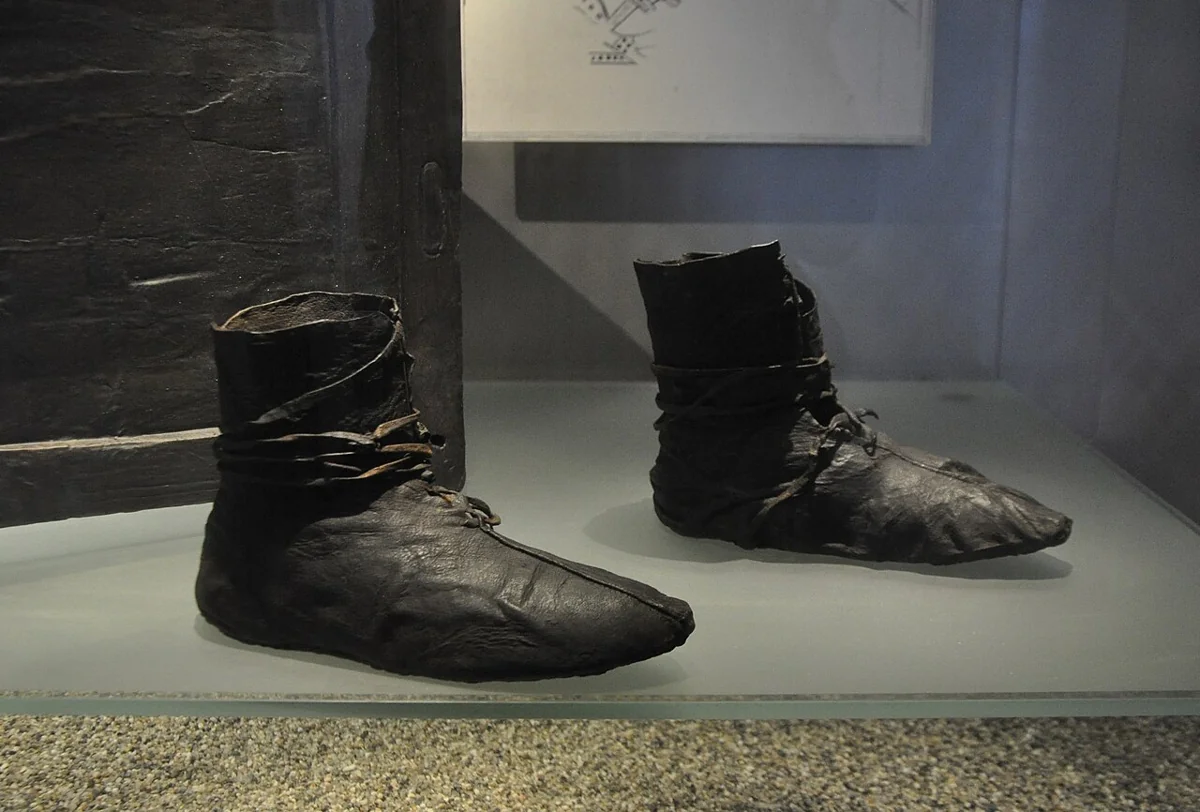
Leather footwear from Viking Age towns survives in several constructions, rather than one standard “Viking shoe.” The Hedeby museum describes turnshoes assembled inside out and then turned so that the completed seams lay within the shoe. Surviving forms include ankle-height shoes and boots, with differences in heel construction, seams, borders, and decoration. These differences required decisions before sewing began. A maker had to decide which pieces would meet, how the upper would surround the foot, and where the opening would sit. A shoe therefore records both a cutting pattern and an order of operations. Reconstructing that order can explain why two superficially similar shoes demanded different amounts of work and why surviving seams are often more informative than the flattened outline.
Sources for this section: 1
Reading the waste at Coppergate
The York leatherworking study distinguishes waste from different operations. Shavings indicate that leather was pared down during preparation, whereas other trimmings came from cutting and shaping pieces for manufacture. These categories help archaeologists move beyond the general claim that leatherworkers lived nearby. Preparing hides and assembling shoes leave different material signatures. Their presence in the same excavation does not automatically establish that one person completed every stage. Waste may also have been swept, dumped, or moved before burial. Nevertheless, a recognizable manufacturing offcut gives stronger evidence for production than a worn shoe alone. The latter might have arrived on someone’s foot; the former records a stage of work that generated material no customer intended to wear.
Sources for this section: 2

The unusual one-piece shoe
JORVIK highlights an almost complete left shoe made from a single piece of leather. Its maker cut a central sole area, folded the sides upward around the foot, and joined them with a seam extending from the toes toward the opening. This construction differs from assembling a separate sole and upper. It also offers a direct lesson in reading an artifact: the position of the seam follows from the way the flat material was folded. The museum suggests that the unusual shoe may have reached York with someone from elsewhere. That remains a possibility rather than a biography. A rare construction can prompt investigation of wider connections, but it cannot by itself distinguish a traveler’s possession from an unfamiliar product made locally.
Sources for this section: 3
Dublin’s accumulated leather
The National Museum of Ireland describes a striking discovery beside a building in Viking Dublin: an accumulation of leather about a meter high. Such a concentration makes leatherworking visible at the scale of a building plot rather than simply through a few finished objects. Its height is not a direct measure of yearly output. That would require information about the deposit’s extent, composition, and duration. The find nevertheless illustrates why waste is central to urban craft history. Large accumulations required space and eventually became a disposal problem. They also survived as a record of activities that could otherwise disappear when a workshop’s valuable tools were removed. Production and the management of its leftovers belonged to the same inhabited urban environment.
Sources for this section: 4
Shoes for smaller feet
A child’s leather boot from High Street, Dublin, survives in the National Museum of Ireland’s collection as object E71:13204. The University College Cork World-Tree Project records it among Viking Age material. It brings smaller wearers into a subject often illustrated exclusively with adult shoes. The object does not tell us the child’s exact age, family circumstances, or whether a relative commissioned it. Those absences should not obscure what it does establish: footwear was made on a scale appropriate to children. Comparing the boot with adult examples requires attention to proportions and construction, not merely overall length. A small artifact is evidence for a young consumer, while the organization of production and the identity of its maker remain separate questions.
Sources for this section: 5
Beyond the trading town
Urban excavations dominate familiar displays of Viking Age leather, but shoes were also present in rural communities. The National Museum of Ireland includes footwear and other leather objects among the everyday finds from Ballinderry and comparable Irish sites. Ballinderry’s crannog was probably a prosperous household occupied between the later ninth and early eleventh centuries. This comparison prevents “urban shoemaking” from becoming a claim that only townspeople wore manufactured footwear. A rural shoe might have been made locally, acquired through exchange, or brought by a visitor; its findspot alone does not settle the matter. Towns and their surroundings must therefore be compared through production evidence as well as consumption. A finished rural shoe and an urban cutting offcut answer different historical questions.
Sources for this section: 6
Many trades within leatherworking
York’s published assemblage contains tools such as awls, creasers, slickers, currier’s knives, and a wooden shoemaker’s last, alongside shoes, knife sheaths, and sword scabbards. It demonstrates a broad leatherworking economy rather than a single activity producing one commodity. Most excavated shoes were turnshoes, while a smaller group used one-piece constructions. The evidence invites comparison between what was common and what was technically possible. It also links footwear to other urban requirements: cutting implements needed covers, and bodies needed clothing accessories as well as shoes. A successful reconstruction of the workshop should preserve that diversity. The surviving collection is strongest when read as an interconnected set of tools, working debris, and used objects, rather than as a parade of intact footwear.
Sources for this section: 2
The Evidence
The sources below support this article. Interpretations and limits are explained in the text; this is not an exhaustive research review.
- Wikinger Museum Haithabu: shoemaking and surviving constructions ↗
- Mould, Carlisle and Cameron: Leather and Leatherworking in York ↗
- JORVIK Viking Centre: the one-piece leather shoe ↗
- National Museum of Ireland: Viking Challenge, leatherworking deposit ↗
- World-Tree Project, University College Cork: child’s boot E71:13204 ↗
- National Museum of Ireland: rural Viking Age material ↗