
Life & Society · Deep dive
Hearths, Lamps, and the Changing Air Inside a Viking House
In Brief
Lighting and warmth shaped where people worked, while experiments reveal how much depended on building design and fire tending.
On this page
Light entered through openings and came from fireTwo lamps, two materialsGlass challenges the completely windowless hallTesting two versions of the same houseWarmth and smoke did not spread evenlyAir measurements are evidence about an experimentLighting connected architecture with daily workSourcesLight entered through openings and came from fire
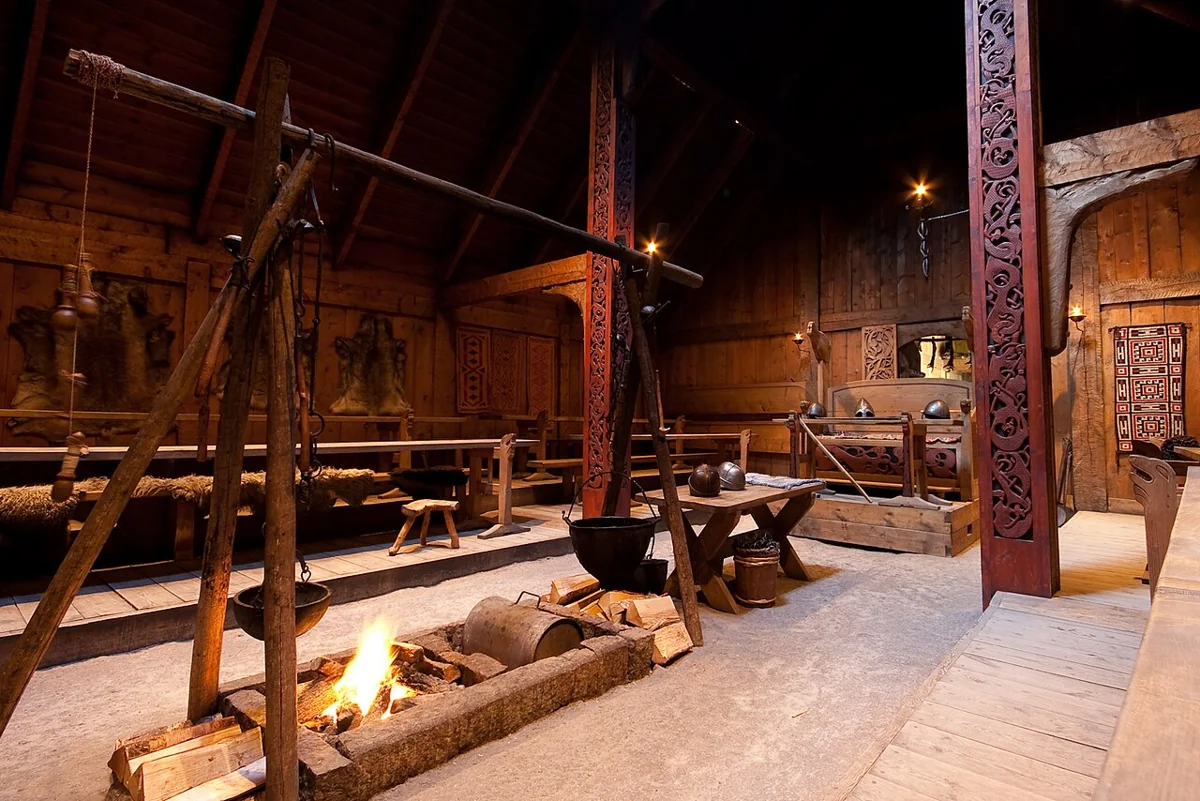
A Viking Age interior was a changing environment rather than a uniformly dark room. The Swedish History Museum describes wall apertures and openings near roof ridges that admitted daylight and air, alongside the hearth as a major source of artificial illumination. It also distinguishes portable lighting, including small lamps and burning brands, from a fixed fire. This distinction matters for how a room could be used: a hearth concentrated light in one location, while a small vessel could bring it closer to a particular task. Daylight, firelight, and a portable flame would create different working conditions. Their relative importance depended on the building, time of day, and season, rather than on one standard arrangement shared across all settlements.
Sources for this section: 1
Two lamps, two materials
An excavated lamp from Birka's Svarta Jorden settlement is cataloged by the Swedish History Museum as a fired-earth oil lamp. A stone hanging lamp illustrated by the University College Cork World-Tree project, using material from the Shetland Amenity Trust, represents another material solution; its interpretation involves animal fat and a wick. The comparison links lighting to ordinary containers and fuel supplies rather than only to the dramatic torchlit halls of modern illustration. The objects establish that small dedicated lighting vessels existed, but they do not preserve a complete household lighting budget. The clay example cannot, from its brief catalog description alone, tell us which fuel was last burned in it or how long it illuminated a room.
Sources for this section: 2, 3


Glass challenges the completely windowless hall
Research announced by the National Museum of Denmark in 2023 examined 61 fragments of window glass from six excavations in southern Scandinavia and Hedeby. The researchers argued that the material belonged to the period around 800–1100 rather than being later contamination. They linked the finds particularly to elite and religious environments, including the possibility of glazed hall windows. The proposed panes were small and colored, not modern sheets providing a clear view outdoors. Their principal visual effect may have been colored light entering an interior. This finding corrects the absolute claim that Viking Age buildings never had glazed windows, while leaving ordinary household arrangements a separate question. It also illustrates how reassessing old finds can change a building reconstruction without the discovery of an intact standing house.
Sources for this section: 4
Testing two versions of the same house
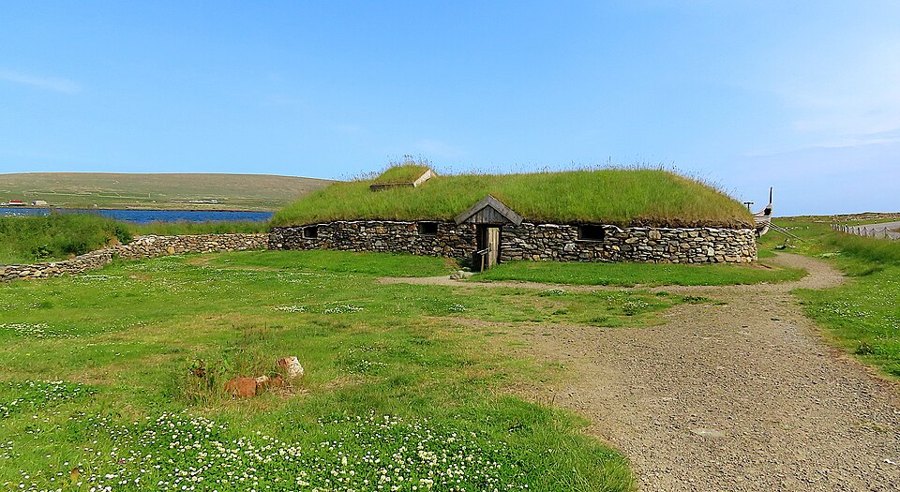
Jannie Marie Christensen's experimental study used reconstructions at Moesgård and Bork Viking Harbour based on a Hedeby house dated around 870. The excavated building supplied evidence for the plan, but its roof had not survived. The reconstructions consequently included choices about upper structures and openings that could influence their performance. Volunteers occupied the houses during winter, cooking and heating with central fires while researchers recorded conditions. Treating the two buildings as experiments is essential: their purpose was to explore how a possible house design behaved, not to reproduce every aspect of ninth-century life exactly. Differences between the reconstructions, including door placement and roof openings, made architectural decisions visible in the resulting indoor environment.
Sources for this section: 5
Warmth and smoke did not spread evenly
Christensen observed that occupants tended to stay low in the room and near the fire, where heat and light were available. Smoke accumulated differently above and below partial ceilings, and the operation of a roof opening depended on conditions including wind direction. The fire also created uneven warmth: a person's side facing away from it could feel colder. These observations help explain why the usable space of a house cannot be understood from floor area alone. Two positions within the same room might offer different combinations of light, heat, and smoke. They also give practical significance to benches, partitions, and overhead structures without proving that every similar feature excavated elsewhere had an identical function.
Sources for this section: 5
Air measurements are evidence about an experiment
A related research paper by Christensen and Morten Ryhl-Svendsen measured carbon monoxide and fine particles during the winter occupation. Measurements varied with position, and personal monitoring supplied information different from a stationary instrument near the fire. The authors emphasized that the volunteers' limited experience tending fires might have contributed to the conditions observed. The study supports taking woodsmoke exposure seriously when considering historical indoor life, but its measurements are not a survey of Viking Age disease or a direct estimate of everyone's daily exposure. The valuable result is the demonstrated interaction between building design, the handling of a fire, and the way people moved through the space. Each influenced what an occupant actually experienced.
Sources for this section: 6
Lighting connected architecture with daily work
The combined evidence suggests a household continually arranging activities around available light and warmth. A lamp offered a different spatial possibility from the hearth, while a wall opening or glazed pane depended on daylight outside. A reconstruction experiment makes these differences tangible, but the surviving objects anchor them in material evidence: a lamp is a real vessel, and window fragments are real manufactured glass. To reconstruct a particular interior, those finds must be considered with the excavated plan and the uncertainties of its missing upper parts. This approach produces a richer account than either an entirely black longhouse or a comfortably bright modern room. It asks where people could see, where they could work, and what fuel and architectural choices supported those activities.
Sources for this section: 1, 2, 3, 4, 5, 6
For the introductory context, read Inside a Viking-Age home.
The Evidence
The sources below support this article. Interpretations and limits are explained in the text; this is not an exhaustive research review.
- Swedish History Museum, Dark but warm and colourful ↗
- Swedish History Museum, Birka oil lamp270759 ↗
- World-Tree Project, Scottish Viking Age finds and hanging lamp ↗
- National Museum of Denmark, The Vikings Had Glass in Their Windows ↗
- Christensen, Living Conditions and Indoor Air Quality ↗
- Christensen and Ryhl-Svendsen, Household air pollution in reconstructed Viking houses ↗