
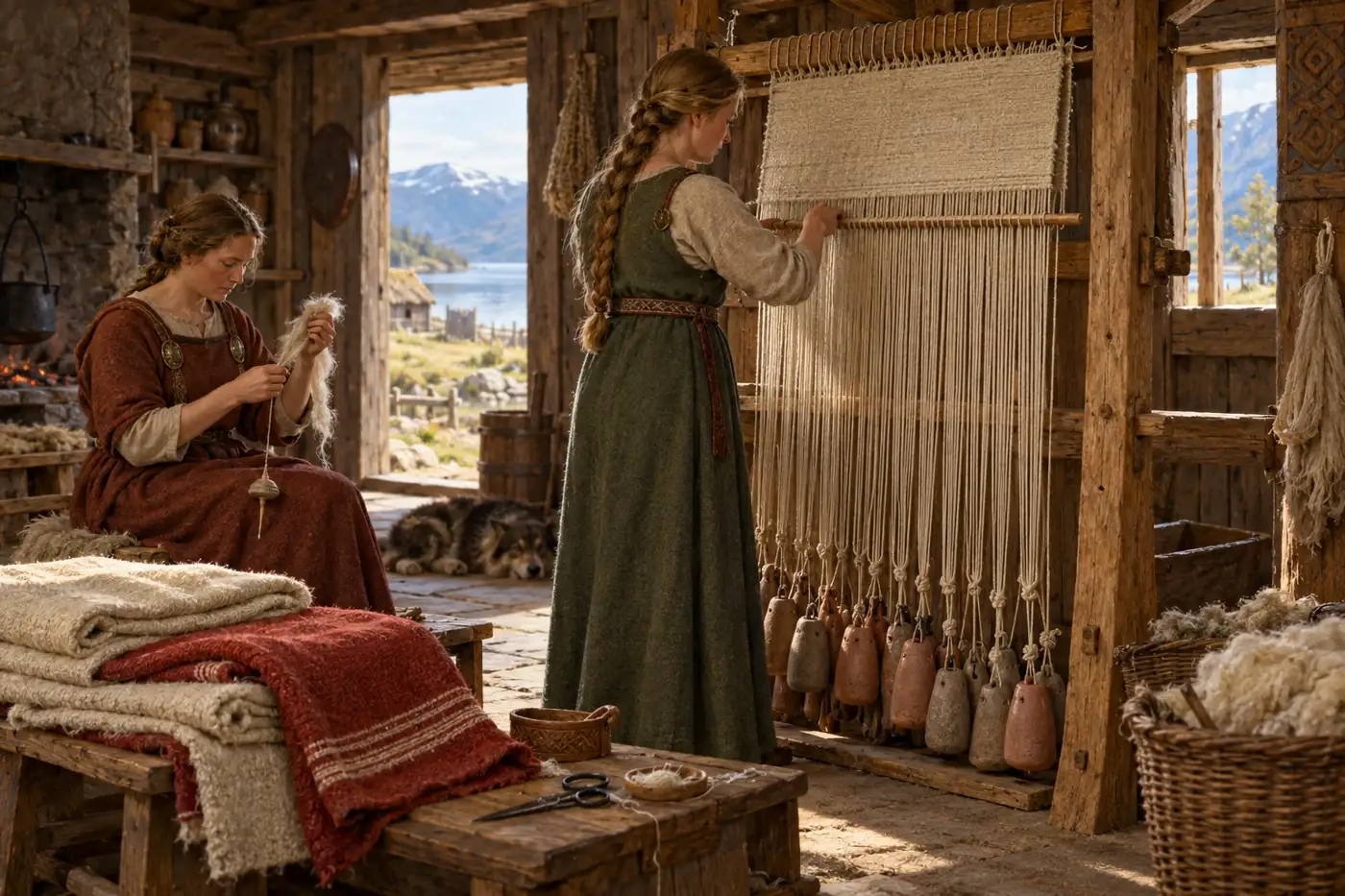
01 · The cloth begins before the thread
Choose the fibre for the work
Before a weaver can open the first shed, someone has made many decisions about the thread. Start with three things beside one another: a loose lock of wool, a length of yarn and a piece of cloth. The finished surface becomes easier to understand when its earlier stages remain in view.
- Wool
- An animal fibre. Sheep’s wool accounts for much of Denmark’s surviving prehistoric textile material.
- Flax
- A plant whose stems provide the fibres used to make linen. Preparing those stems is a separate craft sequence.
- Silk & metal thread
- Luxury materials occur in late Iron Age textile work. Their presence widens the story beyond locally raised sheep and cultivated plants.
Sorting changes what the spinner receives
In the Fashioning the Viking Age project, researchers compared the fibres of selected Hedeby textiles with wool from nine modern sheep populations. They chose suitable material and controlled its sorting before spinning and weaving. A resemblance in fibre quality helped the experiment; it did not identify an unchanged modern “Viking sheep” breed.
Preparation also leaves archaeological traces. At Coppergate in York, a comb from Anglo-Scandinavian layers retained wool at the base of a tooth. Penelope Walton identified some smooth, parallel-fibred yarns as combed, while the preparation of other yarns remained less certain. One surviving technique need not explain every thread.
Look before you spin: spread a small lock on a dark background. Compare the fibres’ lengths and thicknesses, then draw a few gently apart. What would you keep together for a particular yarn? Record your choice before testing it.
Explore sheep husbandry and selecting wool →
Sources: fibre materials [3]; controlled wool selection at Hedeby [1]; Coppergate preparation evidence [2].
02 · A plant becomes a textile
Release the fibres inside a stem
Flax does not arrive at the spindle as a ready-made thread. The Viking Ship Museum documented the following sequence while preparing a modern experimental sail for the Gislinge Boat. It makes each material change visible; the project’s equipment and timetable should be read as a documented reconstruction.
- Remove the seed heads.
Separate the seeds while retaining the stems for fibre processing.
- Ret and dry.
Controlled decomposition loosens the tissues holding the fibres within the stem. Drying prepares the material for further handling.
- Break and scutch.
Break the woody parts, then sweep away the fragments from the fibre bundles.
- Hackle and prepare.
Draw the fibres through toothed tools to remove remaining debris and separate suitable material for spinning.
Seeds and cloth answer different questions
At Tjudnäs on Åland, charred masses of flax seeds were dated to about AD 880–1020. Their size and compressed condition led Vanhanen and Ilves to interpret them as residues of oil extraction. This is a strong example of flax use, but the seeds alone do not demonstrate linen weaving. Following the plant means asking which part was used and what processing traces survived.
Textiles provide a different line of evidence. Lukešová and colleagues examined ten surviving plant-fibre samples from Merovingian- and Viking-Age graves in the Bergen museum collection. Nine were identified as flax; one could only be classified as bast fibre. Here, microscopy reaches the material of the cloth itself.
Follow flax from the field to linen →
Sources: the Gislinge flax-processing project [4]; the Åland seed study [5]; identified plant fibres in Norwegian grave textiles [6].
03 · A small tool with many possibilities
Read the spindle and its whorl together
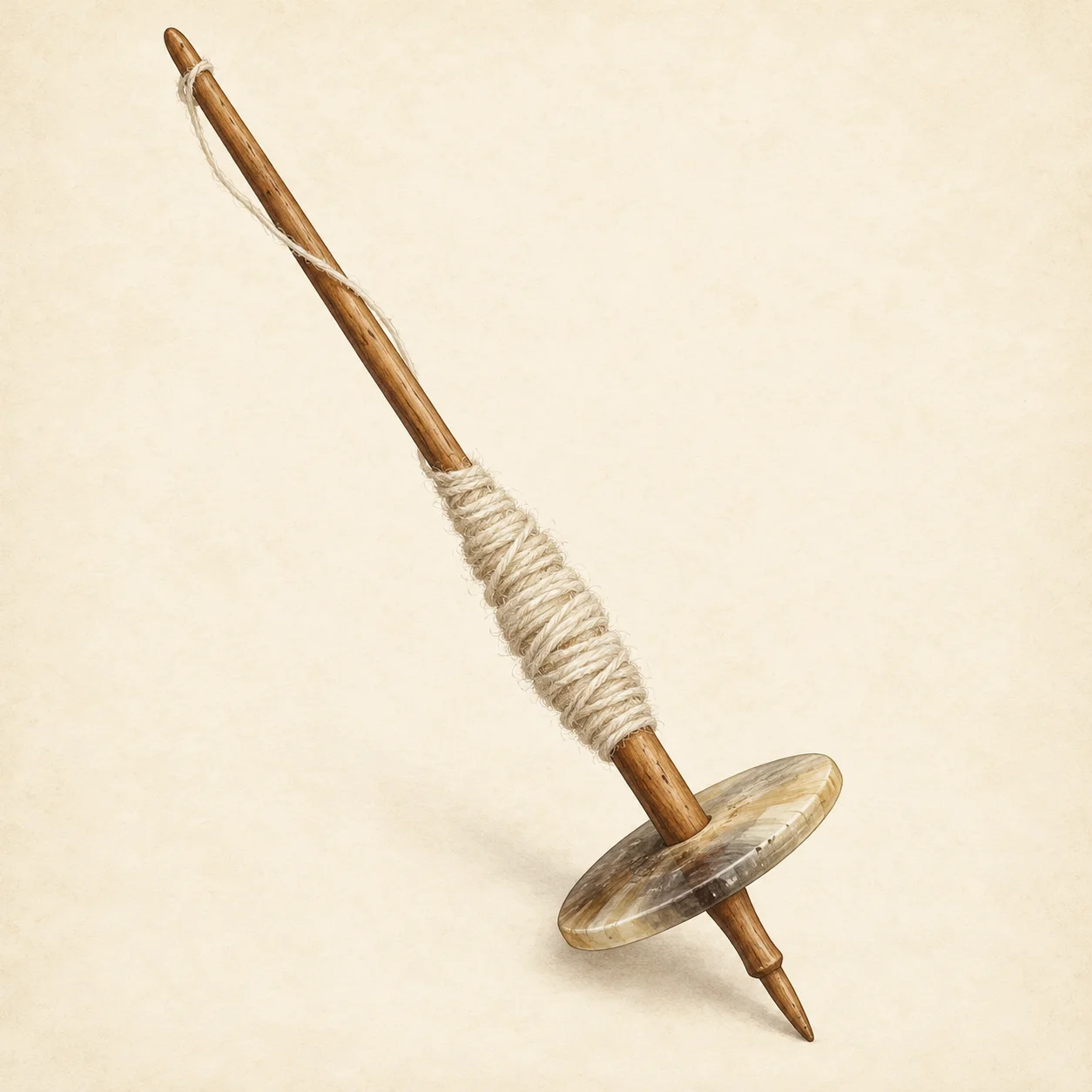
The spindle shown here combines a shaft and whorl. Its rotating weight often survives after the wooden shaft has decayed.
Eva Andersson’s spinning experiments, summarised in her 1999 thesis, found that whorl mass and diameter affected the yarn produced. Small changes could matter. These dimensions help researchers investigate what a tool could do, but do not recover the exact yarn once wound around it.
It is useful to record the tool and the result together: whorl dimensions, fibre preparation, the spinner’s choices and the resulting thread. “Small” or “heavy” becomes more informative when attached to measurements and a particular experiment.
| Object | What survives | A question to follow |
|---|---|---|
| 270338_HST | A biconical stone whorl. The museum identifies the material as Volhynian stone from the Ovruch region of present-day Ukraine. | How did the material or finished object reach Birka? Its origin does not identify the spinner’s birthplace. |
| 270064_HST | A disc-shaped whorl catalogued as horn, with ring-and-dot decoration on both faces. | How do form, material and decoration differ? Those differences alone do not identify the yarn used. |
Sources: hand-spindle mechanics [23]; Andersson’s experiments [7]; museum records [8] and [9].
04 · Draw, twist, wind, repeat
The hands control the thread
Draw out the fibres, add twist, then wind on the yarn. The three drawings separate actions that work together during spinning.
Draw out, twist, wind on
Drafting and twist control work together; this illustration separates the actions.
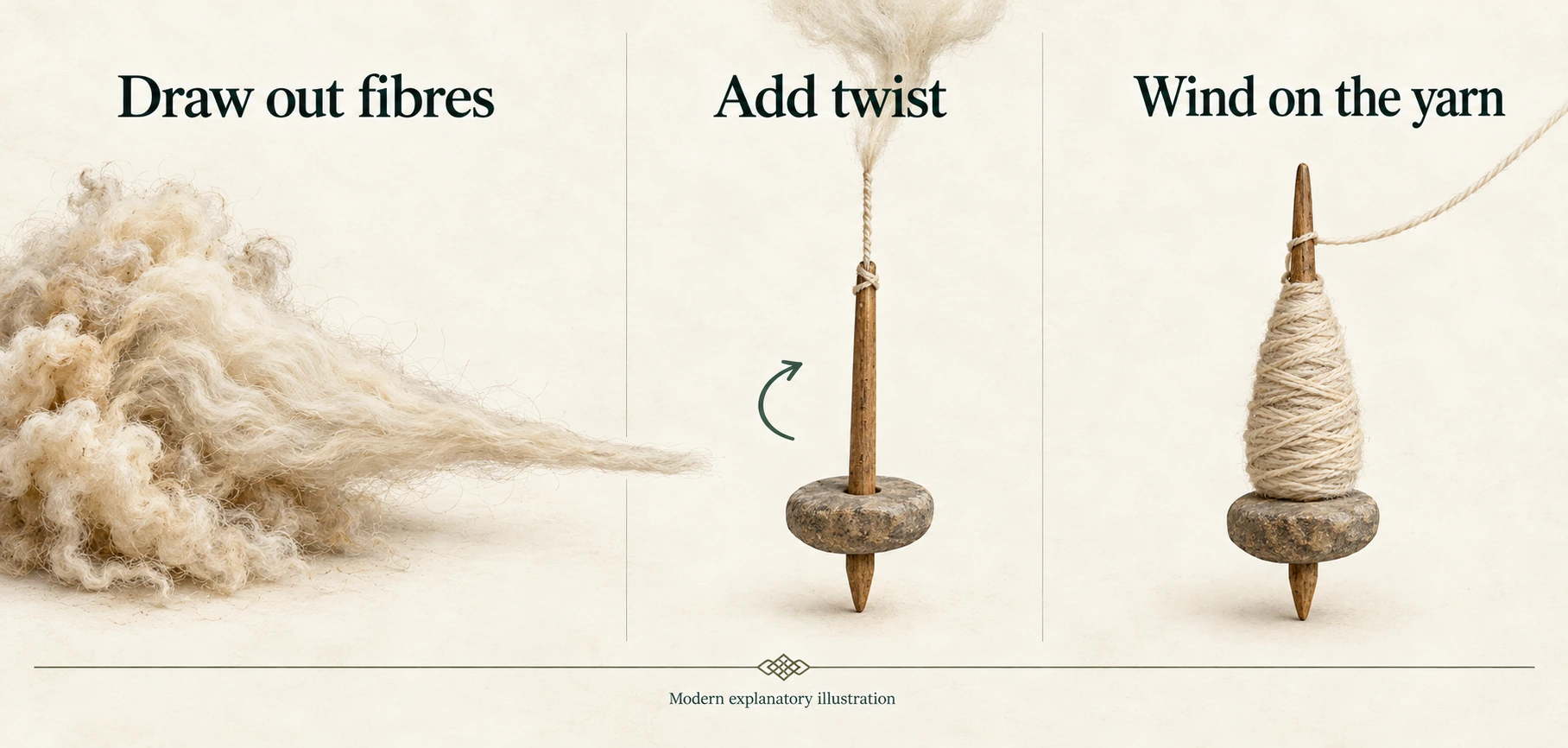
01 Draw out fibres
Draw a smaller supply from overlapping fibres.
02 Add twist
The spindle adds twist. Its whorl helps sustain rotation.
03 Wind on the yarn
Wind spun yarn onto the spindle before working the next length.
What do S and Z mean?
Hold a yarn upright and look at the slant of its fibres. A Z-spun yarn follows the middle stroke of the letter Z; an S-spun yarn follows the corresponding slant in S. These labels describe the finished twist. Plying means twisting already-spun strands together, so the ply direction must be recorded separately. Coppergate preserves variation in both yarn systems, rather than one rule for all Viking-Age cloth.
Try reading a thread before naming it
Use a loose piece of modern yarn and good light. Can you see individual fibres, or is it easier to see several strands twisted together? Sketch the visible slant. If the fibres are too fine to distinguish, write “unresolved” instead of copying the visible ply direction into both observations.
Go deeper into spinning and the household textile economy →
Sources: drawing fibres and adding twist [23]; controlled spinning experiments [10]; spin and ply terminology at Coppergate [2]. The sequence is a teaching diagram.
05 · Follow the numbered parts
Explore a warp-weighted loom
Begin with the complete loom, then choose a group to follow its job. The upright threads are the warp; the thread crossing them is the weft. Weights tension bundles of warp. The drawing explains a plain-weave arrangement, with the fabric forming at the top.
A warp-weighted loom for plain weave
Cloth hangs above weighted warp threads. Weft crosses between their two layers.
Complete plain-weave setup: the weft passes through an open shed and is beaten upwards.
- Frame and upper beam. Cloth is secured above. The frame leans away from the weaver.
- Warp and weights. Front and rear warp groups hang under tension from separate weight bundles.
- Changing the shed. The low fixed rod holds alternate ends forward. String heddles pull only the rear ends forward for the counter-shed.
- Weft and beating. The weft passes between the layers and is beaten upwards towards the cloth edge.
From the side: two openings
Weaver at right. Solid and dashed lines show front and rear warp groups. Green dot: the crossing weft, above the heddle rod.
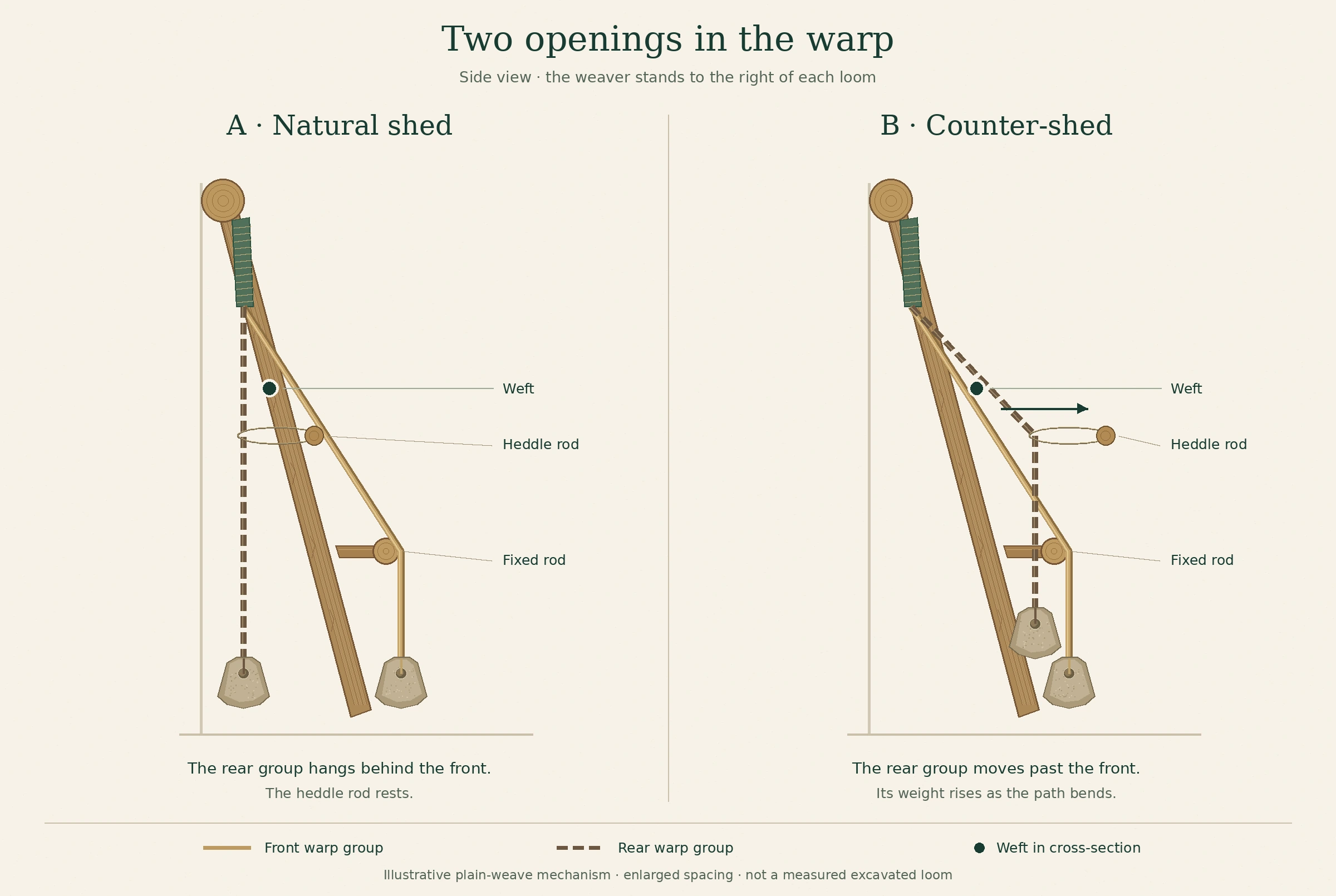
Illustrative plain-weave mechanism. Spacing is enlarged for clarity. The fixed rod holds alternate ends forward; string heddles draw the rear group through for the counter-shed. Its weight rises while the thread length stays the same.
- A · Natural shed. Low fixed rod separates alternate ends; heddle rod rests.
- B · Counter-shed. Pulling the heddle rod brings the rear group past the front.
From a flat picture to a working movement
A low shed bar holds alternate warp ends forward. String heddles pull the rear ends past them to change the opening, or shed.
The weft passes through the opening and is beaten upwards against the cloth. As work advances, finished fabric can be rolled onto the upper beam. The Oselven report documents these working relationships in a modern sail-weaving project; the precise frame dimensions shown here are our schematic choices.
Follow one thread: start at the upper beam and trace its path to a weight. Then compare the two side views. Which group moves, and where could the weft pass? Use the numbers to return to the full scene.
Sources: frame and weighted warp [25]; the northern shedding model [12]; beam, working direction and upward beating [11]; separate weighted groups [10]. This is a teaching model, not a recovered Viking loom.
06 · Change the crossing, change the structure
Compare plain weave and 2/2 twill
Look at the crossings rather than the colours. Plain weave, also called tabby, alternates over one warp thread and under the next. 2/2 twill crosses two at a time and shifts the sequence along successive rows, producing a diagonal. Both occur in Viking-Age clothing.
Plain weave and 2/2 twill
Warp: vertical, goldWeft: horizontal, green
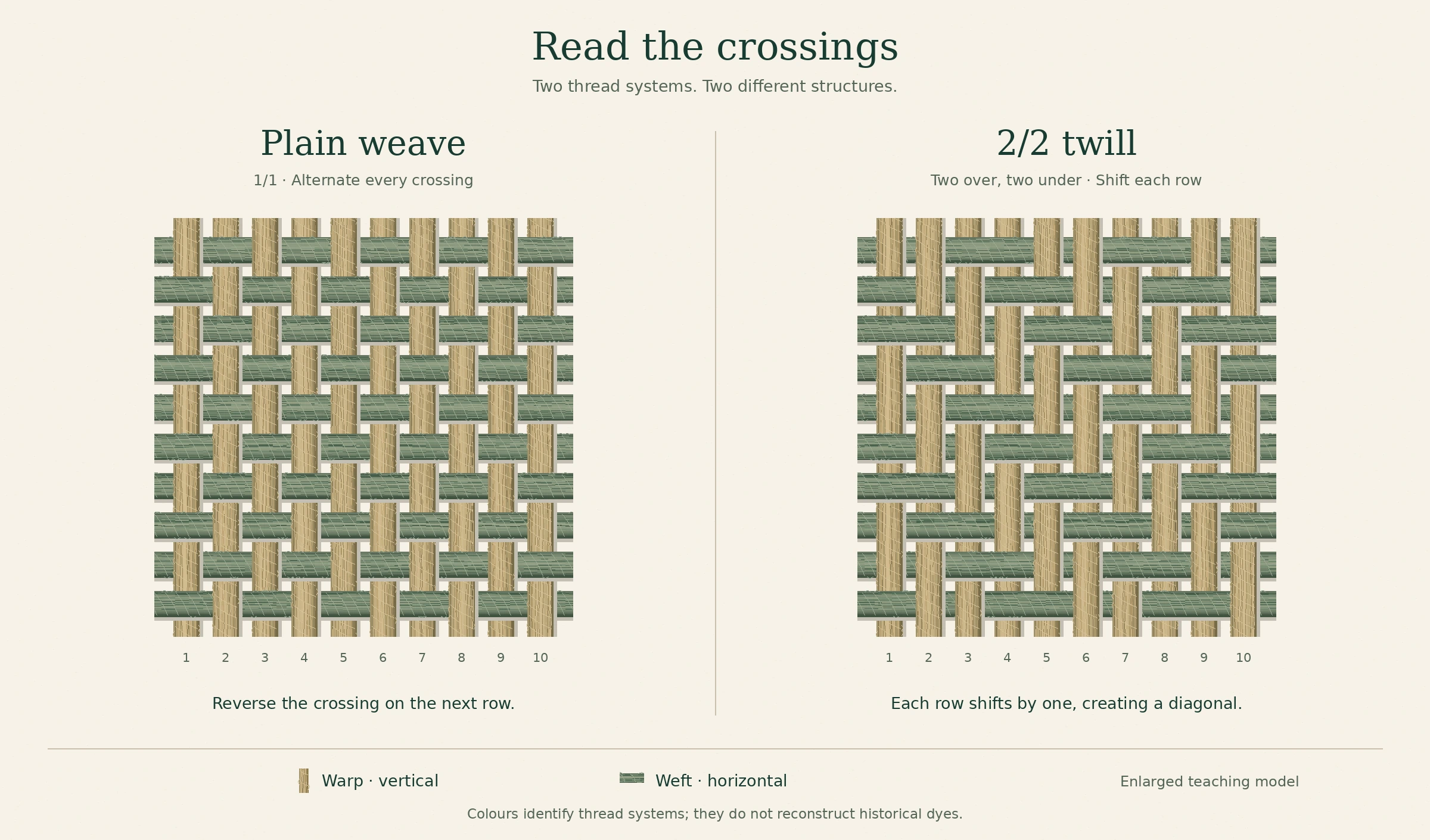
1/1 · Plain weave
One over, one under. Reverse the crossings on the next row.
2/2 · Twill
Two over, two under. Shift by one warp end on each row, forming diagonals.
The illustrated loom alternates two sheds. A repeating 2/2 twill needs four and a different control arrangement. Its grid shows the structure separately.
Trace a crossing: choose a vertical thread in each grid and follow it through four horizontal rows. Then move one thread sideways. What repeats, and what shifts? The colours distinguish the two thread systems; they do not reconstruct a historical dye pattern.
Sources: weave definitions and Viking-Age use [13]; two-shed and four-shed sequences [12]. Grids are enlarged, evenly spaced teaching diagrams.
07 · The loom in the settlement
A weight is part of a larger arrangement
The Swedish History Museum records disc-shaped fired-clay loom weights from Birka’s Svarta jorden. They provide a surviving counterpart to the diagram’s schematic weights. The catalogue identifies the objects and their find place; it does not preserve the original yarn hanging from them.
Experiments reported in Shape of Things examine two properties together. A weight’s mass affects the pull on its thread group. Its thickness affects how a row of weights fits across a working width. Their combination helps constrain possible yarns and densities. Measuring only the diameter or counting objects misses part of their function.
A single weight therefore offers possibilities, while a group with an excavated position can raise questions about the whole loom. Keep the measured object, its context and the proposed reconstruction connected when explaining a workshop.
Tissø: textile work among other crafts
At the magnate’s residence at Tissø, excavations revealed several forms of craft activity. The National Museum identifies pit-houses used particularly for textile work and illustrates spindle whorls and loom weights from them. These finds connect spinning and weaving with an actual settlement, alongside traces of metalworking and other production.
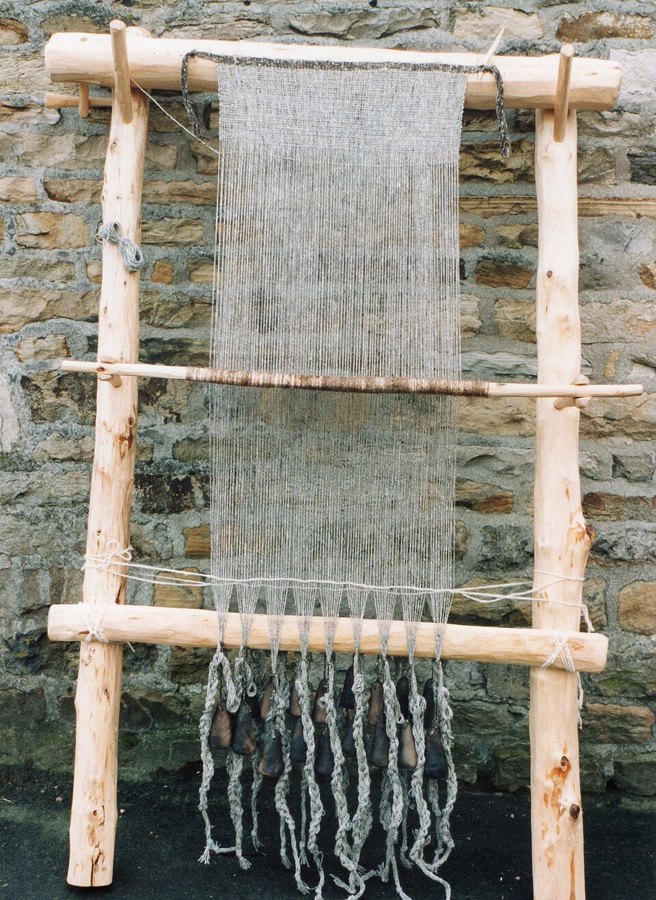

Sources: Birka loom weights [15]; experimental weight and thickness relationships [14]; Tissø’s workshops [16]. The photograph shows a modern replica, as identified in its caption.
08 · Bring the structures back to the finds
Read particular textiles, not one “Viking fabric”
The Hedeby reconstruction project chose three contrasting fragments. H14 is a dress fragment in tabby; H2 comes from hose in 2/2 twill; H39AB is a trouser fragment in diamond or herringbone twill. The experimental samples showed that comparable cloth could be made with reconstructed tools known from Hedeby. That establishes a working possibility, not the manufacturing address of every original.
A different sample gives a different picture
The TRiVAL report for 2024–25 describes 156 fragments from 45 contexts in northern Jutland and western Zealand, almost all from graves. Plain weave and 2/2 twill occur with regional and chronological differences. Tabby dominates much of the ninth- and tenth-century material discussed, while the report contrasts this with the wider range of twills at Hedeby. The sample’s places, dates and burial contexts matter when interpreting the pattern.
Fibre identification adds another layer. The Bergen study used microscopic observations and a modified Herzog test to distinguish plant fibres. A surviving piece can reveal its structure before its exact material is securely identified. “Plant fibre” is a useful observation when a more precise name is not supported.
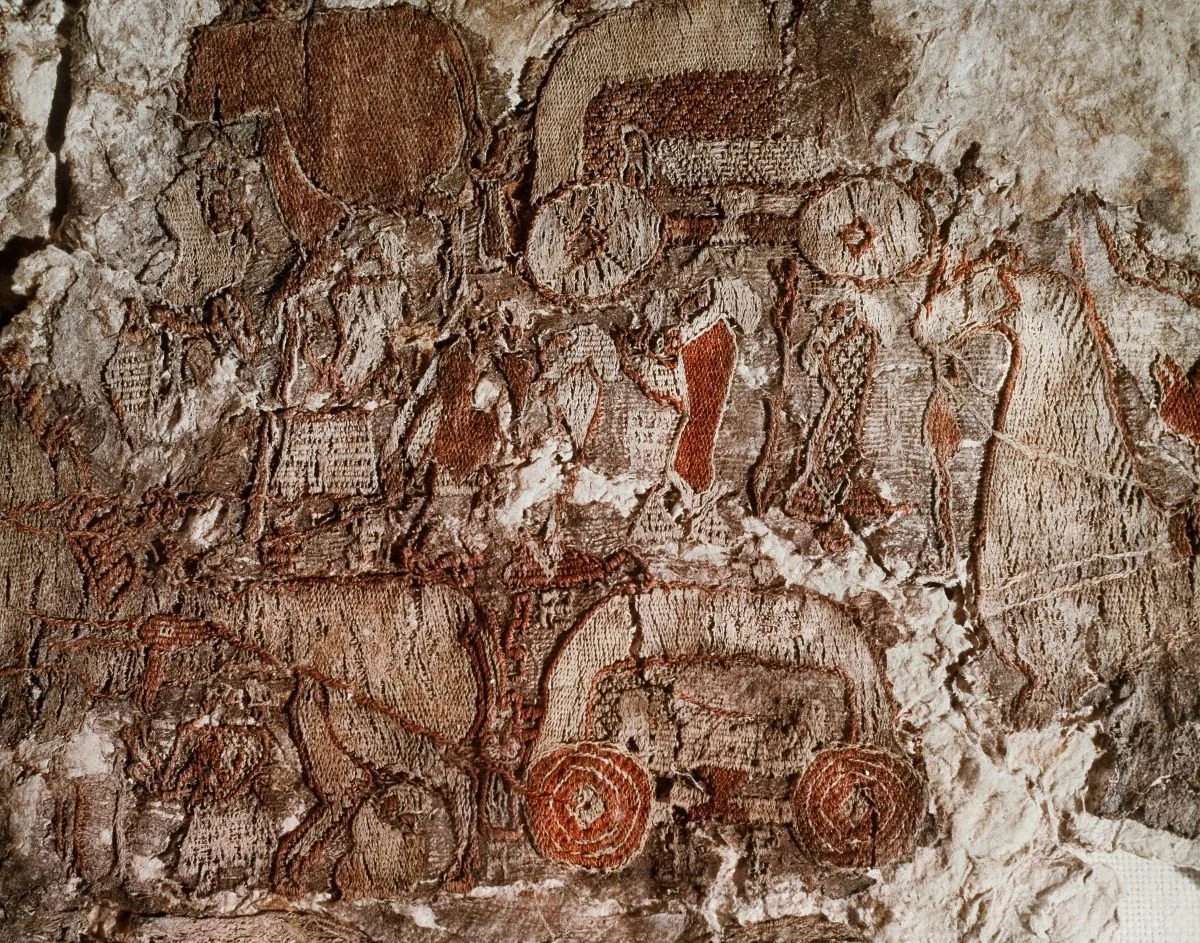

Look at a surviving surface: the Oseberg fragment above is a tapestry, a different kind of textile from the regular cloth grids. Follow a visible figure, then look for a damaged area. Which details can you observe, and which would a reconstruction have to supply?
Explore the Oseberg tapestries and their scenes →
Sources: the three Hedeby reconstructions [1]; the TRiVAL textile sample [17]; microscopic identification [6]. The Oseberg photograph’s museum source and licence are linked in its caption.
09 · Small scale, intricate work
Turn the tablets and follow the band
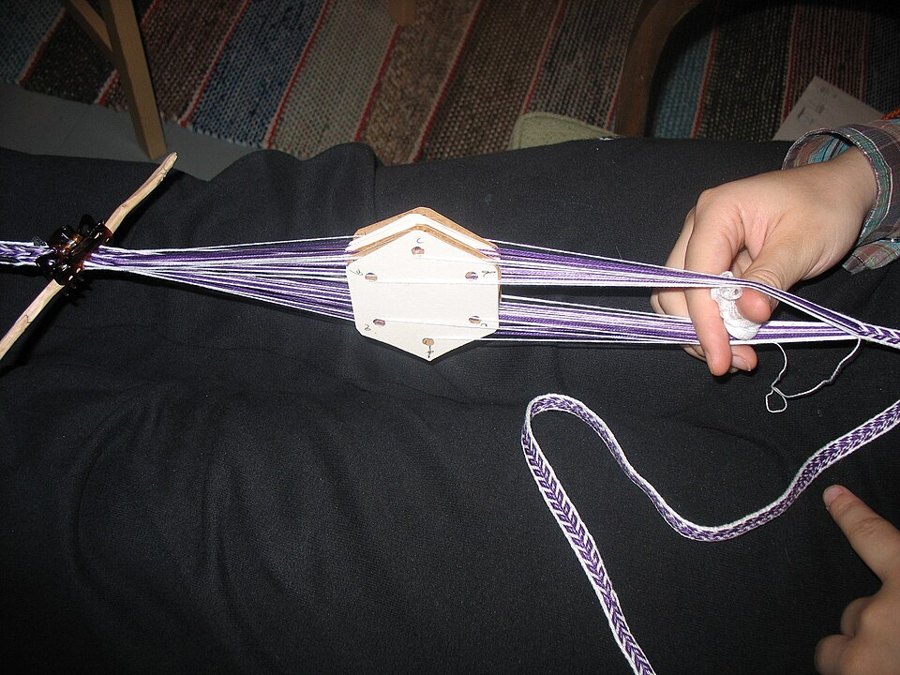
Tablet weaving guides warp threads through holes in small tablets. Turning them changes the opening for the weft and twists the thread groups into the developing band. Threading, turning sequence and colour choices work together; a narrow piece can contain a complex design.

Birka: gold preserves a missing thread’s impression
The band from grave Bj 750 preserves gold weft while its warp has disappeared. Impressions in the metal help reconstruct the pattern. The museum describes a probably silk warp and an arrangement of 25 tablets for a band about one centimetre wide. The qualifier matters: the lost fibre is an interpretation, while the surviving metal is the object that can be examined.
Oseberg: work still on the tablets
An unfinished Oseberg band was found with 52 tablets still threaded. Their arrangement was drawn before lifting in 1904. Bente Skogsaas’s study brings the surviving material and that record together in reconstruction. She also distinguishes the Oseberg bands associated with tapestry fragments from bands proven to have been attached to clothing.
Compare two kinds of evidence: Birka preserves an impression of lost warp in metal; Oseberg preserves part of an unfinished working arrangement. Each offers a different route into the maker’s decisions.
Explore tablet weaving and patterned borders →
Sources: tablet mechanics and the Oseberg study [19]; Birka Bj 750 [18]. The modern photograph demonstrates handling, not a reconstruction of either find.
10 · Cloth continues beyond the loom
Finish the surface and make it useful
Finishing changes a woven surface. Wool can be felted or brushed to raise a nap; plant-fibre cloth can be smoothed or bleached. Cutting, sewing, decoration and repair then give fabric another history. The National Museum’s overview includes Viking-Age embroidery from Mammen as one particular example of work added to woven cloth.
A weave name is only part of the description. The same thread count can conceal a very different feel once fibre properties and surface treatment are considered. When comparing samples, look at the crossings, then the surface over them. Ask which features come from weaving and which might have been added afterwards.
Investigate dyes and colour → · Follow cloth into clothing reconstruction →
A sail asks another set of questions
Sail research tests how a large textile performs in use. Cooke and colleagues’ 2002 study modelled reconstructed woollen sail fabrics using, among its comparisons, material from Trondenes church dated to the mid-thirteenth century. That cloth is medieval evidence used in the investigation, not a surviving Viking-Age sail.
The Oselven project documented a modern 2/1-twill wool sail made with machine-spun yarn. It explains loom work and construction choices, but does not measure the labour of a fully hand-spun production chain.
Explore wool sails and the experiments behind them →
Sources: finishing and sewing [24]; surface and visual appearance [20]; Trondenes and sail modelling [21]; the Oselven project [11].
11 · Count the whole chain
The visible weaving is only one part of the work
Eva Andersson Strand’s study of textile consumption uses the tenth-century Ladby ship to build a model of demand: sailcloth, additional textiles and clothing all belong in the calculation. Production estimates depend on the chosen fabric, quantities, crew assumptions and experimental rates. They are a way to investigate scale, rather than a historical stopwatch.
The CTR’s tool experiments also separate preparing fibre from spinning it. A measured spinning rate only describes the work included in that measurement. Before comparing two demonstrations, check whether both began with the same material and counted the same stages.
| Stage | Record | Keep separate |
|---|---|---|
| Preparation | The starting fibre, sorting decisions and usable material produced. | Raw material brought in versus material ready to spin. |
| Spinning | Tool, spinner, working time, length of yarn and observed unevenness. | Active work versus interruptions and practice. |
| Loom setup | Warp length, number of threads, weighting and time arranging the loom. | Preparing the loom versus passing the weft. |
| Finishing | The woven dimensions, treatment, seams and any repairs. | Cloth off the loom versus the completed object. |
Compare the complete record: name the starting material, tools, maker, finished product and stages counted. These details let someone repeat your demonstration and investigate why their result differs.
Sources: the Ladby textile-demand model [22]; separating preparation and measured spinning [10]. The record sheet is an original learning activity, not an ancient production account.
12 · Try the thread challenge
Make the crossing visible with paper
Use two colours of pre-cut paper strips, a little tape and a flat surface. This exercise enlarges the crossing pattern so it can be followed by eye. Paper will not reproduce wool’s stretch or the action of a weighted loom.
- Set out a warp. Tape eight parallel strips along their top ends. Leave their lower ends free and label the strips 1–8.
- Add a first row. Pass a contrasting strip over strip 1, under strip 2, and continue across. Keep the row loose enough to inspect.
- Reverse the next row. Begin under strip 1, then over strip 2. Repeat these two rows until you have a small sample.
- Try a second sample. Begin over two strips and under two. On the next row move every crossing one strip along. Use the 2/2 grid above to check all four rows of the repeat.
- Leave a deliberate mistake. Repeat one row instead of changing it. Ask someone else to find the place where the intended pattern breaks.
Reveal the pattern check
The first sample should alternate every crossing, producing a checkerboard of visible strip segments. In the second, the blocks move sideways from one row to the next, making diagonals. Trace the strips themselves to check an uncertain square; colour alone can make the crossing harder to read.
Place your samples beside the loom diagram. Point to the warp, the weft and the opening the weft needs. Then choose a museum object or textile from this guide and explain which part of the making it preserves.
This page includes print styles so the diagrams, source list and exercise can be used together away from the screen.
Follow the evidence
Sources & further reading
These sources connect the working principles with excavated objects, textile analysis and documented modern experiments. Dates and places belong to the particular examples. The diagrams are teaching models; photographs and illustrations are identified in their captions.
- Fashioning the Viking Age — Final Project Report, 2018–2023
The researchers’ report, especially pp. 2–5: fibre selection and experimental reconstruction of three Hedeby textiles.
- Penelope Walton, Textiles, Cordage and Raw Fibre from 16–22 Coppergate (1989)
Original excavation report; printed pp. 315–318 explain fibre preparation, spin direction and plying. Anglo-Scandinavian and later medieval finds are distinguished.
- National Museum of Denmark — Fibre
Museum research overview of textile materials across prehistory, including wool, plant fibres, imported silk and metal thread.
- Viking Ship Museum — The Gislinge Boat’s sail: processing and production of flax fibres (2015)
A documented modern craft project explains flax processing; its tools and timings are not a complete excavated Viking-Age sequence.
- Santeri Vanhanen & Kristin Ilves, Flax use, weeds and manuring in Viking Age Åland (2025)
Original archaeobotanical study of charred seeds, including the Tjudnäs material dated to AD 880–1020. Published January 3, 2025.
- Hana Lukešová, Adrià Salvador Palau & Bodil Holst, Identifying plant fibre textiles from Norwegian Merovingian Period and Viking Age graves (2017)
Original microscopy study of ten surviving plant-fibre samples in the University Museum of Bergen’s Late Iron Age collection.
- Eva Andersson, The Common Thread: Textile Production during the Late Iron Age and Viking Age (1999)
The author’s thesis abstract reports tool analysis and spinning experiments; consulted for the relationship between whorl dimensions and yarn.
- Swedish History Museum — Volhynian stone spindle whorl, 270338_HST
A biconical whorl from Birka’s Svarta jorden; the museum identifies its stone with the Ovruch region of present-day Ukraine.
- Swedish History Museum — Decorated horn spindle whorl, 270064_HST
A disc-shaped settlement find from Birka, decorated on both faces. Material follows the museum’s catalogue description.
- Eva Andersson Strand & Marie-Louise Nosch, Technical Textile Tools Report: General Introduction
Controlled spinning and weaving experiments, especially pp. 6–9. The programme concerns the Bronze Age eastern Mediterranean; used here for mechanics and method.
- Erik Andersen & Anna Nørgård, Et uldsejl til Oselven (2009)
Modern sail-weaving report; pp. 17–25 and 38–39 explain the loom and upward beating. Its 2/1 twill and partly medieval comparisons are identified separately.
- Susan T. Edmunds, Picturing Homeric Weaving — The Northern European Model
Comparative technical analysis, §§10 and 25–29. Used for shedding mechanics and the four-shed repeat of 2/2 twill, not a Viking excavation plan.
- National Museum of Denmark — Vævning
Plain weave, twill, thread systems and density; the museum identifies both weave families in Viking-Age clothing.
- Linda Mårtensson, Marie-Louise Nosch & Eva Andersson Strand, Shape of Things: Understanding a Loom Weight (2009)
The published research summary identifies mass and thickness as functional parameters in systematic loom-weight tests.
- Swedish History Museum — Loom weights from Birka, 107582_HST
Catalogue record for disc-shaped fired-clay weights from the settlement’s Svarta jorden layers.
- National Museum of Denmark — Trade and crafts at Tissø
Excavated craft activity, including pit-houses, spindle whorls and loom weights at the magnate’s residence.
- Textile Resources in Viking Age Landscapes — TRiVAL Report, January 2024–May 2025
Charlotte Rimstad’s analysis on pp. 9–10 describes 156 fragments from 45 contexts in northern Jutland and western Zealand.
- Swedish History Museum — Tablet-woven band from Birka Bj 750, 107810_HST
Surviving gold weft and impressions of a lost, probably silk warp support the museum’s reconstruction of this particular band.
- Bente P. Skogsaas, The Tablet-Woven Bands from Oseberg (2024)
The researcher describes her study of the finds, historic documentation and modern reconstructions, including the unfinished band with 52 threaded tablets.
- National Museum of Denmark — Det visuelle udtryk
How fibre properties and surface treatment affect appearance beyond the weave’s technical description. Examples span prehistory.
- Bill Cooke, Carol Christiansen & Lena Hammarlund, Viking woollen square-sails and fabric cover factor (2002)
Abstract consulted for the modelling approach and the mid-thirteenth-century date of the Trondenes comparison material.
- Eva Andersson Strand, Weaving Textiles: Textile Consumption for Travel and Warfare (2021)
A conditional model of textile requirements around the tenth-century Ladby ship, using experimental production rates.
- National Museum of Denmark — Spinding
The working principle of a hand spindle and whorl, fibre drawing and twist. Its earlier prehistoric examples are not presented as Viking finds.
- National Museum of Denmark — Færdiggørelse
Finishing, sewing, decoration and repair across prehistory, including Viking-Age embroidery from Mammen.
- National Museum of Denmark — Væven
Loom frames, weighted warp groups and excavated weights, including Viking-Age examples from Trelleborg.