
Life & Society · Deep dive
Warp-Weighted Looms: Organizing Threads, Space, and Work
In Brief
The weights left behind by a loom can reveal technical possibilities, but reconstructing cloth requires understanding how the whole arrangement operated.
On this page
The surviving weight and the missing frameWhy thickness matters alongside massA linen assumption being testedMaking a full sail on an upright loomWear can become evidenceComplex cloth demands a working geometryOrganization without an imaginary factorySourcesThe surviving weight and the missing frame
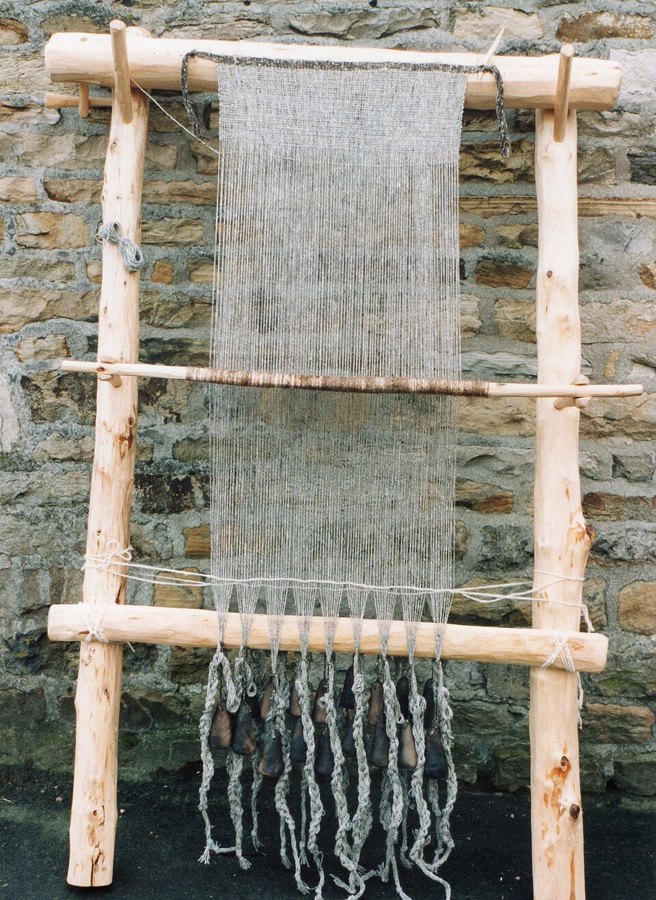
A warp-weighted loom maintains tension through weights attached to groups of warp threads. Much of its structure is wooden and may disappear, while weights survive as archaeological finds. The challenge is to recover relationships among the components rather than treating each weight as a complete machine. Its mass affects the tension applied to a group of threads, but the number of threads sharing that load matters too. The opening through which the weft passes also has to be created and controlled. A working reconstruction must account for these interactions. Otherwise, a plausible upright frame may resemble a loom while failing to explain the textile it is intended to produce.
Sources for this section: 1
Why thickness matters alongside mass
The experimental study Shape of Things identifies both weight and thickness as important functional measurements. Weights hanging beside one another occupy space; their thickness affects the width of the row and therefore the possible arrangement of warp threads. Mass alone does not describe this geometry. The study offers a framework for estimating production possibilities where textiles are absent, provided the relevant measurements survive. This makes careful recording essential. A broken object whose original dimensions are uncertain cannot support the same calculation as a complete example. The approach concerns what an arrangement could produce; it does not establish the exact cloth once woven above every group of archaeological weights.
Sources for this section: 1

A linen assumption being tested
The University of Copenhagen’s TRiVAL project describes a test of the familiar assumption that linen necessarily required heavier tension than wool. Experienced weavers questioned that rule, leading to an experiment with replica Hedeby weights in three mass categories and different weaving swords. The planned fabric follows an archaeological textile, while the yarn is to match specified properties even though it is spun using a modern wheel for the experiment. This is a deliberate experimental choice, not a claim that the wheel belonged in the Viking workshop. The project is valuable because it isolates the question under investigation. Its public description sets out a test; it should not be reported as a completed result proving all earlier interpretations wrong.
Sources for this section: 2
Making a full sail on an upright loom
The Viking Ship Museum reports the production of a twenty-five-square-meter wool sail for an Oselver boat on an upright warp-weighted loom. Work ran from July 2006 to May 2008, with the weaver documenting process and equipment. This is a modern project involving a traditional Norwegian vessel, not a recovered Viking sail. Its scale nevertheless allowed questions that small samples could not answer in the same way. Long sequences of work exposed practical issues of handling cloth and tools. The elapsed project dates should not be converted directly into a universal number of Viking labor hours: the schedule, public setting, preparation, and personnel are part of the experiment’s conditions.
Sources for this section: 3
Wear can become evidence
The same sail project recorded wear on equipment and changes in loom-weight mass. Such observations create a bridge between manufacturing and the traces left on tools. A finished sail is one outcome; a documented set of altered implements is another. Comparing experimentally produced wear with archaeological surfaces may help researchers ask whether a proposed action is plausible. The comparison must remain specific to material, duration, and technique. A mark is not self-interpreting merely because it appears on a tool. Recording how it formed is what gives an experiment explanatory value. This expands weaving research beyond attractive replicas toward the physical consequences of sustained work.
Sources for this section: 3
Complex cloth demands a working geometry
An experimental study of Norwegian reversible double-cloth tested different arrangements of four rows of weights. The tradition spans a long period, so the experiment should not make every later coverlet into a Viking object. Its technical findings are nevertheless relevant to what the loom can do. Weight-row position, heddle length, and access around the uprights affected the usable openings for weaving and the transfer of patterns. These are constraints that a diagram of a finished fabric can conceal. Producing a complex textile requires a body to reach, manipulate, and see the threads. Successful structural analysis therefore needs practical testing of the loom arrangement as well as recognition of the weave itself.
Sources for this section: 4
Organization without an imaginary factory
The cases reveal several scales of organization: grouping threads under a weight, arranging rows across a loom, preparing enough yarn, and sustaining work on a large textile. They do not require an unsupported choice between isolated household manufacture and a centralized factory. The archaeological setting must decide how production was distributed. A small group of weights might represent only the surviving portion of equipment, while a large concentration might contain several episodes of activity. Interpreting the work means relating tools to dated buildings and deposits. What can be established from the experiments is that weaving involved coordinated material choices and bodily routines. The loom was simple in its basic materials but demanding in its successful operation.
Sources for this section: 1, 2, 3, 4
The Evidence
The sources below support this article. Interpretations and limits are explained in the text; this is not an exhaustive research review.