
Beliefs & Stories · Deep dive
Karlevi: A Skaldic Stanza Carved in Stone
In Brief
On Öland, an elaborate memorial poem survives on its Viking Age support. Its meter, arrangement, and uncertain Latin inscription reward separate attention.
On this page
A monument in a changed landscapeRead the different levels of an editionWhy the poetic form mattersThe reading route is part of the compositionA fragment in another writing systemModern visibility is another historical layerSourcesA monument in a changed landscape
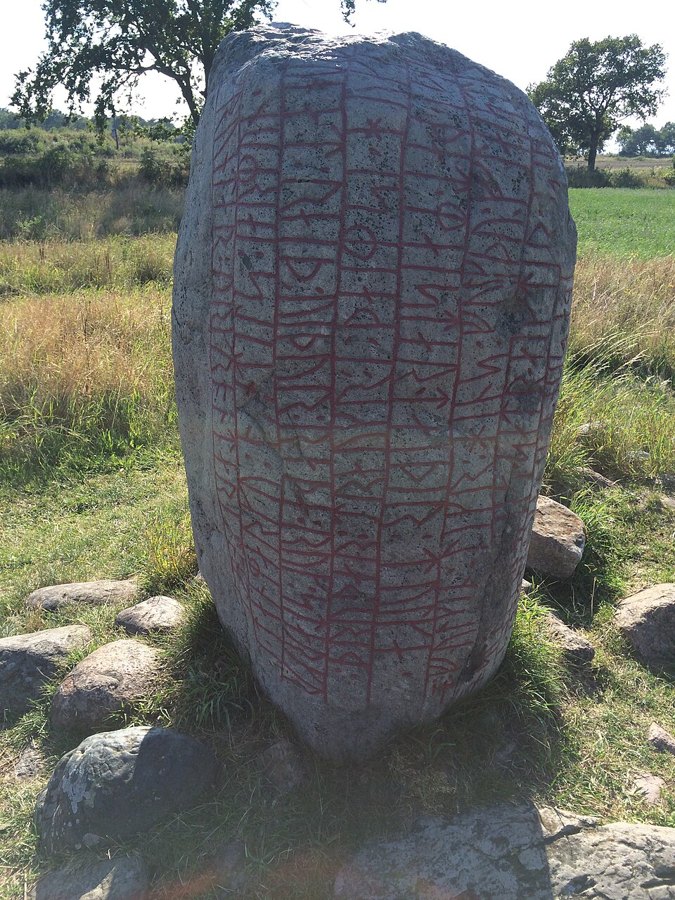
The Karlevi stone stands near Kalmarsund on the western side of Öland. The Swedish National Property Board describes a roughly 1.3-meter block of quartz porphyry, probably originating across the sound near Oskarshamn. It dates the memorial to around the end of the tenth century and identifies the commemorated man as Sibbi, son of Foldarr. The stone is considered to remain in its original position.
The surroundings have changed. A seventeenth-century drawing shows two burial mounds that are now lost, apparently through cultivation. The inscription associates the dead man with a mound, but the visible modern field no longer presents that setting. The suggestion that his companions buried him during a journey is an interpretation of the circumstances, not an episode narrated in full. A visit therefore needs two landscapes in mind: the surviving stone and the partially recoverable arrangement that once made its memorial language concrete.
Sources for this section: 1
Read the different levels of an edition
The Scandinavian Runic-text Database, accessible through the Heritage Board’s Runor service, identifies the inscription as Öl 1. Its presentation distinguishes the runic text, normalized language forms, and translations. The record preserves alternatives in Sibbi’s designation and marks uncertain or missing characters. Those signs are useful information, not typographic clutter to remove before reading.
The prose commemoration names the dead man and his father and associates the raising with his following. The verse then expands the public praise through elaborate language. Read those functions separately before combining them into a biography. A claim that the deceased had exceptional qualities belongs to the commemorative voice; it is not an independent assessment by a neutral observer. The record also includes a separate inscription in Latin letters whose interpretation is uncertain. A complete account of the monument must notice that material even when the runic poem receives most attention.
Sources for this section: 2

Why the poetic form matters
Heather O’Donoghue’s study treats Karlevi as the surviving Viking Age runic witness to a complete stanza of skaldic verse. Its dróttkvætt form combines tightly organized sound patterns with demanding syntax and elaborate figurative expressions. The importance is not merely that the inscription sounds poetic. The stone preserves evidence for a sophisticated compositional practice without relying on a much later manuscript copy of this particular stanza.
A prose translation can clarify the compliment while losing the achievement of fitting it into the form. Conversely, reproducing the sounds without explanation may leave the reader unable to follow the sense. O’Donoghue demonstrates why a responsible presentation needs both. Kennings also require more than a one-word glossary: their constituent words and grammatical relationships may be dispersed through the verse. The mythological vocabulary supplies poetic resources, but its presence alone does not identify the private religious convictions of every person involved in making the memorial.
Sources for this section: 3
The reading route is part of the composition
Kristel Zilmer’s study of travel-related runic inscriptions examines how Karlevi’s prose and verse occupy the stone. Their opening lines adjoin one another and run in the same direction, while the two textual portions develop away from that meeting point. Modern editions have ordered these parts differently. The familiar decision to print the prose first is consequently an editorial arrangement rather than an unavoidable consequence of turning a page.
This observation changes how the monument can be approached. The stone presents connected paths through the writing instead of a single rectangular page. The statement that the memorial was raised and the verse’s reference to the hidden dead can be encountered beside one another. Zilmer does not claim that the layout establishes one certain original sequence. Its value is precisely that it preserves a relationship that a linear quotation can suppress. Photographs of all relevant faces should accompany any close reading.
Sources for this section: 4
A fragment in another writing system
Kate Heslop’s 2026 study investigates the fragmentary Latin inscription on the other side of the monument. Its published abstract proposes that the same makers were probably responsible for both inscriptions and argues for a protective function comparable to invocations of Thor elsewhere. These are the study’s conclusions, not facts supplied unambiguously by the surviving fragment. The database’s cautious rendering of a possible Christian invocation shows why the lettering demands care.
The juxtaposition offers a more productive question than whether the monument belongs in an exclusively pagan or Christian box. What could different scripts and learned formulas contribute to a public memorial? A short phrase might be valued for associations or protective force even when its surviving form is irregular. That possibility does not license inventing the carvers’ education or a conversion ceremony. The fragment widens the inquiry while also setting a clear limit to what can be reconstructed.
Sources for this section: 5, 2
Modern visibility is another historical layer
The Heritage Board’s conservation guidance uses Karlevi to explain that the red coloring visible in the inscription helps modern visitors see the runes; it does not establish the appearance of the monument when newly carved. This is a small but consequential distinction. A sharp modern photograph combines ancient grooves, accumulated weathering, and decisions made for present-day legibility.
Treat the image as documentation of the monument in its recorded condition. For questions about a particular character, consult the edition and its uncertainty signs rather than assuming that painted lines settle every reading. For questions about its setting, distinguish the surviving field from the vanished mounds. For the poem, compare syntax and meter with the paraphrased meaning. Karlevi becomes richer when these layers remain visible: a memorial to a named person, a difficult poetic composition, a shaped encounter with stone, and an object whose continued care influences how we can read it.
Sources for this section: 6
The Evidence
The sources below support this article. Interpretations and limits are explained in the text; this is not an exhaustive research review.
- National Property Board of Sweden — Karlevistenen ↗
- Scandinavian Runic-text Database — Öl 1 ↗
- Heather O’Donoghue — The Karlevi runestone (2023) ↗
- Kristel Zilmer — travel and communication in Nordic runic inscriptions ↗
- Kate Heslop — the Latin inscription on Karlevi (2026), abstract ↗
- Swedish National Heritage Board — guidance on care of carved stones ↗