
Beliefs & Stories · Overview
Viking Skalds: Court Poetry, Kennings and the Art of Dróttkvætt
In Brief
Skalds shaped reputations through skilled verse. Court poetry could praise a ruler, preserve a claim about the past or turn verbal mastery into influence, but it was neither neutral reporting nor merely decorative entertainment.

On this page
The poet at courtHow dróttkvætt worksKennings are more than mysterious nicknamesCould poetry preserve history?When words mattered alongside weaponsSourcesThe poet at court
A skald could celebrate a ruler’s deeds and generosity in front of an audience that understood the value of reputation. Calling the poet a Viking PR chief is a useful joke, but an imperfect description: it risks importing a modern profession and overlooking the poet’s artistry, personal relationships and varied subjects.
Court praise is a substantial part of the surviving tradition, not the whole of it. Individual stanzas and later Christian poetry also belong to skaldic literature.
Sources for this section: 1, 2
How dróttkvætt works
In its regular form, dróttkvætt has eight lines, normally six syllables per line. Alliteration connects paired lines, while internal rhyme adds another pattern. Odd lines normally use partial internal rhyme, called skothending; even lines use full internal rhyme, aðalhending.
This is not simply English end-rhyme written in Old Norse. The position of sounds within the line matters. Variants exist, so this outline is a starting model rather than a rule that every surviving stanza obeys without complication.
Sources for this section: 3
Kennings are more than mysterious nicknames
A kenning expresses something through a combination of words, often involving a relationship or an allusion. Heiti are poetic names or synonyms. Both give the poet choices within demanding metrical constraints.
The listener’s knowledge matters. A mythological allusion can compress a story into a few words, while an English translation may need to unfold it. Difficult syntax is another reason why a readable translation can differ markedly from the order of the original words.
Sources for this section: 3, 1
Could poetry preserve history?
Yes, but preservation is not the same as impartiality. A praise poem can retain names or claims while presenting its patron favorably. A later saga can also place an older stanza inside a narrative that gives it a particular explanation. The verse’s date and the surrounding prose’s date should not be silently treated as identical.
Attribution is therefore a research question, not a fact guaranteed by the name written above a translation.
Sources for this section: 1, 2
When words mattered alongside weapons
Reputation helped a ruler’s deeds outlive the immediate event. Poetic skill could make those deeds memorable, meaningful and repeatable. This does not prove that a verse was always more powerful than a sword; it explains why political power had a verbal dimension.
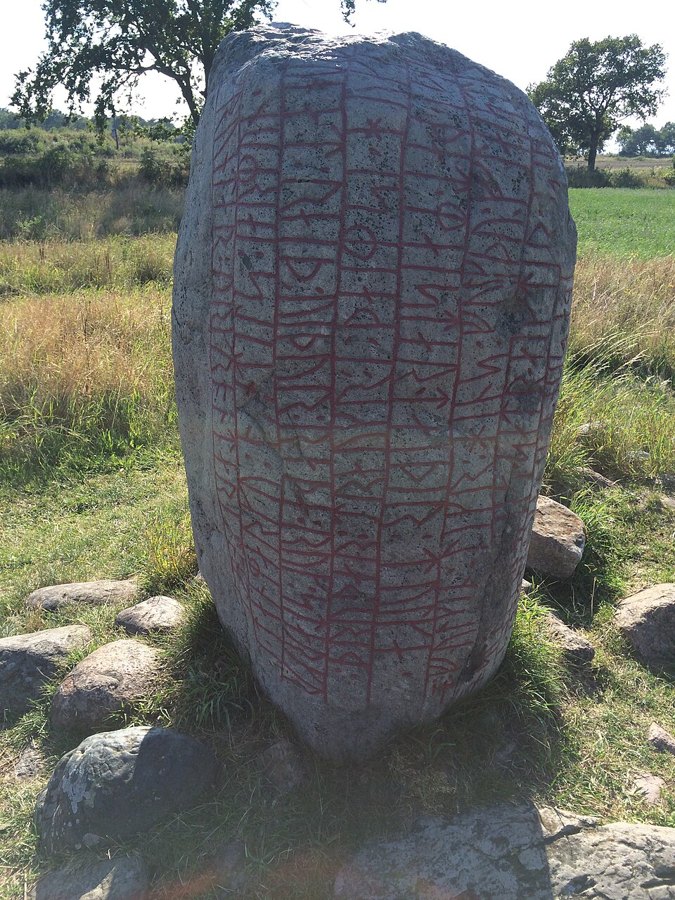
The Karlevi runestone offers a particularly useful next step: verse preserved on a physical monument can be compared with poems transmitted through manuscripts. The medium changes the questions a historian can ask.
Sources for this section: 2, 3
The Evidence
The sources below support this article. Interpretations and limits are explained in the text; this is not an exhaustive research review.