
Beliefs & Stories · Deep dive
The Rök Stone: Reading an Argument in Stone

In Brief
An extraordinary inscription offers an unusually clear lesson in the difference between recognizing runes, translating words, and explaining a monument.
On this page
Start with the surviving objectClear marks do not guarantee clear wordsThe familiar hero is also a hypothesisA different route around the inscriptionClimate enters a particular interpretationCompare complete explanationsSourcesStart with the surviving object
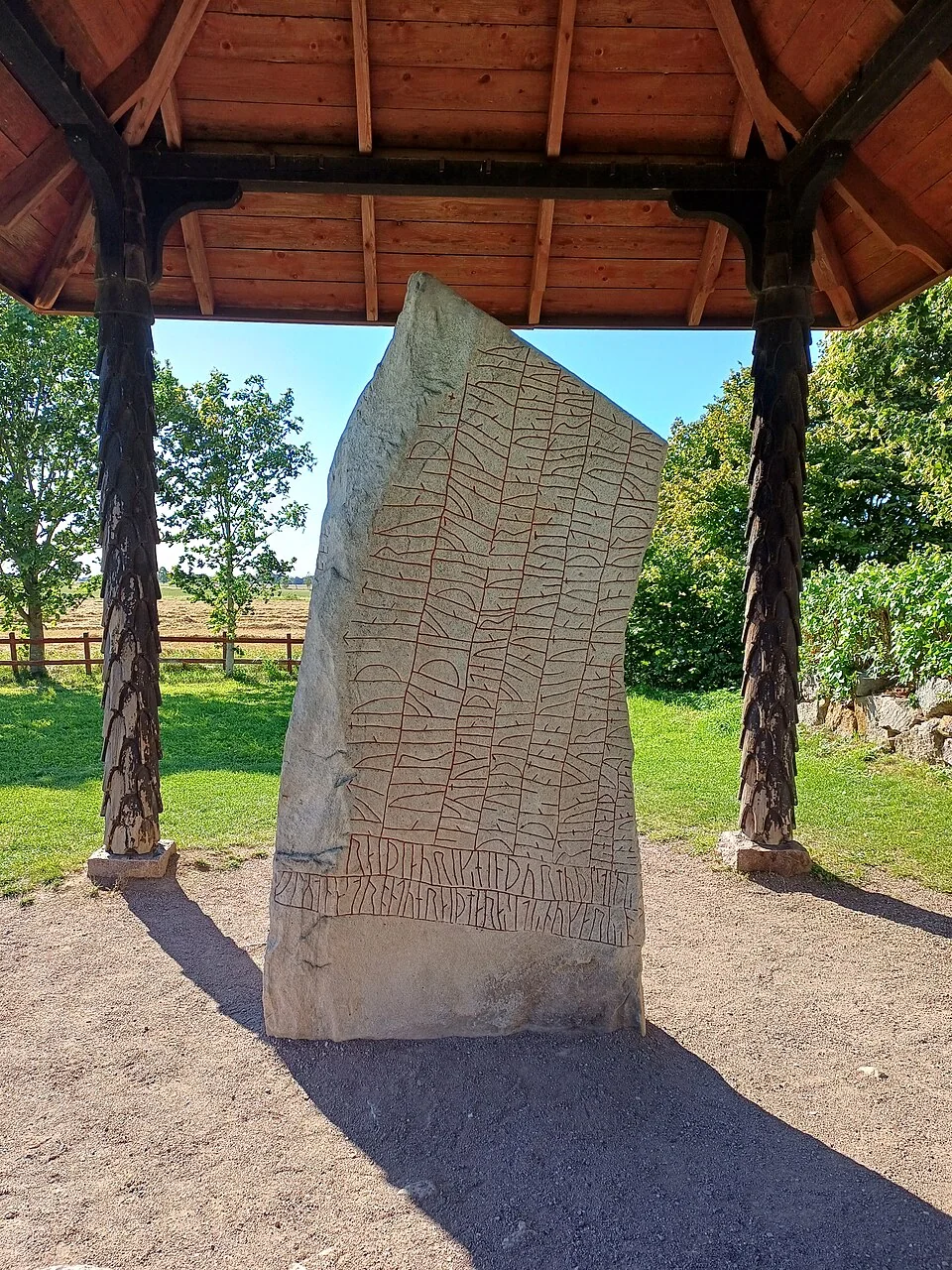
The Rök stone stands beside Rök church in Östergötland. The Swedish National Heritage Board dates its inscription to the ninth century and records more than 760 characters. That makes it substantially earlier than the great concentration of Swedish runestones from the eleventh century. Comparisons with those later memorials are useful, but they cannot simply supply every missing piece of its cultural setting.
Its length is part of the problem. A modern book presents an expected sequence of pages; an inscribed stone requires the reader to decide how surfaces and lines connect. A photograph of one face is consequently an incomplete reading environment. Before asking what the monument means, establish which part of the object a transcription reproduces and how its editor moves to the next part. The physical arrangement belongs to the evidence, rather than serving only as an attractive background for a translated text.
Sources for this section: 1
Clear marks do not guarantee clear words
Magnus Källström’s account of the stone’s research history recalls that early antiquaries could see its marks without understanding its writing system. Johannes Bureus and Johan Hadorph encountered difficulties long before modern arguments about myth or climate. Hadorph’s seventeenth-century observation also points toward the absence of ordinary word division. The reader had to work out boundaries that a printed translation now supplies silently.
This creates several separate decisions. Identifying a rune is one operation; deciding where a word ends is another. Recognizing a grammatical form and choosing between possible referents are further steps. Confidence at the first stage cannot automatically pass through the whole chain. A smooth English sentence conceals this labor unless the edition explains it. Asking for a transliteration alongside the translation is therefore a practical way of seeing where an interpretation begins.
Sources for this section: 2
The familiar hero is also a hypothesis
The University of Gothenburg’s research project examines the long-standing identification of a passage with Theodoric the Great. It also investigates how twentieth-century scholarly disputes shaped that reading. Elias Wessén opposed Otto Höfler’s interpretation involving a Germanic cult of leadership, while retaining the identification of Theodoric. In the project’s analysis, disagreement about the significance of the supposed reference helped leave the reference itself insufficiently questioned.
This is an argument about the history of scholarship, not proof that every traditional reading is politically motivated. An interpretation can be inherited because it explains difficult language well, because alternatives have weaknesses, or because influential editions make it familiar. Those possibilities require separate examination. The useful question is precise: which runic forms and grammatical choices support the proper name? The reputation of an interpretation is relevant to its reception, but it cannot replace the linguistic case.
Sources for this section: 3
A different route around the inscription
In his 2016 interpretation, Per Holmberg proposed that several riddles concern writing, daylight, and the monument itself. His account also addresses a striking numerical difficulty: an apparent leap from the second item to the twelfth. Instead of supplying lost material from an imagined oral version, he argued that a different reading route around the stone makes the numbering intelligible.
This proposal changes the reader’s task. Rather than searching first for lost heroic stories, one asks whether the inscription directs attention to the act of reading. It is an economical possibility when the monument’s arrangement provides the missing connection. Yet economy alone does not establish correctness. The proposed route must also fit the actual placement of lines, the wording of transitions, and the other passages. Readers should compare diagrams of the competing sequences instead of judging only their polished translations.
Sources for this section: 4
Climate enters a particular interpretation
A 2020 interpretation by Holmberg, Bo Gräslund, Olof Sundqvist, and Henrik Williams connected the inscription with anxiety over cosmic disruption. The university’s presentation describes nine riddles involving the sun and Odin’s warriors. The researchers linked this reading with memories of the sixth-century climatic crisis and with later phenomena that might have provoked fear about the sun’s continuing power.
The distinction between environmental evidence and remembered experience is crucial. Evidence that unusual natural events occurred does not independently demonstrate what a particular commissioner believed about them. Nor does it establish that an ambiguous phrase refers to those events. The climate interpretation needs both a defensible reading of the words and a plausible cultural connection. It is a serious scholarly proposal, but a headline announcing that the stone’s mystery has finally been solved would erase the argument that makes it worth examining.
Sources for this section: 5
Compare complete explanations
A useful comparison starts with a small table of questions: what reading order does each interpretation use, which words receive unusual meanings, which parallels are invoked, and what remains unexplained? The Gothenburg project itself describes developments between its successive studies. That history is a reminder that an interpretation is revisable work rather than a single permanent revelation.
Prefer explanations that identify their difficult passages openly. An account that fits one dramatic line while requiring unsupported assumptions elsewhere has a different strength from one that explains the monument’s arrangement as well as its vocabulary. Equally, disagreement does not make the stone meaningless. Its exceptional written complexity remains evidence of deliberate composition. The responsible outcome is a layered understanding: the surviving object is observable, individual readings have varying levels of support, and the larger purpose continues to invite competing reconstructions.
Sources for this section: 3
The Evidence
The sources below support this article. Interpretations and limits are explained in the text; this is not an exhaustive research review.