
Beliefs & Stories · Deep dive
The Poetic Edda: A Collection with Several Histories
In Brief
The familiar title conceals a medieval manuscript, a wider poetic tradition, and many modern editorial decisions. Separating them changes what the poems can tell us.
On this page
Start with a manuscript, not an authorThe collection is larger than its best-known godsOral history is not a recoverable original recordingTranslation changes the reader’s experienceA national treasure also has a modern historyBuild a reading practice around the differencesSourcesStart with a manuscript, not an author
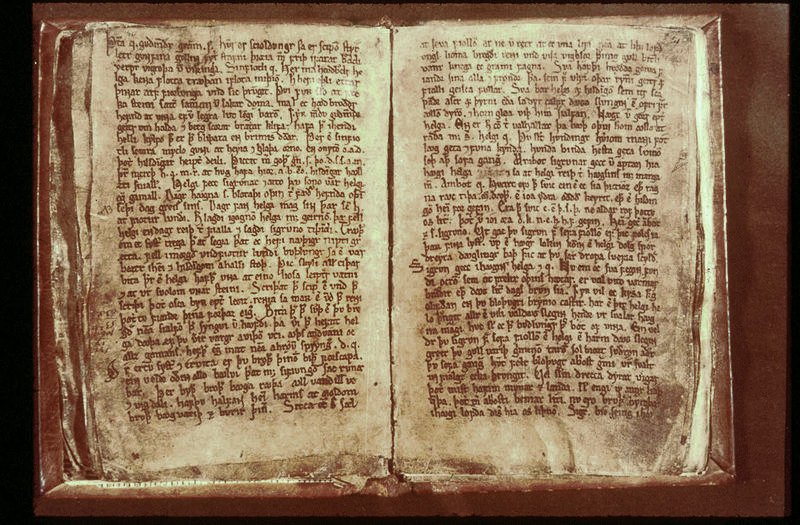
The principal manuscript behind the familiar collection is Codex Regius, shelfmark GKS 2365 4to, copied around 1270. That date establishes when this surviving physical witness was made. It does not provide a single date for the composition of all its poems. Nor does the existence of one bound volume establish that its contents were conceived together. A collection can preserve works with different voices, subjects, and histories while giving them a new relationship through arrangement.
The Árni Magnússon Institute’s digital edition makes this distinction unusually accessible. It provides manuscript images, diplomatic transcriptions, grammatical analysis, and a concordance. These tools answer different questions. A photograph shows the written page; a transcription makes its characters searchable; grammatical tagging interprets forms. None is simply interchangeable with a modern English translation. Reading across those layers exposes the distance between an old book and the readable text presented to a contemporary audience.
Sources for this section: 1
The collection is larger than its best-known gods
Edward Pettit’s modern dual-language edition includes thirty-six texts. Its contents extend from creation and divine conflict to the personal tragedies associated with Sigurðr, Guðrún, and Brynhildr. This range matters because popular introductions often allow the mythological poems to stand for the whole Edda. Heroic narratives bring other questions into view: loyalty, marriage, revenge, grief, and the consequences of choices made within families.
The edition also distinguishes poems associated with Codex Regius from material preserved elsewhere. A printed book therefore offers a scholarly collection whose boundaries are not identical to those of one medieval codex. Two translations can contain different numbers of poems without either being fraudulent or incomplete in the same sense. The relevant question is what editorial boundary each adopts. A contents page, often skipped on the way to Thor or Odin, can reveal that choice immediately and prevent misleading comparisons between editions.
Sources for this section: 2

Oral history is not a recoverable original recording
The scholarly Handbook to Eddic Poetry emphasizes the problem of accessing earlier oral composition through later written witnesses. Alliterative verse forms connect the material with a broader Germanic poetic tradition, but metrical resemblance does not supply an exact date or place of composition. A traditional form could remain available to poets over a long period. The manuscript date and the possible age of a story must therefore remain separate.
This leaves room for more than one kind of change. A performer might vary wording, a compiler might arrange inherited material, and a copyist might misunderstand a line. Similarities between witnesses can support a relationship without revealing every stage that produced it. Describing a poem as oral in origin is consequently a starting point for investigation, not permission to invent a lost performance. The surviving wording is evidence for earlier traditions, but it is also evidence for the people who put those traditions into writing.
Sources for this section: 3
Translation changes the reader’s experience
Carolyne Larrington’s account of revising her translation describes how a translator’s knowledge, scholarly context, and intended audience can change over time. She contrasts earlier English versions, with their deliberately archaic language, with the circumstances of her own work and revision. The practical implication is substantial: an old-fashioned English voice is not itself a feature of Old Norse antiquity. It is a choice made in another language, often many centuries later.
Consider what happens when a reader encounters an unfamiliar divine name or a compressed allusion. One edition may preserve the difficulty and explain it below the page; another may make the reference clearer in the translation. Neither strategy removes interpretation. For close study, compare the same stanza in two editions and read their notes before deciding that the poem itself is inconsistent. The discrepancy may lie in an ambiguous word, an editorial reconstruction, or a different understanding of what English readers need.
Sources for this section: 4
A national treasure also has a modern history
The manuscripts’ later travels belong to their history of survival. The Árni Magnússon Institute records the long negotiations over returning Icelandic manuscripts from Denmark and the arrival of Codex Regius and Flateyjarbók in Iceland on April 21, 1971. Legal decisions, scholarly committees, institutions, and conservation arrangements all formed part of that transfer. Medieval transmission did not end when the last medieval scribe put down a pen.
This modern history does not decide the meaning of an individual stanza, but it explains why access to the poems depends on collections and public institutions. It also helps separate two kinds of significance. The manuscript can be evidence for medieval literary culture and, at the same time, a powerful national symbol in a much later setting. A modern ceremony honoring its return should not be projected backward as proof that its original compiler understood Icelandic identity in the same terms.
Sources for this section: 5
Build a reading practice around the differences
Cambridge’s Old Norse teaching bibliography places modern Edda translations alongside scholarly editions, skaldic poetry, sagas, and language-learning resources. That combination suggests a productive route for an interested reader: begin with an accessible translation, then use an edition’s introduction and apparatus to investigate a specific problem. A complete mastery of Old Norse is not required to notice whether a note identifies a manuscript variant, proposes a correction, or supplies background from another text.
Keep a small record of the poem, stanza, translation, and witness under discussion. When a retelling combines passages from several works, trace one detail back to its source instead of assuming the assembled narrative was once a single ancient book. This method makes the Edda less tidy but more intelligible. Its value lies partly in preserving different voices together, not in making every voice agree.
Sources for this section: 6
For the introductory context, read Norse beliefs and the stories that survived.
The Evidence
The sources below support this article. Interpretations and limits are explained in the text; this is not an exhaustive research review.
- Árni Magnússon Institute — electronic Codex Regius edition ↗
- Edward Pettit — The Poetic Edda, edition and contents ↗
- A Handbook to Eddic Poetry — transmission, dating, and performance ↗
- Carolyne Larrington — translating and retranslating the Edda ↗
- Árni Magnússon Institute — collection history ↗
- University of Cambridge — Old Norse primary-source bibliography ↗