
Beliefs & Stories · Deep dive
Snorri’s Edda: Mythology in the Service of Poetry
In Brief
Snorri Sturluson preserved indispensable stories, but his Edda was also a technical and intellectual project shaped by thirteenth-century Iceland.
On this page
An author working after the conversionWhy a poet needed storiesThe prologue creates distanceSkáldskaparmál states a practical purposeHáttatal demonstrates the craftPolitics enters the demonstrationSourcesAn author working after the conversion
Margaret Clunies Ross places the composition of Snorri’s Edda approximately in 1221–25, while emphasizing that its exact date is uncertain. Snorri, who died in 1241, belonged to a powerful Icelandic family and participated in Icelandic and Norwegian politics. He was not taking field notes among communities untouched by Christianity. His book belongs to a Christian learned world looking back at inherited poetry and the traditions needed to understand it.
That position explains a productive tension. The old stories were culturally useful even when their gods were no longer accepted as the proper objects of worship. Preserving them did not require preserving their earlier religious setting unchanged. Snorri could organize, interpret, and narrate traditional material for new purposes. The result is neither a transparent window onto Viking Age belief nor a worthless late invention. It is a medieval work whose goals must be considered whenever it supplies the fullest surviving account of a myth.
Sources for this section: 1
Why a poet needed stories
The University of California Press describes the Edda as a handbook for composing in the manner of earlier skalds. Traditional poetic language depends on compressed references. A listener who recognizes a story can understand an allusion that would otherwise seem like a strange combination of nouns. Teaching poetic expression therefore requires more than rules about syllables or sound: it also requires a shared body of narrative knowledge.
Imagine being given an elaborate metaphor with no knowledge of the episode behind it. Knowing the dictionary meaning of each word would not necessarily solve the phrase. The Edda’s stories provide that missing background. This helps explain why an entertaining narrative may appear in a technical work and why extracting the narrative alone can obscure its function. A tale does not have to be presented as religious instruction to remain necessary to the language of praise, description, and cultural prestige.
Sources for this section: 2
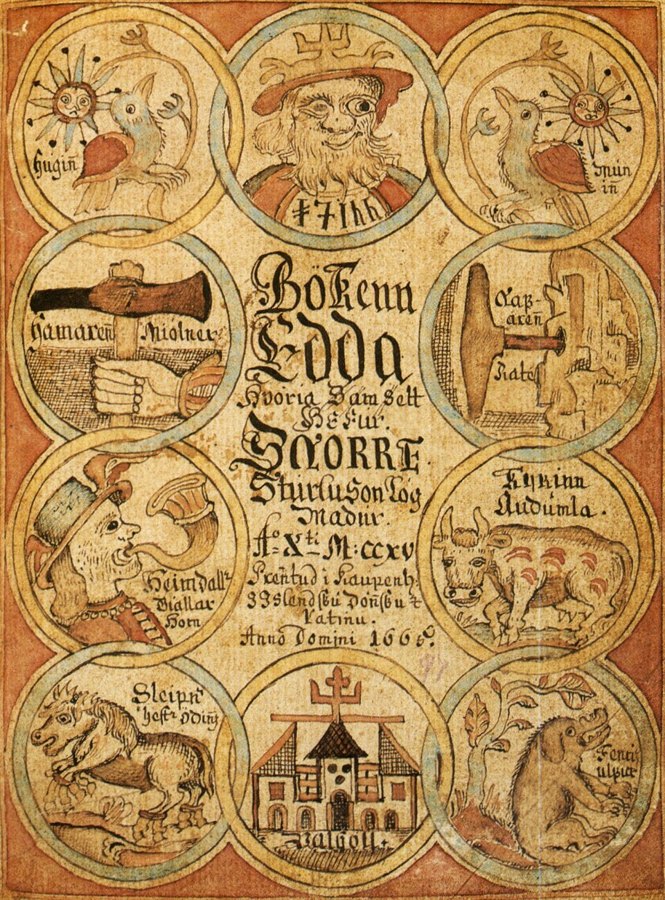

The prologue creates distance
Anthony Faulkes’s edition explains how the prologue accounts for the emergence of non-Christian religions and connects the Æsir with a migration from Troy. This framework places the gods inside a learned historical explanation rather than simply affirming their divine status. It allows inherited names and traditions to be retained while changing the explanation of what they originally represented.
The main mythological narrative, Gylfaginning, is also framed as an encounter rather than delivered as an unqualified authorial declaration. Its questions and answers organize a large body of material into a readable sequence. The framing matters because speakers inside a story are not identical with the author addressing a reader directly. When a modern handbook removes that structure and lists the answers as a systematic creed, it has already transformed the source. Snorri’s arrangement is evidence for his literary intelligence as well as for the traditions on which he drew.
Sources for this section: 3
Skáldskaparmál states a practical purpose
Faulkes identifies a passage in Skáldskaparmál where the purpose of instruction becomes explicit: the work assists young poets in understanding traditional poetic expression. The discussion moves between narrative explanation, categories of diction, and examples from verse. That combination turns the book into a resource for learning how language works, rather than merely a collection of plots.
There is a further distinction between an instructional aim and a documented classroom. Faulkes cautions that formal teaching arrangements are difficult to establish. A text useful for training poets might be read privately, consulted to interpret older verse, or used in several ways. We should not furnish an imagined schoolroom simply because the prose sounds pedagogical. What is secure is the relationship between explanation and example. The work preserves older poetry while showing readers how particular expressions belong to a wider repertoire of names, substitutions, and narrative references.
Sources for this section: 4
Háttatal demonstrates the craft
The metrical section Háttatal supplies another perspective on the project. In Faulkes’s edition, the differences among its manuscript witnesses extend to commentary, stanza arrangement, headings, and the names of verse forms. These details show that the technical apparatus was part of the text’s transmission, not merely a modern scholarly addition. A reader encounters verse together with instructions about how its effects are made.
The Uppsala witness includes a list of forms with opening lines, which Faulkes considers potentially useful as a reminder in performance or discussion. The precise use remains uncertain. Nevertheless, this material changes the balance of a modern reading of the Edda. The book is not exhausted by cosmology and divine adventures. Its interest includes the repeatable techniques by which verbal skill can be demonstrated, recognized, and transmitted. Omitting the technical section may make a selection more approachable, but it changes the reader’s impression of the whole.
Sources for this section: 5
Politics enters the demonstration
Kevin Wanner’s study of Háttatal examines the poem’s praise of King Hákon Hákonarson and Skúli Bárðarson, whose political relationship was complicated. Wanner focuses on a stanza connecting Hákon’s kingship with divine favor and considers how that claim interacts with Snorri’s preference for Skúli. His analysis is an interpretation, but it makes an essential point: the examples of poetic technique can also participate in contemporary arguments about authority.
The Edda consequently operates on several levels at once. It transmits stories, explains language, demonstrates craft, and exists within the author’s political and religious environment. A careful reading asks which of those purposes is active in a passage. The answer need not discredit the inherited material. It instead helps identify what kind of evidence a paragraph supplies: a remembered narrative, a poetic explanation, a Christian framing device, or a carefully fashioned intervention in the world of its writer.
Sources for this section: 6
For the introductory context, read Norse beliefs and the stories that survived.
The Evidence
The sources below support this article. Interpretations and limits are explained in the text; this is not an exhaustive research review.