
Beliefs & Stories · Deep dive
Grímnismál: Knowledge Spoken Between Two Fires
In Brief
The poem’s lists belong inside a dangerous encounter. Names, numbers, and cosmology become instruments of recognition, judgment, and changing royal authority.
On this page
A failed welcome sets the termsA catalogue can be an actionNumbers need their own historical contextIrregular formulas may preserve transmissionRitual readings require an argumentCosmological imagery also raises dating questionsSourcesA failed welcome sets the terms
The prose frame tells of the brothers Agnarr and Geirröðr, fostered by an apparently ordinary couple who are actually Frigg and Odin. Geirröðr eventually becomes king. Later, after a dispute between the gods, he mistreats a mysterious visitor who gives his name as Grímnir. The king’s son, also called Agnarr, offers the captive a drink. The encounter ends with the revelation of Odin’s identity and Geirröðr’s death.
The University of Victoria’s MyNDIR project summarizes this frame as a story in which deception, hospitality, and succession are closely connected. The names need care: the younger Agnarr is not simply the returning brother from the opening. Keeping the two figures distinct clarifies the reversal. The son responds differently from his father, and that difference matters before the captive explains who he is. Recognition begins with conduct toward a vulnerable stranger rather than possession of the correct divine name.
Sources for this section: 1
A catalogue can be an action
Pettit’s edition treats Grímnir’s speech as serving several purposes. It can offer Geirröðr opportunities to recognize the divine visitor, provide knowledge to Agnarr, and expose the consequences of a failed relationship between ruler and god. The many names and descriptions are therefore not necessarily an unrelated encyclopedia inserted into a story. They change what the people inside that story can know.
Read a stretch of the catalogue while remembering its immediate audience. A declaration about divine dwellings sounds different when the speaker is being tortured by a king who should release him. The speech’s accumulation can become pressure: more information arrives, yet the listener continues to misunderstand. This reading does not solve every textual difficulty, but it explains why removing the frame produces a thinner poem. The catalogue is not just a store of facts for modern mythology charts; it participates in an unfolding encounter with consequences.
Sources for this section: 2

Numbers need their own historical context
Vittorio Mattioli’s critical study draws attention to the numerical language describing the immense halls. A medieval Scandinavian “hundred” can represent the long hundred of 120, so an expression translated casually as five hundred may require a different calculation. The study also notes that the two principal witnesses reverse the order of the adjacent stanzas concerning the halls. Even an apparently exact piece of architectural information therefore involves linguistic and textual decisions.
The lesson is not that every number conceals a secret code. Mattioli explicitly leaves the significance of the large total uncertain. Nor should poetic scale be converted into a practical floor plan. A translation can make a number look precise while obscuring the counting convention behind it. The reader should ask what the phrase meant linguistically, how the witnesses arrange it, and what effect such vastness has within the poem before trying to measure a divine building.
Sources for this section: 3
Irregular formulas may preserve transmission
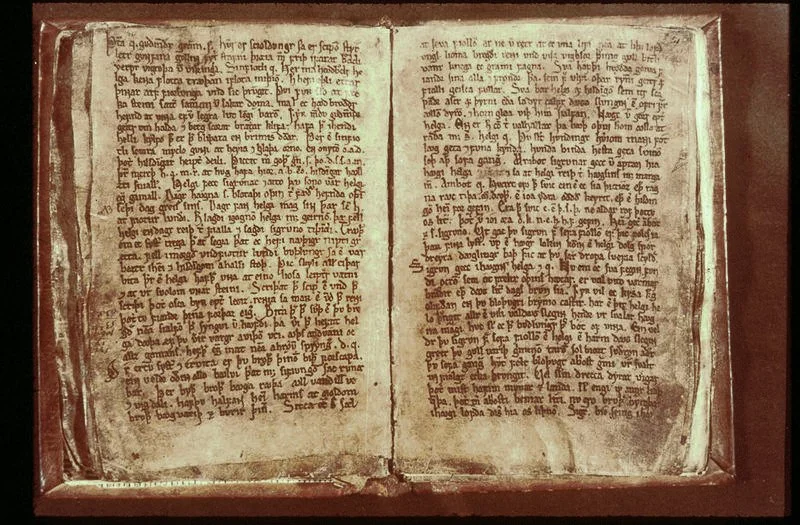
Frog’s study of numbered inventories in Grímnismál and Vafþrúðnismál examines variation against a background of repeated poetic formulas. Some changes may represent creative handling of a tradition; others may reflect difficulties in presenting or recording it. The proposed explanation includes the possibility of an oral presenter and a separate transcriber. This is an exploratory argument from textual patterns, not an eyewitness report of the poem being written down.
Its value lies in taking small inconsistencies seriously. A phrase that seems awkward need not be immediately corrected into what a modern editor expects. It might preserve evidence of how the text moved into writing. Conversely, not every difference can be explained by invoking performance. The details of alliteration, sequence, and repetition have to support the hypothesis. Reading an apparatus alongside the poem can therefore reveal more than a neat printed text that silently regularizes the very features requiring explanation.
Sources for this section: 4
Ritual readings require an argument
The study titled “Being Óðinn Bursson” considers whether the poem’s oral performance may have helped establish obligations within warrior groups. It also reviews the history of attempts to connect eddic poetry with ritual drama, warning against confidently filling gaps with imagined ceremonies. A performance-oriented interpretation asks what a poem could do before an audience, rather than treating its words as information detached from an occasion.
That question is worth pursuing because the scene involves hierarchy, divine recognition, suffering, and a replacement ruler. Yet the poem does not provide stage directions for a documented Viking Age rite. A proposed ritual setting must remain a model tested against the wording and comparative evidence. The distinction protects an important possibility from becoming an invented certainty. We can consider how hearing the speech might alter a listener’s understanding of authority without claiming to know the hall, costumes, calendar date, or participants of an original performance.
Sources for this section: 5
Cosmological imagery also raises dating questions
Matthias Egeler compares the stag, tree, and river imagery in stanzas 26–28 with medieval Christian cosmological traditions. He argues that the detailed correspondences may place this portion of the poem within a high medieval Christian setting. His conclusion concerns a particular passage and its imagery; it should not automatically become a date for every part of the surviving work.
This argument sits uneasily with a simple account of the poem as a complete unchanged survival from pre-Christian ritual, and that tension is useful. Different approaches investigate different kinds of evidence: formulas and performance, narrative structure, manuscripts, and visual or literary parallels. They may not produce one uncontested history. A substantial reading holds them together while distinguishing observation from reconstruction. Grímnismál remains a dramatic work about knowledge and recognition, but its own path into the surviving manuscripts is a further problem of knowledge that the reader must confront.
Sources for this section: 6
For the introductory context, read Yggdrasil: A Living World, Not a Fixed Map.
The Evidence
The sources below support this article. Interpretations and limits are explained in the text; this is not an exhaustive research review.