
Beliefs & Stories · Deep dive
Skírnismál: Desire, Coercion, and the Problem of a Happy Ending
In Brief
Freyr wants Gerðr, but she repeatedly refuses his messenger. The poem’s changing tactics make it one of the most difficult and revealing conversations in Eddic poetry.
On this page
Two manuscript titles and a divided conversationGifts fail before threats beginChanging the reader’s positionTwo different forms of painful desireThe threat reaches beyond outward obedienceChristian parallels are a hypothesis to testSourcesTwo manuscript titles and a divided conversation
The poem usually called Skírnismál appears as Fǫr Skírnis, or Skírnir's Journey, in the Codex Regius. Another medieval witness, AM 748 I a 4to, preserves the beginning and much of the first twenty-seven stanzas. Its surviving text then breaks off. Edward Pettit's edition distinguishes these witnesses rather than treating the familiar modern title as evidence for a single fixed book.
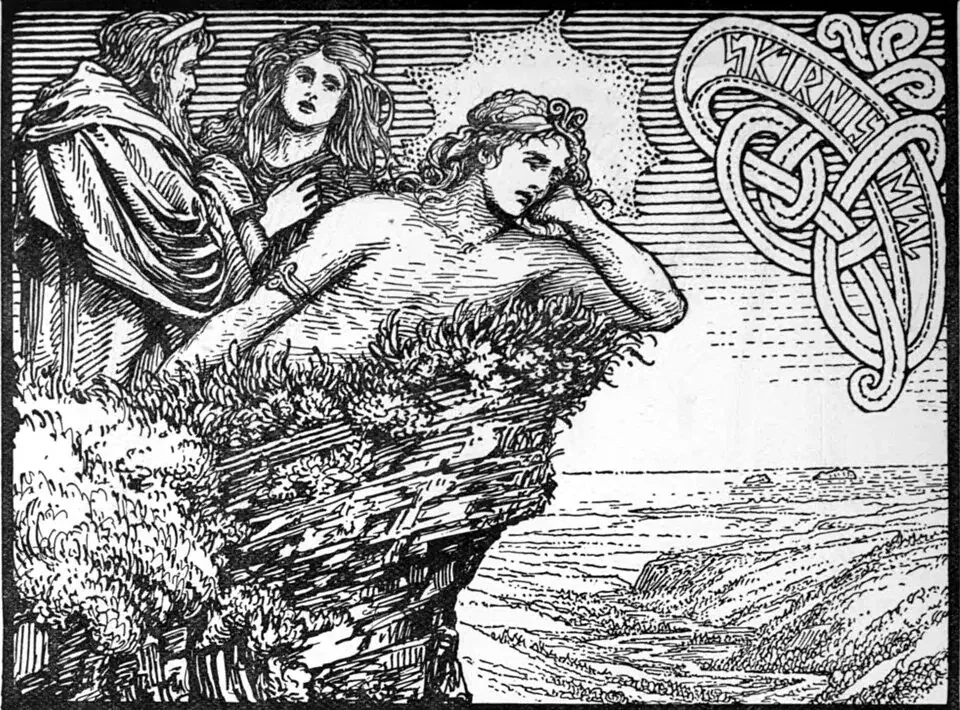
Most of the verse consists of dialogue, principally in ljóðaháttr, with extended forms appearing in the curse. Prose supplies connecting information, including Freyr's initial view of Gerðr from the high seat Hliðskjálf. Separating prose and verse matters: a detail supplied by the framing narrator need not have belonged to every performance of the poem. The composition's age remains uncertain, and an early motif does not establish an early date for the complete surviving arrangement. Dialogue invites performance, but no surviving stage directions reconstruct an actual performance occasion.
Sources for this section: 1
Gifts fail before threats begin
Skírnir's meeting with Gerðr proceeds through distinct tactics. First he offers golden apples. She refuses both the gift and life with Freyr. He next offers the remarkable ring associated with Baldr's funeral, but she replies that her father's household has enough wealth. These answers make her a speaking participant who can evaluate an offer and reject its premise.
Skírnir then threatens her with a sword and extends the threat to her father. When this also fails, the speech becomes a curse. That order is crucial. A summary that calls the scene successful courtship erases the poem's explicit refusals and the escalation needed to overcome them. The eventual agreement specifies a meeting after nine nights; it does not retrospectively turn the earlier threats into welcome persuasion. Freyr's impatience at the end gives the narrative its final emotional emphasis, while leaving Gerðr's experience of the arrangement largely outside the closing exchange.
Sources for this section: 2

Changing the reader’s position
Carolyne Larrington's influential interpretation asks what changes when the reader follows Gerðr rather than automatically identifying with Freyr and his agent. From that position, the event begins with an unknown visitor entering a woman's household and demanding that she meet another man. Her possession of wealth makes bribery ineffective, so the visitor attacks her capacity to maintain an independent future.
This is a method of reading, not a claim that the poem records an individual historical woman's life. Larrington explicitly challenges one-to-one equations between literary characters and social institutions. The value of her approach lies in making the narrative's allocation of sympathy visible. The god's distress occupies the opening and ending, while the consequences for the woman are compressed into the middle. Recognizing that distribution lets readers discuss coercion without assuming either that every medieval listener approved it or that an ancient fertility explanation makes it disappear.
Sources for this section: 3
Two different forms of painful desire
Daniel Sävborg separates Freyr's suffering from the punishment threatened against Gerðr. Freyr already desires someone and suffers because he cannot immediately obtain the desired relationship. Gerðr is threatened with distressing desire if she refuses a relationship she has not chosen. These are not simply two examples of the same romantic emotion.
Sävborg also challenges the assumption that lovesickness must indicate borrowing from continental courtly literature. Earlier Norse poetic traditions could associate desire with grief, and the precise language and symptoms deserve comparison before a dating argument is built upon them. Conversely, a medieval Bryggen runic inscription provides a parallel for desire imposed as hostile magic. Such evidence helps distinguish literary traditions and practices, but it does not provide a date for the entire poem. The analytical gain is precision: who feels desire, who causes it, and whether suffering follows love or is threatened as punishment for refusing it.
Sources for this section: 4
The threat reaches beyond outward obedience
Richard Cole's discussion of induced desire identifies a distinction easily lost in a brief retelling. Ordinary intimidation can make someone act as an aggressor wishes while leaving the person's inward wishes unchanged. The threat of magically imposed desire imagines a more invasive form of control: the victim's wanting itself becomes vulnerable.
Applied to Skírnir's speech, this distinction explains why the curse carries a different force from the sword. A threat to kill targets survival; a threat to reshape desire targets the conditions under which Gerðr could continue to recognize her own choices. The text's fantastic setting permits this danger to be spoken with literal magical force. Readers need not believe such magic works to understand the structure of the threat. Nor should an interpretation turn acquiescence under that threat into evidence of freely emerging affection. The difference between compliance and desire remains central even when the narrative stops short of describing her later feelings.
Sources for this section: 5
Christian parallels are a hypothesis to test
Gro Steinsland proposes that the poem reworks elements familiar from the Genesis account of the Fall. She compares the sequence of temptation, curse, and a changed condition of life, alongside motifs such as fruit and the thistle. In her reading, the comparison involves reversals: the divine messenger's aim is union in a grove, whereas the biblical narrative ends with expulsion from the garden.
The proposal does not establish a direct quotation or identify a specific Bible manuscript used by the poet. Its strength depends on the combined pattern and on the availability of biblical narratives in medieval Scandinavian culture. Its limits are equally useful: motifs can circulate widely, and structural resemblance does not settle authorship or date. Read alongside the poem's explicit refusals and its magical threats, this interpretation broadens the possible intellectual setting without replacing close reading. The poem can engage inherited myth, contemporary storytelling, and competing moral frameworks at once.
Sources for this section: 6
The Evidence
The sources below support this article. Interpretations and limits are explained in the text; this is not an exhaustive research review.