
Beliefs & Stories · Deep dive
Heimdall: Watchfulness, Hearing, and the Gaps Between Traditions
In Brief
Heimdall guards a boundary, fathers human ranks in one framing account, and has nine mothers. His scattered appearances resist reduction to a single tidy biography.
On this page
The watchman at the edgeNine mothers belong to a genealogical poemRígr and the authority of a prose introductionHearing, silence, and a difficult wordA possible name on a working objectInvocation does not identify a whole religionSourcesThe watchman at the edge
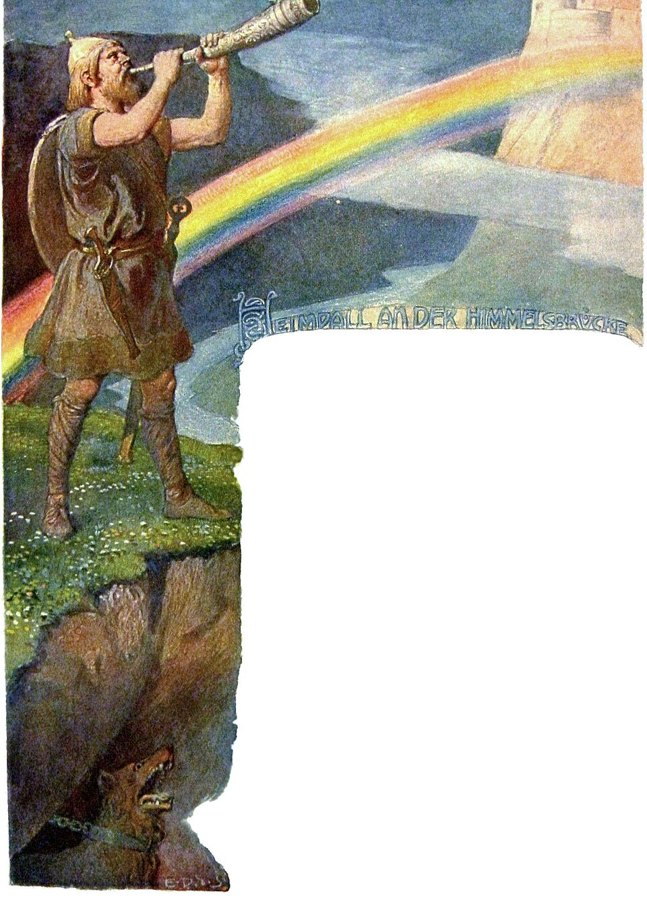
Heimdall's most recognizable role is the guardian whose extraordinary senses make surprise almost impossible. The Swedish History Museum summarizes the familiar literary portrait: he needs little sleep, sees in darkness, and hears grass and wool growing. His dwelling Himinbjörg stands beside the bridge Bifröst, and his horn announces the approach of the final conflict.
These details form a coherent narrative role without necessarily explaining every tradition about him. A watchman must detect movement before others can, and impossible hearing makes that duty imaginable on a cosmic scale. Yet the guardian does not simply prevent the catastrophe. Warning and rescue are different actions, and the final confrontation includes his own death in combat with Loki. The stories therefore portray exceptional awareness within limits. They should also be distinguished from evidence of worship: the museum notes the scarcity of secure cult evidence, which prevents a confident reconstruction of his everyday religious importance.
Sources for this section: 1
Nine mothers belong to a genealogical poem
Hyndluljóð survives in the late-fourteenth-century Flateyjarbók. Within its account of descent, a powerful figure is born from nine giant maidens at the world's edge; subsequent stanzas list their names and describe strengthening through earth, sea, and boar's blood. The figure is conventionally identified as Heimdall, with support from other references to his nine mothers.
Edward Pettit's edition also distinguishes the surviving poem from the possible earlier unit called Völuspá hin skamma, or the Short Prophecy of the Seeress. The exact relationship remains uncertain. That textual setting matters: the passage is concerned with origins and relationships, rather than explaining how a watchman performs his duties. Identifying the mothers as sea waves is an interpretation, not an explanation delivered plainly by the stanza. Even the phrase locating the birth at the world's edge admits different spatial readings. A list of names can preserve important tradition while leaving its narrative connections elusive.
Sources for this section: 2

Rígr and the authority of a prose introduction
Rígsþula describes a divine visitor moving through households associated with different social ranks. Its surviving manuscript, the mid-fourteenth-century Codex Wormianus, has an incomplete text. The visitor calls himself Rígr; the identification with Heimdall comes from the prose introduction, not from an explicit declaration repeated throughout the verse.
Pettit emphasizes why that distinction matters. The wandering figure's knowledge, aliases, and relationship to elite authority also resemble features associated elsewhere with Odin. Scholars have therefore questioned whether the prose identification belongs to the poem's earliest form. Whatever its origin, the surviving framing makes Heimdall part of a genealogy of social difference. That is not a neutral census of Scandinavian households. The poem represents hierarchy through bodies, work, food, and descent, giving the arrangement divine authorization. A reader should therefore distinguish the story's ideological construction of society from evidence that everyone recognized the same god as an ancestor.
Sources for this section: 3
Hearing, silence, and a difficult word
A particularly obscure Völuspá passage places Heimdall's hljóð beneath the sacred tree. Translation changes the apparent picture: the word's range includes hearing, sound, and silence, while rendering it as a horn supplies a concrete object familiar from his other appearances. In a 1935 study, Jan de Vries challenged the assumption that the horn interpretation could simply be treated as settled vocabulary.
His discussion belongs to a long history of competing reconstructions, and his own larger theories should not be mistaken for consensus. The linguistic question remains instructive in its own right. If a translation selects an instrument, readers imagine something deposited; if it selects hearing or silence, they confront a different and less easily pictured relationship. A polished retelling can conceal that choice. Keeping the Old Norse term visible at this point reminds readers that some uncertainty arises from the words themselves, before any broader theory of Heimdall's identity is attempted.
Sources for this section: 4
A possible name on a working object
The Saltfleetby spindle whorl brings the discussion into a different kind of evidence. This small lead object from Lincolnshire bears Scandinavian runes that appear to mention Odin and possibly Heimdall. The University of Nottingham's Vikings in the East Midlands project presents a proposed reading in which named powers help a person called Úlfljót, while stressing uncertainties in interpretation and dating.
The object is especially interesting because its function belongs to textile production rather than an illustrated mythological book. If Heimdall is indeed named, the inscription would show his name operating in a setting unlike the cosmic watchman's literary station. But neither the object nor a short inscription explains the complete circumstances of that appeal. Suggested dates span the late Viking Age and later centuries, and local manufacture is considered likely. The combination of a local object and Scandinavian writing points to cultural contact without requiring every aspect of its use to have arrived from Scandinavia.
Sources for this section: 5
Invocation does not identify a whole religion
Judith Jesch's reconsideration of the Saltfleetby inscription argues that it may belong as late as the later eleventh or twelfth century. She also questions whether mentioning older divine names necessarily establishes that the user was a practitioner of a wholly non-Christian religion. Her argument concerns the relationship between linguistic evidence, object dating, and the interpretation of belief.
That distinction changes what the whorl can contribute to Heimdall's history. A name can remain available in a formula after religious institutions and public affiliations have changed. Equally, uncertainty about the user's religion does not make the inscription unimportant. It demonstrates why literary evidence and material evidence should meet through specific questions: is the name securely read, what action does the wording express, and what date can be defended? Heimdall emerges from this comparison as a figure encountered in several kinds of transmission, with the links between them still requiring explanation rather than automatic harmonization.
Sources for this section: 6
The Evidence
The sources below support this article. Interpretations and limits are explained in the text; this is not an exhaustive research review.
- Swedish History Museum, Heimdall: forefather of humankind ↗
- Edward Pettit, Hyndluljóð, stanzas35–38 and commentary ↗
- Edward Pettit, Rígsþula: edition and introduction ↗
- Jan de Vries, Studies in Germanic Mythology, Heimdall section6 ↗
- University of Nottingham, Saltfleetby spindle whorl ↗
- Judith Jesch, Further Thoughts on E18 Saltfleetby, research abstract ↗