
Beliefs & Stories · Deep dive
Frigg: Knowledge, Family, and the Power of What Remains Unsaid
In Brief
Frigg appears as Odin’s wife, a bereaved mother, and an effective strategist. Her limited surviving stories resist a simple portrait of passive domesticity.
On this page
A position within a divine householdKnowing fate without announcing itCunning in the frame of GrímnismálA much earlier parallel: Frea and the long beardsWhy Frigg and Freyja should not simply mergeDomesticity also has a modern historySourcesA position within a divine household
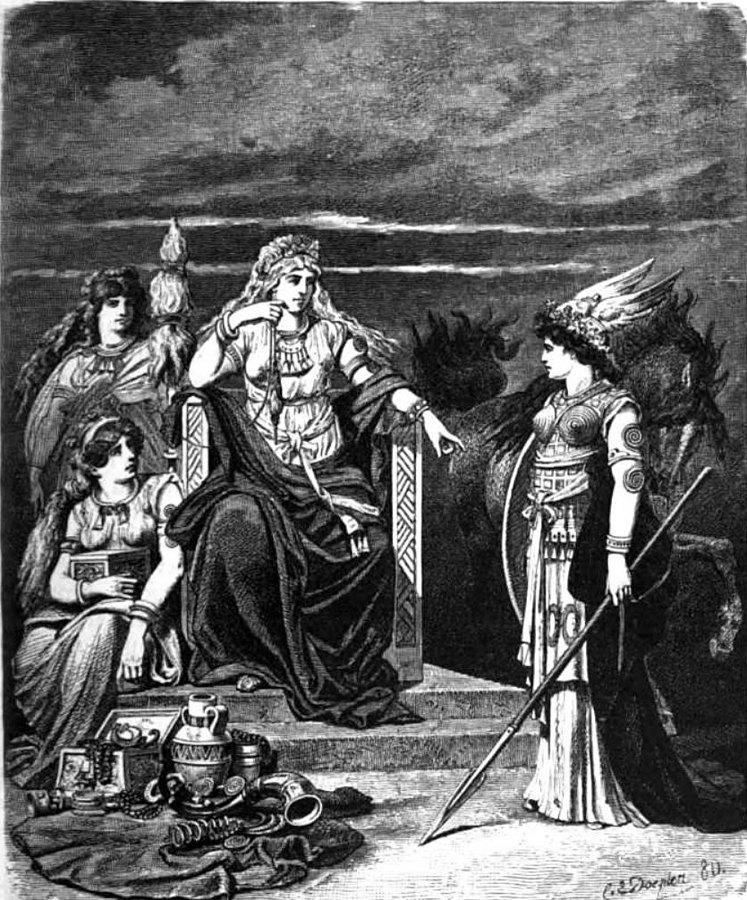
The Swedish History Museum presents Frigg as the leading goddess of Asgard, Odin's wife, and the mother of Baldr. Those relationships give her an important position in the surviving narratives, but the people around her also deserve attention. Fulla keeps her belongings and knows her secrets; Gna serves as a messenger; Hlin is associated with protection. Their activities give the impression of a household with delegated responsibilities rather than an isolated emblem of motherhood.
A household is a structure through which knowledge and action can move. A trusted attendant knows what outsiders do not, and a messenger can intervene somewhere her mistress is not physically present. Reading these relationships as narrative resources makes Frigg's status more concrete. It also avoids assuming that a modern summary such as goddess of marriage describes every aspect of a documented ancient cult. The literary household is visible in the sources; the ceremonies and social reach of her worship are much harder to recover.
Sources for this section: 1
Knowing fate without announcing it
In Lokasenna, the poem of Loki's insults at a divine feast, Frigg urges that old misconduct should not be spoken about. Loki responds with sexual accusations and then claims responsibility for her loss of Baldr. Frigg's appeal to the strength of a son like Baldr exposes the pain that Loki immediately exploits. The exchange is a scene of deliberate provocation, not a neutral catalog of divine biographies.
Freyja then says that Frigg knows everyone's fate although she does not disclose it. The contrast between knowledge and speech is crucial. Frigg's silence does not automatically mean ignorance or helplessness; neither does knowing an outcome necessarily imply the ability to prevent it. The poem supplies no general theory resolving that tension. Its dramatic force comes from placing an assertion of extraordinary knowledge beside bereavement and public humiliation. Readers should preserve that uncomfortable combination rather than inventing an explanation that makes Frigg either omnipotent or foolish.
Sources for this section: 2

Cunning in the frame of Grímnismál
The prose framing Grímnismál gives Frigg an active role in a contest with Odin over their human protégés. She challenges his favorable view of King Geirrödr and arranges a warning that makes the king suspicious of an arriving stranger. The stranger is Odin in disguise. What begins as an argument between the divine couple produces the god's mistreatment and a crisis in human kingship.
Henning Haglskær Kure interprets this framing story through an initiation model. His 2022 study proposes that it concerns the transformation of warrior behavior into authority suited to a society of peace. That is a scholarly reading, not an explicit explanation delivered by the medieval narrator. It nevertheless shows why reducing Frigg's intervention to a petty marital quarrel misses interpretive possibilities. Her manipulation changes the conditions under which rulers are tested. The narrative allows her to expose the limitations of Odin's chosen man, even though Odin delivers the poem's great speech.
Sources for this section: 3
A much earlier parallel: Frea and the long beards
The seventh-century Origo Gentis Langobardorum tells how the Winniles gained the name Lombards. Godan promises victory to the people he first sees at sunrise. Their opponents seek his favor, while the Winniles appeal to Frea. She advises their women to arrange their hair around their faces like beards, then turns Godan's bed so that he sees the assembled group when he wakes.
When he asks who the long-bearded people are, Frea presses the advantage: having given them a name, he should also give them victory. The story combines marital access, visual deception, naming, and a political outcome. Frea's relationship with Godan invites comparison with Frigg and Odin, but the account is a Lombard origin story from a different setting and period. It should not be inserted into an Icelandic myth collection as though it were another chapter by the same author. Its value lies in the comparison, including the distance between the witnesses.
Sources for this section: 4
Why Frigg and Freyja should not simply merge
Similarities between powerful goddesses have encouraged reconstructions of a single original Great Goddess. In a conference study, Ingunn Ásdísardóttir challenges the tendency to let that model erase the individual characteristics of Frigg and Freyja. Shared associations are a starting point for inquiry, not sufficient proof that every separate name once belonged to one deity. The model risks explaining away the differences before investigating them.
Ásdísardóttir's discussion treats fertility broadly but emphasizes that the two figures developed different portrayals, roles, and social settings in surviving tradition. Her reconstruction of their earlier histories remains an argument, particularly where the evidence is sparse. For reading the actual stories, a modest conclusion is firmer: the texts can place Frigg and Freyja together as different speakers and give them different relationships. Comparison becomes more productive when it asks what each figure does in a particular passage. A resemblance may reflect shared narrative functions without establishing a recoverable moment when one goddess split into two.
Sources for this section: 5
Domesticity also has a modern history
Kathleen Self's study of gender in the reception of Norse mythology draws attention to an additional layer: the interpreters between medieval texts and modern readers. In her account, Jacob Grimm's reworking develops Frigg's association with weaving, family, and domesticity. Later audiences can inherit that organized portrait without recognizing how much interpretation stands between it and individual medieval witnesses.
This does not make modern religious or artistic engagements illegitimate. It changes the historical question. A contemporary image of an ideal household goddess is evidence for contemporary meaning, while the sources need to be read on their own terms. Frigg's surviving portrait contains strategies, secrets, grief, challenges to her husband, and knowledge that is not publicly explained. Those elements do not fit neatly into a single domestic role. Reading them together yields a more interesting figure: one whose authority is sometimes exercised through speech, sometimes through intermediaries, and sometimes through the very distinction between knowing and telling.
Sources for this section: 6
The Evidence
The sources below support this article. Interpretations and limits are explained in the text; this is not an exhaustive research review.
- Swedish History Museum: Frigg—mistress of Asgard ↗
- Lokasenna, stanzas 25–29, translated by Henry Adams Bellows ↗
- Henning Haglskær Kure: Frigg’s Cunning (2022) ↗
- Origo Gentis Langobardorum, chapter 1, MGH edition at LacusCurtius ↗
- Ingunn Ásdísardóttir: Frigg and Freyja—One Great Goddess or Two? ↗
- Kathleen Self: Straightening Out the Gods’ Gender (2018), publisher abstract ↗