
Beliefs & Stories · Deep dive
Idunn: Stolen Youth, Apples, and a Story Preserved in Poetry
In Brief
The gods’ youth depends on Idunn, but the surviving evidence is more varied than a familiar picture of a goddess holding golden apples suggests.
On this page
A disappearance that changes every divine bodyWhat Haustlöng actually emphasizesA myth painted on a patron’s shieldIdunn speaks when the feast turns hostileA later poem should remain a later poemReal apples and the limits of archaeological confirmationSourcesA disappearance that changes every divine body
In the familiar account summarized by the Swedish History Museum, Loki helps the giant Thjazi abduct Idunn. The gods soon grow old without her and compel Loki to bring her back. Borrowing Freyja's feather garment, he reaches the giant's dwelling, transforms Idunn into a nut, and carries her away in bird form. Thjazi pursues them as an eagle and dies when the gods turn fire against him.
The remarkable feature is the vulnerability that precedes the rescue. Youth is not simply an intrinsic condition the gods possess forever. It depends on access to Idunn and the apples in her care. Losing one member therefore alters the bodies of the whole community. Loki's personal escape from danger creates a collective emergency, and his cleverness must repair a crisis that cleverness helped produce. Idunn has little direct speech in this adventure, but narrative silence is not the same as insignificance: the entire sequence turns on recovering her.
Sources for this section: 1
What Haustlöng actually emphasizes
The skaldic poem Haustlöng, attributed to Thjodolf of Hvinir, gives an earlier poetic form of the episode preserved in medieval transmission. In stanza 9, Idunn is the woman who knows the gods' remedy against old age. The stanza does not explicitly name apples. The following verse contrasts the giants' satisfaction at her arrival with the gods, now gray and aged, gathering in assembly.
That difference should neither be ignored nor forced into a claim that the poet knew nothing about apples. Compressed verse can refer indirectly to something its audience recognizes. What the wording securely foregrounds is her knowledge and the effect of her removal. The gods then constrain Loki to recover her, and the pursuit ends in the giant's burning. Reading the sequence on its own terms makes the loss of youth bodily and communal. It also separates the poem's compact expressions from details supplied by a later prose explanation of the same adventure.
Sources for this section: 2
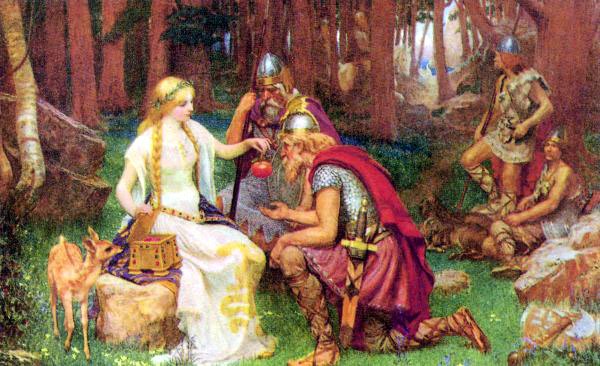

A myth painted on a patron’s shield
Haustlöng belongs to the tradition of shield poetry: the poet describes mythological scenes associated with a decorated shield and acknowledges its giver. Margaret Clunies Ross calls attention to the double focus of such poetry. A narrative about gods simultaneously answers a patron's gift with an elaborate verbal performance. The audience attends both to the myth and to the relationship between the poet and the human giver.
This setting helps explain why the language is densely allusive rather than a straightforward lesson about belief. Clever descriptions demonstrate poetic skill, while shifts between the picture, its narrative, and the gift keep several relationships active. Clunies Ross also examines the irony and grotesque effects of skaldic mythological verse. The spectacle of gods becoming physically unattractive and a powerful enemy being burned can be aesthetically pointed as well as religiously meaningful. The poem is a crafted performance whose tone deserves attention alongside the events it preserves.
Sources for this section: 3
Idunn speaks when the feast turns hostile
Maria Cristina Lombardi's study of rejuvenation traditions also examines Idunn's appearances in Lokasenna. Here she speaks as Bragi's wife, asking him to avoid a quarrel with Loki. Her appeal invokes relationships among the participants. When Loki turns his insults on her, she restates that her purpose is to calm Bragi and prevent fighting rather than to retaliate with an accusation of her own.
Loki alleges that she embraced her brother's killer, but neither the brother nor the episode can be securely reconstructed from another surviving account. Filling that silence with an invented family history would turn a tantalizing allusion into false certainty. Her response, by contrast, is present on the page and can be analyzed directly. She tries to preserve a social gathering threatened by escalating speech. That role complements the abduction story in an interesting way: in one narrative the gods require her bodily presence, while in another she works to maintain their relationships through measured words.
Sources for this section: 4
A later poem should remain a later poem
Hrafnagaldur Óðins gives Idunn another, stranger role. Odin sends figures including Heimdall, Loki, and Bragi to seek information from her, but she cannot supply the needed answer and weeps. This apparent addition to the mythological archive has a different status from the medieval witnesses. Annette Lassen's critical edition argues that the work is postmedieval, probably composed in the seventeenth-century revival of interest in eddic poetry.
The surviving manuscript record and features of its language matter more than its old-sounding names and meter. A poem can imitate an inherited style convincingly enough to enter collections without being a Viking Age composition. Its Idunn remains worth reading as evidence of how later writers imagined the gods and their approaching doom. It should not silently provide missing details for an ancient biography. Keeping the chronology visible allows the tradition to grow across time without making every stage equally early or collapsing literary invention into recovered religious history.
Sources for this section: 5
Real apples and the limits of archaeological confirmation
The Swedish archaeological organization Arkeologerna points out that apples are less common in Viking Age finds than modern themed menus might suggest. Its discussion distinguishes the wild apples from Oseberg from a small number of finds identified as cultivated apples in Denmark and Scania. It also explains a technical difficulty: differences in seed size overlap, making the separation of wild and cultivated forms less straightforward than a simple label implies.
These finds establish a material setting in which apple stories could be understood. They do not demonstrate that a particular buried fruit was an offering to Idunn, or that every apple carried the same meaning. Food can have nutritional, social, funerary, and symbolic significance at once. A familiar fruit could also invite imagination about extraordinary varieties and properties. The strongest comparison keeps those scales distinct: surviving plant remains reveal something people possessed, while the literary apples explain how divine bodies could resist aging.
Sources for this section: 6
The Evidence
The sources below support this article. Interpretations and limits are explained in the text; this is not an exhaustive research review.
- Swedish History Museum: Idun—gudinnan för ungdom och livskraft ↗
- Haustlöng, Old Norse text and Danish translation, Finnur Jónsson edition ↗
- Margaret Clunies Ross: Style and Authorial Presence in Skaldic Mythological Poetry, Saga-Book XX ↗
- Maria Cristina Lombardi: Ageing and Myths of Rejuvenation (2022) ↗
- Annette Lassen: Hrafnagaldur Óðins, critical edition (2011) ↗
- Arkeologerna: Älskade äpple, archaeological discussion of apples ↗