
Beliefs & Stories · Deep dive
Freyr: Lordship, Fertility, and the Limits of Identifying a God
In Brief
Freyr is associated with prosperity and royal ancestry, but identifying his image requires more than finding a figure with an emphatic body.
On this page
What does the name explain?An ancestor useful to rulersAdam of Bremen and the image at UppsalaLooking carefully at the Rällinge figureDevotion tested in Hrafnkels sagaA broken arm changes the questionSourcesWhat does the name explain?
Freyr is often introduced as a fertility god. That description captures part of the surviving tradition, but can quietly become an argument about everything else: his name, his political significance, and the identity of archaeological objects. Olof Sundqvist's study of the name examines a different starting point. Its generally accepted connection is with a Germanic word meaning lord, although an alternative derivation relating it to fertility has also been proposed.
The distinction matters because an attractive interpretation of a god's character cannot settle a linguistic question. Sundqvist argues that lordship fits aspects of Freyr neglected by a narrow fertility label, including political authority, peace-making, and martial associations. A name can function as a title without revealing an original, complete divine identity behind it. Beginning with lord rather than with agriculture therefore opens the inquiry: prosperity might be part of the power expected of a successful ruler, instead of defining a wholly separate sphere from rulership.
Sources for this section: 1
An ancestor useful to rulers
Sundqvist's research on religious ruler ideology identifies Freyr as an explicit divine ancestor in Ynglingatal's language about the royal family. Later accounts also connect him with the Ynglingar. Such claims should be understood as statements about legitimate ancestry, not treated as entries in a biological genealogy. A ruling lineage presented as descended from a god occupies a different imaginative position from rivals with merely human forebears.
Place-names add another dimension to the argument. Sundqvist discusses names containing Frö in the Lake Mälaren region, including examples associated with central places and administrative organization. These support a regional connection between the god and social authority, although an individual name cannot tell us the ceremonies performed there. The conjunction is more informative than either strand alone: poetic descent claims and names embedded in a political landscape make it difficult to reduce Freyr to the private hopes of individual farmers for a productive harvest.
Sources for this section: 2

Adam of Bremen and the image at Uppsala
Writing in the 1070s, Adam of Bremen describes three divine images at Uppsala. His Fricco, conventionally identified with Freyr, grants peace and pleasure and is represented with an exceptionally prominent phallus. Adam also associates offerings to this figure with marriage celebrations. Those details have strongly influenced the modern identification of small Scandinavian figures, but they belong first to a particular Latin description.
Adam's wording distinguishes the three gods through contrasting powers and appearances. His comparisons of other figures with Mars and Jupiter reveal an explanatory framework intended for readers familiar with classical and Christian learning. His opening language also openly condemns the religion he describes. Neither feature makes every detail worthless; both affect how the description should be used. The passage provides evidence for an eleventh-century representation of a sexualized divine image. It does not provide a universal identification guide for every miniature male body found anywhere in Scandinavia.
Sources for this section: 3
Looking carefully at the Rällinge figure
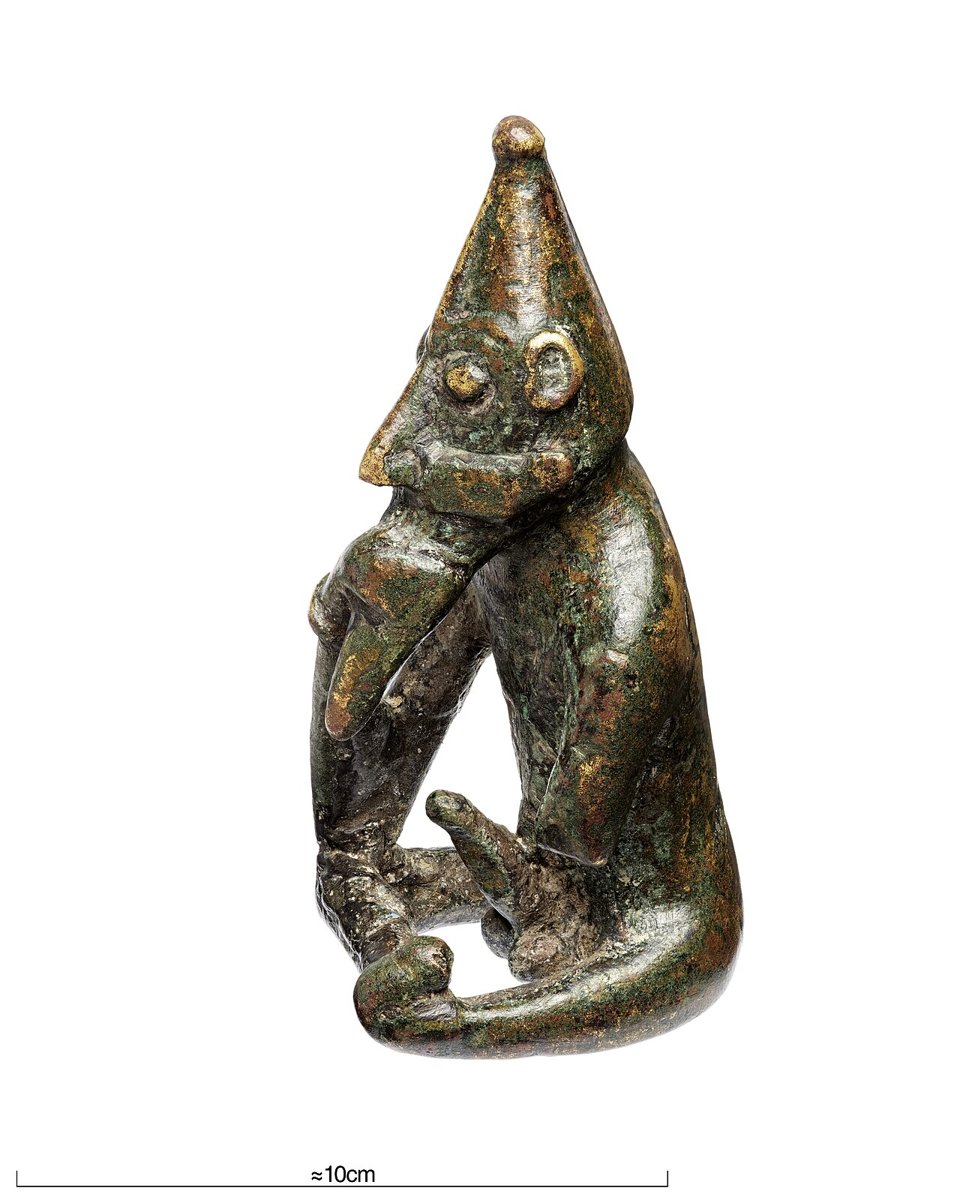
The Swedish History Museum catalogs the Rällinge statuette as Freyr and dates it broadly to the Viking Age. The seated copper-alloy figure is naked apart from a pointed head covering, with an erect penis, conspicuous eyes, and a long beard held by one hand. Part of the other arm is missing. Spiral decoration on the back introduces a detail easily overlooked when photographs concentrate on the figure's front.
The object was discovered at Rällinge in Södermanland in 1904, but surviving accounts of its discovery differ. That weakens any attempt to reconstruct its original setting from the find story. Its resemblance to Adam's description supplies a plausible reason for the traditional identification. Yet resemblance is an interpretive bridge between different kinds of evidence, not an inscription naming the figure. A museum label usefully communicates a well-established interpretation; close examination should still distinguish what is physically visible from the story used to explain it.
Sources for this section: 4
Devotion tested in Hrafnkels saga
In the medieval Hrafnkels saga Freysgoða, attachment to Freyr becomes part of a story about power and its reversal. Hrafnkell shares his most valued possessions with the god and dedicates half of his horse Freyfaxi to him. An oath to kill anyone who rides the horse without permission turns devotion into a dangerous obligation. The religious relationship is inseparable from the character’s authority over other people.
Later, his enemies destroy the horse and burn the sanctuary. Hrafnkell responds by abandoning sacrifice and declaring his former trust in the gods worthless. The sequence refuses a simple equation between piety and worldly success: he continues rebuilding his position after that rejection. This is a crafted narrative about a powerful man, not a transcript of an actual worshipper’s testimony. Its Freyr connection nevertheless demonstrates a literary possibility easily lost in a static fertility label: devotion can involve property, allegiance, violence, disappointment, and a deliberate change of commitment.
Sources for this section: 5
A broken arm changes the question
A 2025 study by Marianne Hem Eriksen and colleagues examined miniature figures through microscopy and Reflective Transformation Imaging. The Rällinge statuette showed signs of working after casting, including the addition of decorative grooves. Differences in the execution of its back decoration raised the possibility that making or modifying it occurred over multiple episodes. Unlike most objects in their sample, it lacked an obvious attachment device.
The broken arm proved especially revealing. The researchers could not determine whether the break was accidental or intentional, but observed evidence that the fractured area had subsequently been reworked and smoothed. Someone apparently continued engaging with the altered figure instead of simply restoring its original appearance. This does not solve the question of Freyr's identity. It supplies a different historical achievement: evidence about what people did with the object. The miniature gains a history of manufacture and alteration, making it more than a static illustration pasted beside a medieval god's name.
Sources for this section: 6
The Evidence
The sources below support this article. Interpretations and limits are explained in the text; this is not an exhaustive research review.
- Olof Sundqvist: On Freyr—the Lord or the fertile one? (2013), publisher abstract ↗
- Olof Sundqvist: Religious Ruler Ideology in Pre-Christian Scandinavia (2024) ↗
- Adam of Bremen, Book IV chapters 26–27: Latin text and English translation ↗
- Swedish History Museum: Rällinge statuette, object 109037_HST ↗
- Hrafnkels saga Freysgoða, translated by John Coles (1882) ↗
- Eriksen and colleagues: Viking body-making (Antiquity, 2025) ↗