
Beliefs & Stories · Deep dive
Njord: Sea Wealth, Hostages, and the Problem of the Vanir
In Brief
Njord connects maritime prosperity with a difficult question: how far can the surviving poems support the divine families familiar from modern mythology books?
On this page
A maritime god with a wider horizonA hostage in a contest of knowledgeProsperity translated into royal historyNjord in the landscape: the Nærå problemWhy the Vanir became controversialReading poetic vocabulary before drawing bordersSourcesA maritime god with a wider horizon
The National Museum of Denmark describes Njord as a deity associated with wind and water and a protector of sailors and fishermen. That compact description explains why its maritime research center bears his name. It also points toward a useful historical distinction: maritime wealth includes more than spectacular voyages. Fishing, movement between coasts, and the conditions under which a vessel reaches its destination all belong to the same economic horizon.
Calling Njord a sea god is therefore helpful as an introduction, but less helpful if it becomes an exclusive job description. A connection with successful travel does not tell us exactly who prayed to him, which offerings they made, or whether communities along different coasts understood him identically. The museum's modern use of his name is itself an act of selection: it emphasizes a maritime association for a maritime institution. Medieval accounts also place Njord within stories about kinship, political settlement, and prosperity on land.
Sources for this section: 1
A hostage in a contest of knowledge
In Vafþrúðnismál, Odin and the giant Vafthrudnir exchange questions about the world. Stanzas 38–39 single out Njord's unusual position: he has shrines or temples among the gods, although he did not originate among them. The answer places his origin in Vanaheim and says that he was delivered to the gods as a hostage. It also anticipates a return at the world's end.
The passage is brief, but its structure matters. Origin, present membership, and future destination need not coincide. Njord belongs in the gods' community without having begun there, and his movement is explained through an arrangement recognizable from political relationships. Yet the poem does not give a complete history of that settlement. It names neither all the negotiators nor a detailed sequence of battles. Reading the stanza before a modern family tree preserves its particular interest: a knowledgeable speaker explains why an apparently anomalous member nevertheless occupies an honored place.
Sources for this section: 2

Prosperity translated into royal history
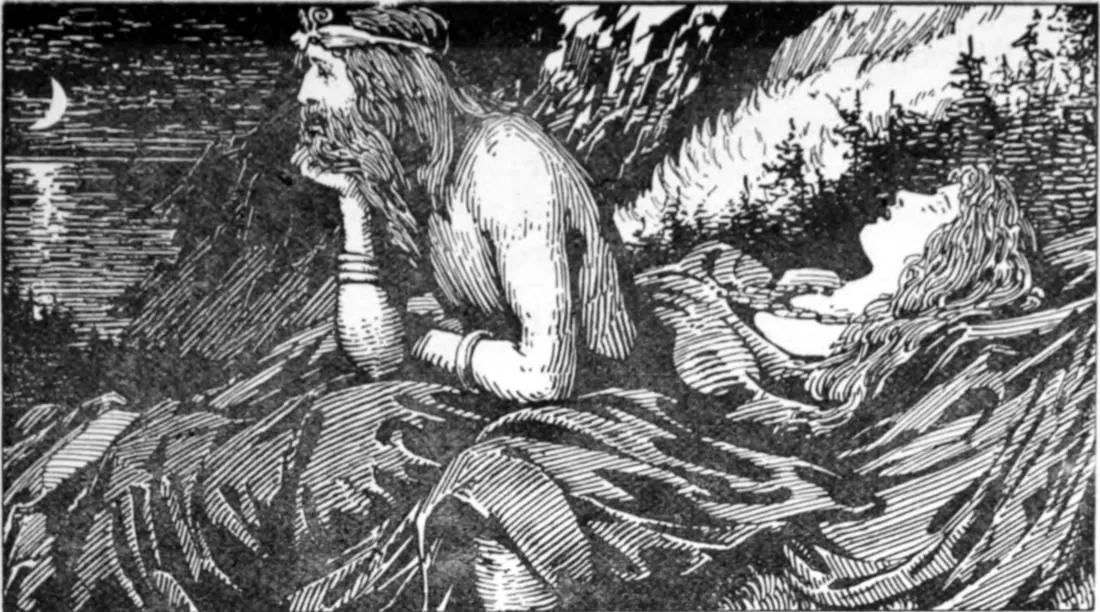
Ynglinga saga, the opening part of the thirteenth-century Heimskringla traditionally attributed to Snorri Sturluson, presents the gods as figures in an ancestral history. Njord succeeds Odin as a ruler associated with Sweden. His reign brings peace and good seasons, and the account connects the population's prosperity with their confidence in his power. Sacrifice and political authority appear together rather than in separate religious and administrative compartments.
The death scene extends that transformation. Njord dies from illness, receives a spear marking associated with Odin, and is cremated and mourned. This is not the narrative of an immortal departmental god simply controlling the sea. It is a literary account that makes divine tradition intelligible as succession, rule, and funerary memory. Its evidence is strongest for the medieval arrangement of those themes. Treating the reign as a recoverable political chronology would mistake the saga's explanatory framework for a contemporary record of an actual ruler.
Sources for this section: 3
Njord in the landscape: the Nærå problem
At Nærå on Funen, place-name research and excavation offer a different kind of evidence. A medieval form of the name, recorded in 1304, has been interpreted as referring to Njord's mound. Archaeologists Jesper Hansen and Michael Borre Lundø discuss possible locations, including the church hill and a Bronze Age mound southeast of it. The name does not identify its original feature with complete certainty.
Excavation around the settlement revealed extensive Iron Age building traces, predominantly from approximately 150–550 CE. Two small buildings oriented differently from the ordinary houses prompted discussion of a possible special function. Their contents, however, did not establish that they were cult buildings. The distinction is essential: a potentially divine place-name can make a ritual interpretation worth investigating, but cannot independently label every unusual nearby structure. Conversely, uncertainty about a particular building does not erase the linguistic evidence. Each strand supplies a different question rather than a ready-made answer to the other.
Sources for this section: 4
Why the Vanir became controversial
Modern introductions commonly place Njord, Freyr, and Freyja in a separate divine family called the Vanir. In his provocative 2010 article, Rudolf Simek questioned how securely the surviving evidence supports that category. He emphasized the rarity of the word outside restricted poetic contexts and Snorri's importance in presenting the Vanir as a distinct people. His argument challenged a familiar assumption, not the existence of the named gods in the texts.
The debate also exposes a problem with dividing all divine activity into agriculture on one side and warfare on the other. Figures assigned to those categories do not remain within them. A prosperous ruler can be connected with battle; a deity associated with war can participate in narratives of generation or fertility. Simek's interpretation should be presented as an argument open to examination. Its enduring value for a reader is methodological: a convenient modern classification must be tested against the distribution and wording of the actual witnesses.
Sources for this section: 5
Reading poetic vocabulary before drawing borders
Frog and Jonathan Roper's 2011 study approached vanir through poetic composition. They observed that its occurrences in eddic verse consistently participate in alliteration and occupy unusually restricted positions. A word can survive because it fits a traditional line even when its meaning is less precise than a modern taxonomy requires. Their analysis found the poetic evidence compatible with Simek's challenge, while stopping short of declaring the riddle solved.
For Njord, this makes the wording of Vafþrúðnismál especially important. The relationships among Vanaheim, the wise powers, the recipient gods, and the anticipated homecoming are not clarified simply by capitalizing group names in translation. Different readings remain possible. A careful account can therefore retain the familiar Vanir label while explaining its limitations. Njord's literary identity is sufficiently substantial without manufacturing an entire uniform religious system around him: maritime association, wealth, hostage status, family relationships, and royal memory form overlapping lines of evidence rather than a single surviving creed.
Sources for this section: 6
The Evidence
The sources below support this article. Interpretations and limits are explained in the text; this is not an exhaustive research review.
- National Museum of Denmark: About the Njord maritime research center ↗
- Vafþrúðnismál, stanzas 38–39, translated by Henry Adams Bellows ↗
- Ynglinga saga, translated by Samuel Laing ↗
- Hansen and Lundø: Nærå og Njords høj, Museum Odense ↗
- Rudolf Simek: The Vanir: An Obituary, RMN Newsletter 1 (2010) ↗
- Frog and Jonathan Roper: Verses versus the Vanir, RMN Newsletter 2 (2011) ↗