
Beliefs & Stories · Deep dive
Týr, Fenrir, and the Cost of Binding the Wolf
In Brief
The gods obtain safety through a promise they will not keep. Týr’s lost hand exposes the price of that success and the difficulty of assigning a single function to a poorly documented god.
On this page
Strength is not enough to hold the wolfA missing hand becomes a weapon in argumentThe older image needs its own historyWhy a god of law is not a settled labelA competing reading places the conflict in the skyA vivid illustration may be much later than its subjectSourcesStrength is not enough to hold the wolf
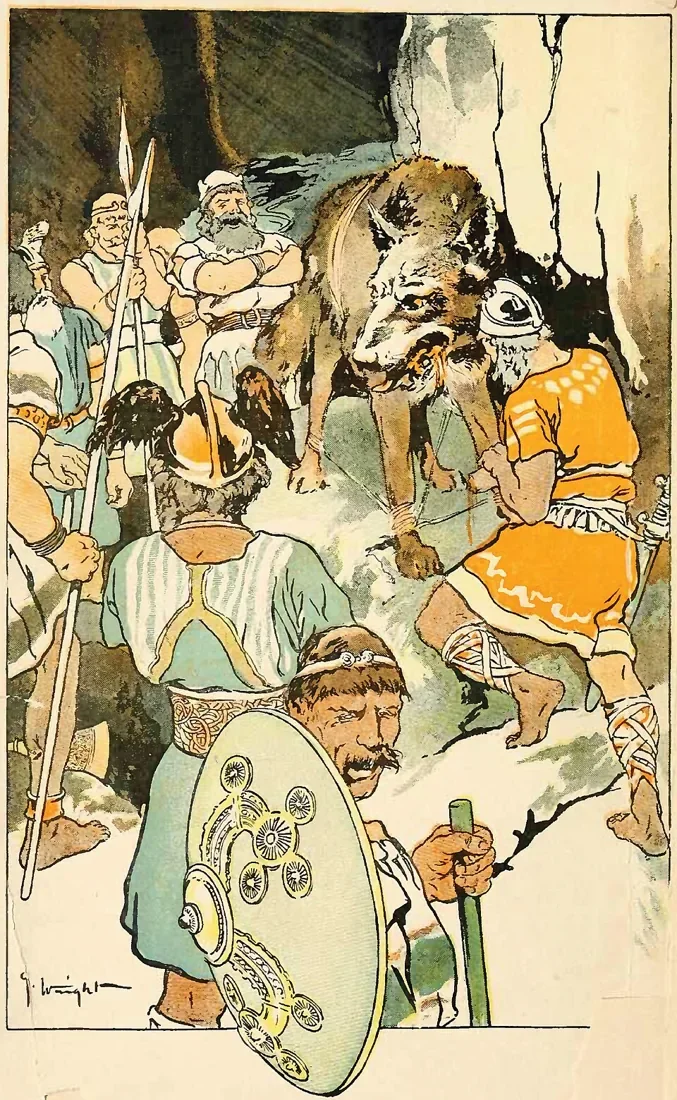
In Snorri's Gylfaginning, the gods raise Fenrir among themselves, and Týr alone dares to feed him. Their alarm grows with the wolf. Two powerful fetters fail before dwarfs make Gleipnir from impossible ingredients, including a cat's footfall and a mountain's roots. The new restraint looks deceptively slight, making Fenrir suspicious rather than reassured.
He agrees to try it only if someone places a hand in his mouth as a guarantee. Týr provides the pledge. Once the gods refuse to release the bound wolf, Fenrir bites the hand off. The episode makes ingenuity, deception, and bodily risk cooperate where force has failed. Calling it simply a victory over a monster loses its difficult center: the gods secure an advantage through a guarantee whose apparent meaning they do not honor. Týr's injury is therefore part of the mechanism of success, not an incidental wound received in battle.
Sources for this section: 1
A missing hand becomes a weapon in argument
Lokasenna gives the injury a different setting. During Loki's verbal confrontation with the gods, Týr defends Freyr. Loki responds by invoking the right hand Fenrir tore away. Týr answers that both sides have suffered: he lacks a hand, while Loki is deprived of the wolf, who remains bound until the final crisis.
The exchange does not retell the binding in full. It relies on an audience recognizing enough of the story to understand an insult and its reply. This provides an independent poetic use of the episode, but not independent confirmation of every detail in Snorri's prose. Edward Pettit's edition also marks uncertainty in the phrase commonly translated as making peace between two parties. The passage has encouraged legal interpretations of Týr, yet a taunt spoken by Loki is not a neutral description of a divine office. The dramatic speaker and the debated wording both matter.
Sources for this section: 2

The older image needs its own history
A gold bracteate found near Trollhättan in 1844 shows a human figure with a hand at the mouth of a wolflike creature. Morten Axboe and Magnus Källström discuss its identification as Týr and Fenrir, an interpretation proposed long before their 2013 study. The other side carries intertwined creatures, connecting the object with a wider repertoire of animal imagery.
If the identification is correct, the bracteate would supply an image of the episode centuries before the medieval manuscripts. But the image does not name its participants, and recognizing the later story remains an interpretive step. The authors also situate the human figure within designs influenced by Roman imperial imagery. That context prevents the object from becoming merely a miniature illustration of the Edda. Its maker worked with inherited visual conventions as well as local meanings. Object date, artistic ancestry, and narrative identification are three related but distinct forms of evidence.
Sources for this section: 3
Why a god of law is not a settled label
Klas Wikström af Edholm argues that the surviving Old Norse evidence presents Týr most securely through martial associations. His study of Tissø brings textual evidence into discussion with the place-name, commonly interpreted as Týr's lake, and weapons deposited in the water. He challenges reconstructions that give linguistic ancestry greater weight than the later Scandinavian sources themselves.
The methodological issue is wider than choosing a label. A name related to words for sky or deity may preserve a very old linguistic history without demonstrating the same role in every later community. Conversely, weapons and a divine place-name can support a connection without identifying each act of deposition or its participant's intention. The attractive modern portrait of Týr as a perfectly defined judge or lawgiver therefore requires argument. The binding narrative certainly involves a pledge, but one story about an obligation does not automatically establish a comprehensive jurisdiction over law.
Sources for this section: 4
A competing reading places the conflict in the sky
Eldar Heide offers a different reconstruction, arguing that celestial associations remained important later than the martial interpretation allows. He connects the restrained wolf with traditions about wolves threatening the sun, and brings together place-names, weekday terminology, celestial names, and the atmospheric phenomenon of parhelia, or bright spots beside the sun.
This is an interpretive model, not an explicit explanation supplied by the medieval binding story. Its value for readers lies partly in showing why the same limited evidence can support competing accounts of a god's significance. One argument emphasizes the strongest direct descriptions of Týr; another seeks a pattern connecting scattered traditions. Evaluating them requires following each connection separately. A linguistic resemblance, an astronomical phenomenon, and a mythic action do not all provide the same kind of proof. The disagreement should remain visible rather than disappear into an encyclopedia sentence presenting one reconstruction as established ancient belief.
Sources for this section: 5
A vivid illustration may be much later than its subject
The University of Victoria's MyNDIR repository identifies an illustration of Fenrir with Týr's severed hand in the manuscript SÁM 66 4to. Jakob Sigurðsson made the image in 1765. The manuscript is a hand-copied paper Edda, also known as the Melsteð Edda, rather than a Viking Age or thirteenth-century picture book.
That precise attribution matters because striking mythological illustrations are frequently detached from their dates. The image documents an eighteenth-century Icelandic artist's engagement with inherited literature. It can clarify a familiar narrative moment, but it cannot independently confirm how Viking Age worshippers imagined the scene. Placed beside the Trollhättan bracteate, it also illustrates the unequal security of identifications. The later picture belongs to a documented Edda manuscript; the earlier object's narrative interpretation must be inferred. Both are valuable, but they answer different questions about the enduring fascination of the wolf, the pledge, and its human cost.
Sources for this section: 6
The Evidence
The sources below support this article. Interpretations and limits are explained in the text; this is not an exhaustive research review.
- Snorri Sturluson, Gylfaginning, Rasmus B. Anderson translation ↗
- Edward Pettit, Lokasenna 37–41 and commentary ↗
- Morten Axboe and Magnus Källström, Gold Bracteates from Trollhättan ↗
- Klas Wikström af Edholm, The War God Týr and Tissø, author abstract ↗
- Eldar Heide, Týr and Viðarr: Equinox, Wolves and Old Norse Celestial Traditions ↗
- University of Victoria, The Binding of Fenrir, SÁM66 folio78v ↗