
Beliefs & Stories · Deep dive
Baldr’s Death: Why the Surviving Accounts Disagree
In Brief
A blind brother, a jealous rival, a grieving mother, and a journey to the dead belong to different tellings. Keeping those tellings distinct reveals more than combining them into one seamless myth.
On this page
The poem asks about a death still to comeSnorri makes protection depend on a missing oathSaxo’s Hother is an active rivalObscurity can be part of the poem’s designEven the Edda does not have one uniform wordingComparison needs more than a dying godSourcesThe poem asks about a death still to come
Baldrs draumar survives in the manuscript AM 748 I a 4to rather than the Codex Regius collection. Its composition date is unknown. In this short poem, alarming dreams lead Odin to ride into the realm of the dead and compel a buried seeress to answer him. The encounter concerns preparations for Baldr's arrival, his killer, and the avenger who will follow.
The sequence is prospective: a father asks about a catastrophe that has not yet occurred within the narrative. It differs from an account of someone trying to retrieve Baldr after his death. Edward Pettit's edition places the poem beside related Eddic references while distinguishing their different speakers and structures. That is a useful starting point for readers. Shared names and events establish connections, but they do not make each text a surviving chapter of one lost original. The poem's economy also presupposes knowledge that it never fully supplies.
Sources for this section: 1
Snorri makes protection depend on a missing oath
In Gylfaginning, part of Snorri Sturluson's early-thirteenth-century Edda, Frigg obtains promises that things will not harm Baldr. The gods then amuse themselves by attacking him harmlessly. Loki discovers that mistletoe has been omitted and guides the blind Höðr in throwing it. The very demonstration of safety becomes the setting of the fatal injury.
This version concentrates agency in several places. Frigg's protective effort contains an exception; Loki deliberately exploits it; Höðr performs the final act without seeing his target. The gods' response moves from speechlessness to grief, while the sanctity of the meeting place prevents immediate vengeance. These details make a densely organized narrative about failed protection and restricted action. They should be attributed to this account rather than distributed automatically across every poem mentioning Baldr. The distinction between the person directing the attack and the person physically delivering it is especially important when comparing other versions.
Sources for this section: 2
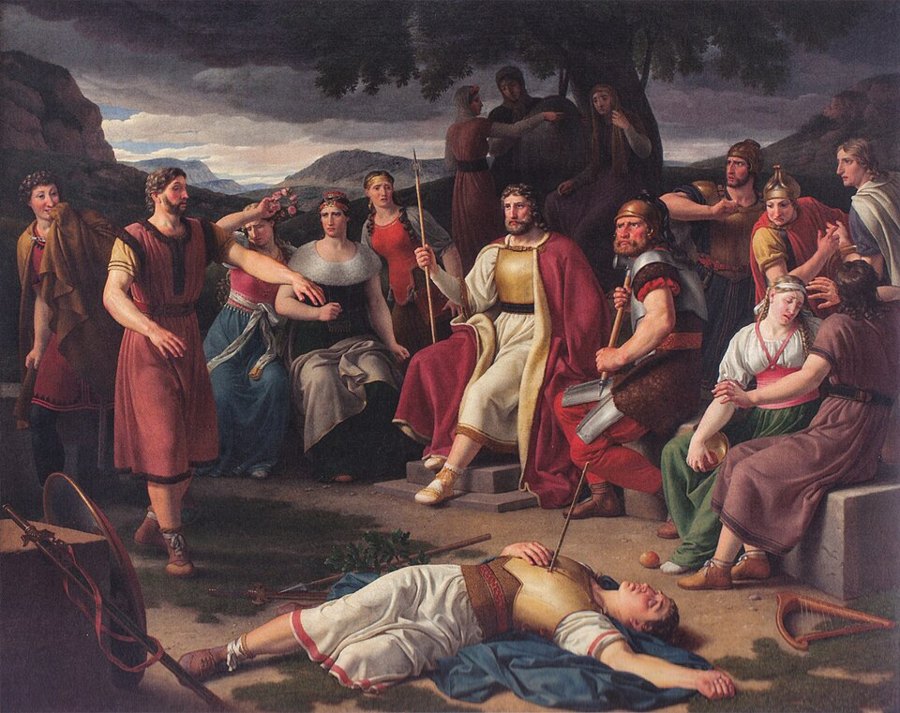

Saxo’s Hother is an active rival
Book Three of Saxo Grammaticus's Gesta Danorum presents a substantially different conflict. Hother is a capable warrior, and Balder is his rival for Nanna and political power. Nanna rejects Balder's suit; she is not simply the wife who dies beside him in Snorri's funeral narrative. Battles and changes of fortune extend the rivalry across a much larger story.
Hother acquires a special sword and eventually wounds Balder, who dies afterward. There is no need for a blind thrower guided by Loki: Hother's own campaign supplies the action. Saxo also explains that his use of the word gods follows inherited naming rather than an acceptance of their divinity. His Christian historical framework is therefore visible within the account. Reading him merely as an imperfect witness to Snorri misses the central difference. Saxo's version is organized around rivalry, kingship, and heroic action, giving the killer an entirely different narrative position.
Sources for this section: 3
Obscurity can be part of the poem’s design
Mats Malm argues that Baldrs draumar becomes more intelligible when read as a literary encounter rather than only mined for mythological facts. Odin conceals his identity, asks a series of questions, and reaches a final exchange that exposes who he is. The dialogue recalls contests of knowledge, but its ending does not offer an explanatory key to every uncertainty.
The seeress is both in the realm of the dead and buried there, while her speech evokes weather and exposure. Attempts to turn these images into a perfectly consistent map can obscure their effect. Malm emphasizes suggestion and the listener's recognition of inherited material. On this reading, gaps are not necessarily damaged information awaiting repair from Snorri. They help create apprehension and compel the audience to supply associations. That approach does not solve every textual puzzle, but it explains why a poem can be powerful without functioning as an orderly mythological handbook.
Sources for this section: 4
Even the Edda does not have one uniform wording
Kristen Mills draws attention to a smaller but revealing difference within the manuscript tradition of the Prose Edda. In the Uppsala version, Hermóðr makes his request for Baldr's release, but the narration does not explicitly identify Hel as the person who sets the condition of universal weeping in the same way as other recensions do.
This does not prove that the Uppsala text rejects a goddess Hel. It shows why apparently straightforward statements about an author's account may depend on the version being read. The destination, the ruler, and the terms of an agreement are separable pieces of narrative information. A modern synthesis can quietly supply one of them from another witness and thereby conceal the difference. For a careful comparison, the question is not only whether Saxo differs from Snorri. It is also which Edda text, which passage, and which explicit wording support the reconstruction being offered.
Sources for this section: 5
Comparison needs more than a dying god
Anatoly Liberman cautions against treating resemblance to distant myths as an explanation by itself. Placing Baldr alongside other dying gods establishes a broad category, but it does not demonstrate how a particular Scandinavian narrative developed. A proposed connection must explain meaningful details and a plausible relationship, rather than accumulate similarities that lead nowhere.
That caution also applies inside the northern evidence. Differences should first be described before scholars decide whether they result from adaptation, independent tradition, or a misunderstood earlier story. The surviving accounts allow firm observations: Baldr's death matters greatly, his killer's role varies, and later consequences are narrated differently. They do not allow every stage of transmission to be recovered. A useful reading therefore preserves two scales of inquiry. Close attention explains what each account achieves; historical comparison asks how those accounts might be related, while keeping the proposed relationship distinct from the surviving evidence.
Sources for this section: 6
For the introductory context, read Loki: Read the Argument Before the Biography.
The Evidence
The sources below support this article. Interpretations and limits are explained in the text; this is not an exhaustive research review.
- Edward Pettit, Baldrs draumar: edition and introduction ↗
- Snorri Sturluson, Gylfaginning 49, Arthur Gilchrist Brodeur translation ↗
- Saxo Grammaticus, Gesta Danorum Book Three, Oliver Elton translation ↗
- Mats Malm, Baldrs draumar: Literally and Literarily ↗
- Kristen Mills, Baldr, Ymir, and the Myth of the First Death, Part2, note6 ↗
- Anatoly Liberman, Some Controversial Aspects of the Myth of Baldr ↗