
Beliefs & Stories · Deep dive
Völuspá: One Prophecy, Several Surviving Versions
In Brief
Differences between manuscripts are part of the evidence. They affect the prophetic voice, the sequence of events, and arguments about religious change.
On this page
The voice carries the visionThree witnesses do different workRead variation before repairing itChristian influence is more than one questionScholars disagree about the scale of influenceEven the ending remains open to argumentSourcesThe voice carries the vision
Völuspá presents an immense history through the speech of a seeress. Edward Pettit’s edition emphasizes the poem’s shifts of person, dense allusions, and complicated movement through time. The speaker remembers, declares, and foresees; the reader is not simply following a chronological textbook about the gods. Odin belongs to the audience, but the poem also reaches beyond the encounter between two mythological figures.
This perspective affects interpretation. A sudden transition may be part of the prophetic mode rather than evidence that a passage has accidentally fallen out. An unexplained name may assume knowledge that the audience possessed. The poem’s difficulty is therefore not solved by supplying a smooth prose plot. That plot can be helpful, but it suppresses changes in voice and emphasis. A close reading begins by asking what the seeress claims to know, whom she addresses, and how the movement between recollection and prediction shapes the authority of her words.
Sources for this section: 1
Three witnesses do different work
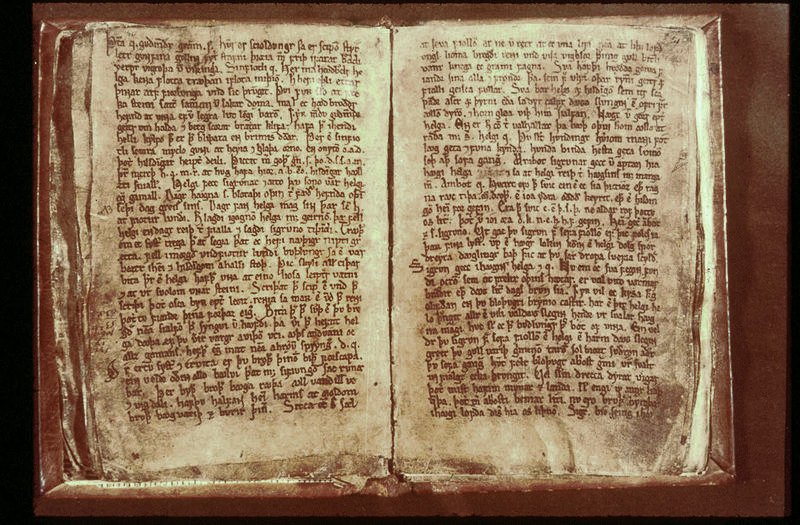
Bernt Thorvaldsen compares the versions associated with Codex Regius, Hauksbók, and Snorri’s Edda. His analysis treats their differences in speaker and audience as evidence of literary adaptation. In particular, Snorri uses stanzas within a prose framework whose immediate purpose is explaining mythology. There, the information supplied by the seeress can matter more than preserving the full dramatic situation of her speech.
The distinction prevents a simple ranking of complete versus damaged versions. A compiler may select, move, or adapt material because a new work needs it to perform a different task. Thorvaldsen also argues against treating increasing literary adaptation as a straightforward chronological progression. A later manuscript can preserve features suggestive of performance that an earlier prose adaptation does not. The date of a witness matters, but it does not automatically measure how much earlier tradition it retains in every detail.
Sources for this section: 2


Read variation before repairing it
Giulia Pillon’s study takes the Hauksbók version as its reference point rather than assuming that Codex Regius supplies the only proper form. It asks how oral and scribal variation might contribute to the differences among witnesses. This is a methodological proposal, not a demonstration that every variant has a known cause. Its value is that it invites readers to examine a surviving version on its own terms before reconstructing another text behind it.
Try the approach with a passage printed in parallel versions. First record what differs: wording, sequence, omission, or addition. Then consider how that difference changes the local reading. Only afterward ask which form might be earlier. Reversing this order can turn a preferred reconstruction into the standard by which every manuscript is judged. The surviving copies are historical products in their own right, and their differences may tell us about adaptation even where the lost ancestry of a line remains inaccessible.
Sources for this section: 3
Christian influence is more than one question
John McKinnell distinguishes general Christian influence from dependence on a particular Christian text. Shared language or a broad image of renewal is not the same kind of evidence as a detailed sequence of correspondences that may suggest a source. His study of Völuspá and Easter therefore asks what standards should be used before calling a resemblance borrowing.
This distinction helps when familiar apocalyptic images appear. A reader can recognize parallels without claiming to have established their route of transmission. Specific influence requires an argument about availability, correspondence, and meaningful differences. The presence of Christianity in northern Europe provides a context in which exchange was possible; it does not identify the origin of every motif. Conversely, the possibility of inherited non-Christian material does not place the poem in cultural isolation. The strongest comparisons explain both what matches and what fails to match, rather than assembling only similarities.
Sources for this section: 4
Scholars disagree about the scale of influence
Kees Samplonius argues for a substantial Christian contribution to the poem’s destructive agents and asks what ideological purpose such a composition could serve. His approach moves beyond identifying individual parallels to considering a larger interpretation of the work. That is an ambitious scholarly argument, not a fact established merely by the existence of biblical apocalypse.
Its importance for readers is partly comparative. If Christian influence is treated as decisive, scenes may be read as elements of a program directed toward a particular audience. If the influence is judged limited, the same scenes may be placed more strongly within inherited mythic patterns. These approaches can generate different explanations of the poem’s unity and purpose. The responsible response is to identify which claim is being made and what evidence supports it. A disagreement over overall interpretation should not be hidden inside a confident sentence announcing what the poet intended.
Sources for this section: 5
Even the ending remains open to argument
Anders Hultgård’s study gives Christian influence a much smaller role and compares the strands represented by the principal witnesses. He also argues that the disputed final stanza belongs to the poem’s framing situation rather than straightforwardly continuing the seeress’s vision. This illustrates how a decision about voice can alter a large narrative conclusion: the last image may not function as a simple final event in a cosmic timeline.
For an independent reading, use an edition that identifies its witness and records variants. Keep manuscript date, proposed composition date, and interpretive hypothesis separate. A polished translation may need to choose an order, but its choice should remain visible in the notes. Völuspá is powerful because its images are concentrated and unsettling. Treating its textual difficulties as part of its history allows that power to remain without pretending that modern scholarship has recovered a single uncontested original prophecy.
Sources for this section: 6
For the introductory context, read Ragnarök: Destruction, Renewal, and a Difficult Text.
The Evidence
The sources below support this article. Interpretations and limits are explained in the text; this is not an exhaustive research review.
- Edward Pettit — Völuspá, Codex Regius edition ↗
- Bernt Ø. Thorvaldsen — literary adaptation of Völuspá ↗
- Giulia Pillon — comparing the Hauksbók version ↗
- John McKinnell — Völuspá and the Feast of Easter ↗
- Kees Samplonius — background and scope of Völuspá ↗
- Anders Hultgård — the prophecy and its textual traditions ↗