
Beliefs & Stories · Focused study
The Fuller Brooch: Five Senses in the Age of Viking Invasions

In Brief
The Fuller Brooch belongs to Anglo-Saxon England, not to Viking manufacture. Its human figures offer a different view of the ninth-century world: one concerned with perception, Christian learning and the relationship between seeing and understanding.
On this page
Reading the centerA useful comparison: the Alfred JewelSight as a visual argumentWhen quality made scholars suspiciousSourcesReading the center
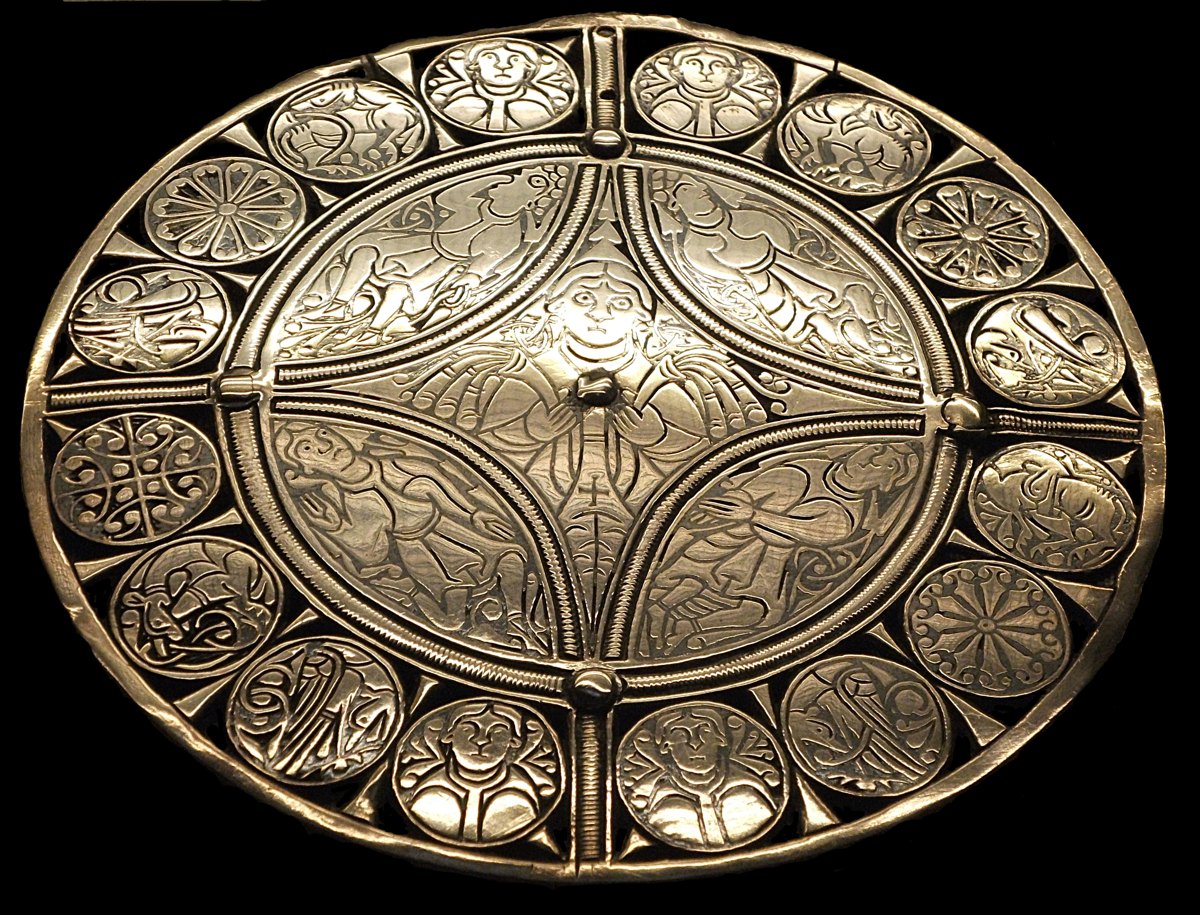
The British Museum dates this silver disc brooch to the later ninth century. Five human figures occupy its central arrangement, conventionally interpreted as the senses. Sight has the dominant position and conspicuous eyes; surrounding figures represent hearing, touch, taste and smell. Human, animal and plant motifs also populate the border.
The contrast between silver and dark niello makes the composition legible. Rather than a scene of combat or a portrait of a named ruler, the maker organized an abstract subject through bodies and gestures. The result is a reminder that early medieval metalwork could carry intellectual arguments as well as display wealth.
Sources for this section: 1
A useful comparison: the Alfred Jewel
The Ashmolean's Alfred Jewel combines gold, enamel and rock crystal with an inscription linking its manufacture to Alfred. Its museum interpretation suggests a reading pointer and identifies the enclosed figure as possibly Sight. Unlike the Fuller Brooch, it has an inscription naming the patron, though its exact function is still expressed cautiously.
Comparing the two objects reveals both a connection and a limit. The representation of sight fits a world in which learning and religious understanding mattered. Yet an interpretive resemblance does not transfer the jewel's named ownership to the brooch. Similar intellectual concerns can appear in objects with different functions and different evidential histories.
Sources for this section: 2
Sight as a visual argument
Scholar Loredana Teresi's published chapter summary places the Fuller Brooch in Alfred's cultural environment and explores connections with the continental court of Charles the Bald. Her proposed reading asks whether the imagery could act as a visual kenning: a compact material expression comparable to the suggestive compounds used in poetry.
This is an interpretation rather than an inscription decoded on the object. Its value is that it asks how an audience might move from visible eyes to the less tangible idea of intellectual illumination. The brooch can consequently be studied within wider networks of Christian learning, instead of being reduced to a national artistic label.
Sources for this section: 3
When quality made scholars suspicious
The brooch's exceptional preservation once contributed to its rejection as a modern fake. Scientific examination and stylistic comparison subsequently supported its early medieval authenticity. That episode is important because an expert judgment changed when the available evidence was reconsidered; an attractive appearance alone was not a reliable authenticity test.
For a Viking-history collection, the Fuller Brooch belongs under neighboring societies and shared chronology. Anglo-Saxon people were not merely background characters in Scandinavian raids. Their surviving objects also document sophisticated visual thought. Read this brooch alongside accounts of warfare, but do not let the warfare become its only possible meaning: the central figures invite a discussion of knowledge, senses and interpretation in their own right.
Sources for this section: 1, 3
The Evidence
The sources below support this article. Interpretations and limits are explained in the text; this is not an exhaustive research review.