
Vanir
Freyja
Desire, magic, wealth and a share of the slain
Freyja is associated with love and desire, but also with magic, precious objects and the battle-dead. Her many connections resist the familiar shorthand of a simple “love goddess”.
Explore the stories ↓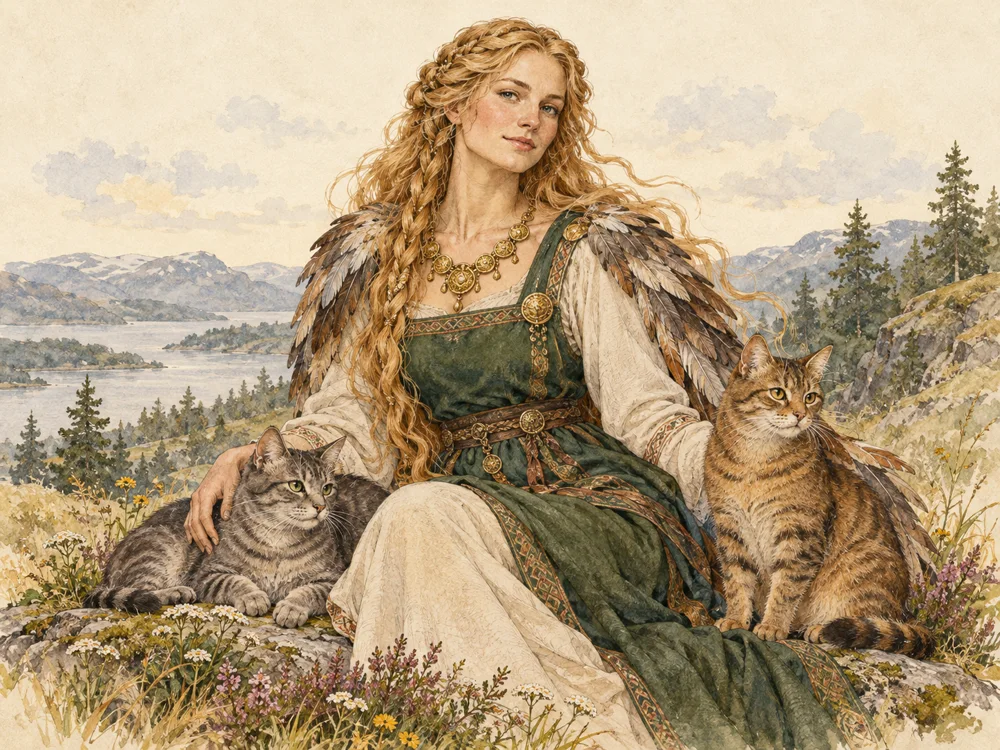
A Vanir goddess among the Æsir
Freyja and Freyr are the children of Njörd. Snorri calls her a leading goddess and describes her home as Fólkvangr, with a hall named Sessrúmnir. Grímnismál says she receives half of those who fall in battle, while Odin receives the other half. This does not provide a complete rulebook for the afterlife. The brief verse should not be expanded into modern claims about exactly which kinds of warriors she chooses or a formal order in which she and Odin select them.
Her necklace, her cats and her missing husband
Brísingamen is Freyja’s celebrated necklace. She also possesses a feather garment that can be borrowed for flight, and Snorri gives her a chariot drawn by cats. The surviving passage does not provide the cats with the personal names often assigned to them in modern retellings. Her husband is Ód, who travels far away; she searches for him and weeps tears of red gold. Their daughter Hnoss links the family’s story to the language of beauty and precious things. Ód and Odin are not simply interchangeable characters in the texts, even though their relationship has generated scholarly debate.
A goddess who refuses to be traded
Several narratives make Freyja the prize someone else wants to claim. The builder of Asgard’s wall demands her along with the sun and moon. Thrym offers to return Thor’s hammer if Freyja becomes his bride. In Þrymskviða she rejects the plan furiously, and Thor must take her place in disguise. Reading these scenes closely matters: the story gives her an emphatic refusal, not silent agreement to a marriage arranged around somebody else’s problem.
Knowledge beyond romance
In Hyndluljóð, Freyja assists her devotee Ottar in obtaining genealogical knowledge. Her narrative world includes ancestry, obligation, animal transformation and disputes over knowledge. Other medieval accounts connect her with seiðr, a form of magic, but the surviving evidence does not supply a complete ritual manual. Love, wealth, magic and death overlap in her representation. Treating those themes together makes her a more substantial figure than the modern image of a decorative goddess accompanied by cats.
Why Freyja demands a family history
In Hyndluljóð, Freyja seeks help for Ottar, whose claim to inherited wealth depends on ancestry. She approaches the giantess Hyndla and asks for an account of his forebears. Ottar accompanies her in the poem's boar disguise, which Hyndla sees through. Freyja recalls his devotion: he has made her a stone shrine and offered sacrifices. The long chain of names that follows is therefore not random decoration. Knowledge is something a human supporter needs, and Freyja is working to secure it for him. At the end, she asks for a memory drink so he can retain the genealogy when the dispute is heard. Hyndla resists and the exchange turns threatening. Freyja threatens fire, while Hyndla tries to attach an evil outcome to the drink; Freyja rejects that curse. The goddess is a demanding patron here, not merely a figure of romance.
The absent Óðr and the language of gold
Snorri says that Freyja travels among unfamiliar peoples searching for her husband Óðr, and explains her many names through those journeys. Her tears are red gold. Yet the text supplies no complete travel itinerary, no succession of named adventures and no definite scene in which the couple reunite. What it does preserve is a powerful narrative situation: a goddess associated with wealth is also someone whose grief produces it. Skáldskaparmál shows how poets could draw on that image, referring to gold through Freyja's eyes or tears. The emotional story and the craft of poetic description belong together. Óðr's absence is not an excuse to borrow adventures from Odin and assign them to Freyja's husband as though the sources made the two identical.
Read behind the retelling
Sources & limits
Freyja is not Frigg. Proposed historical relationships between the two should not erase their distinct roles in surviving stories.
- Gylfaginning, chapters 24, 35, 42 and 49
- Grímnismál, stanza 14
- Þrymskviða
- Hyndluljóð
- Ynglinga saga, chapter 4: Freyja and the magic of the Vanir
- Gylfaginning 35 and Skáldskaparmál 37, Freyja's tears; Brodeur, 1916
Retold in contemporary English. Dialogue is summarized, not presented as a translation. How to read our sources and versions.
Follow the thread
Stories & related reading: Freyja
2 min read
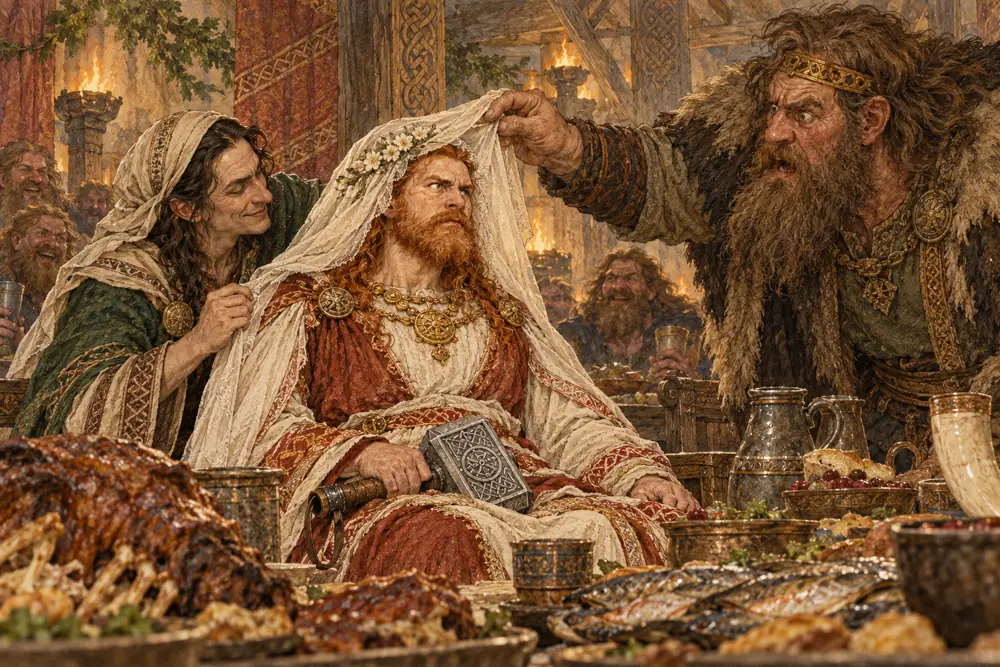
Thor’s extraordinary wedding
When Thrym demands Freyja in exchange for Mjölnir, the gods send a very different bride.
Read the story ↗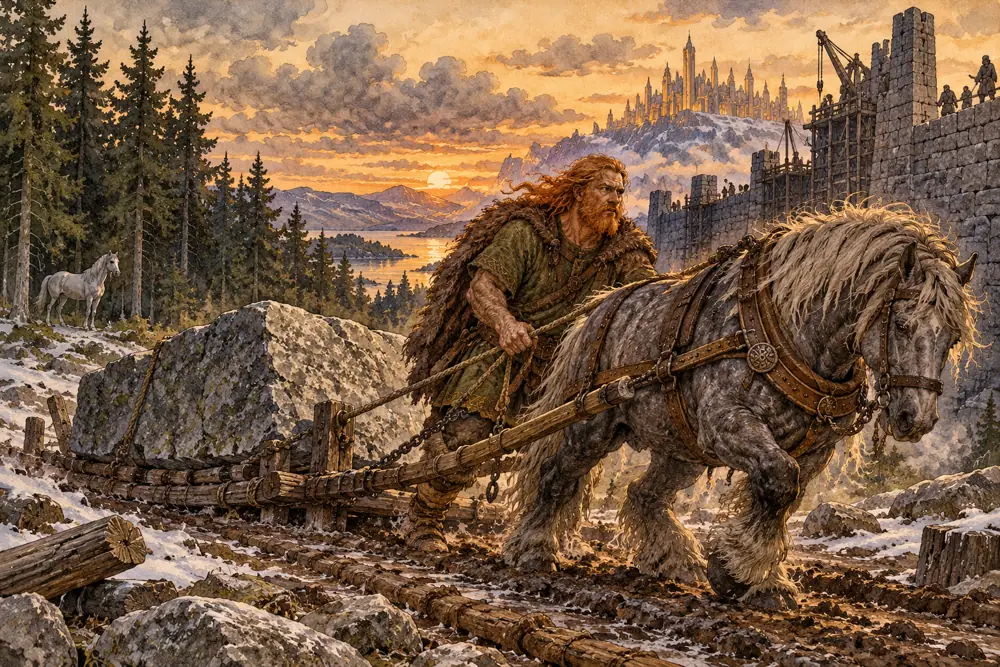
2 min read
The builder of Asgard’s wall
A builder nearly earns the sun, moon, and Freyja. Loki disrupts the work, and the gods’ protected settlement acquires a troubling history.
Read the story ↗
2 min read
Idunn and the stolen apples
A bargain forced from Loki delivers Idunn to Thjazi. Without her, the gods discover that their youth is not secure.
Read the story ↗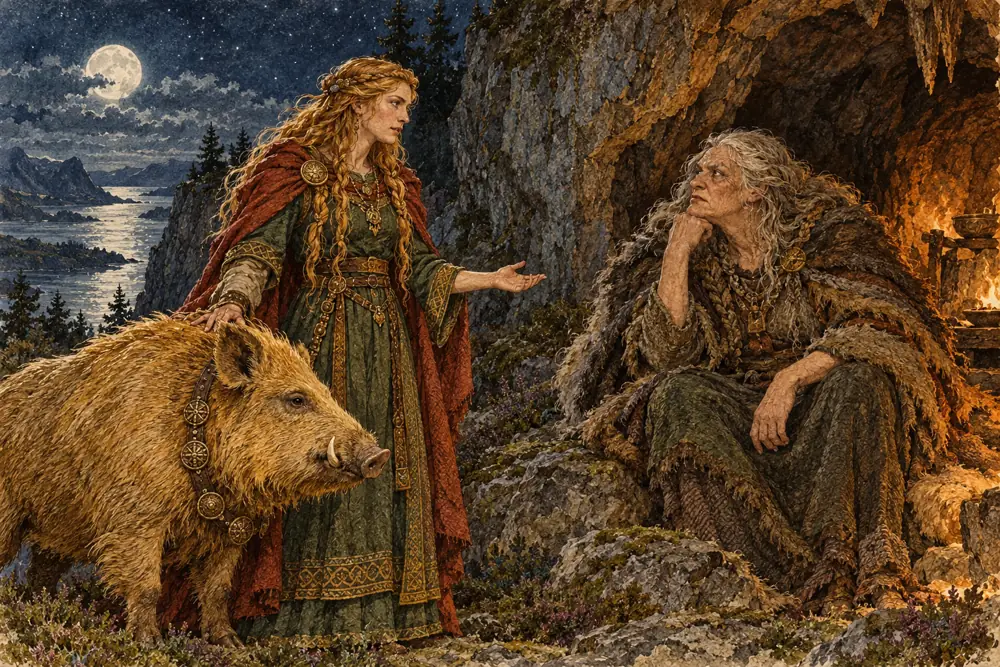
2 min read
Freyja, Hyndla, and Ottar’s ancestry
Freyja seeks a genealogy for her devotee Ottar. The encounter becomes a dispute about ancestry, memory, and the price of knowledge.
Read the story ↗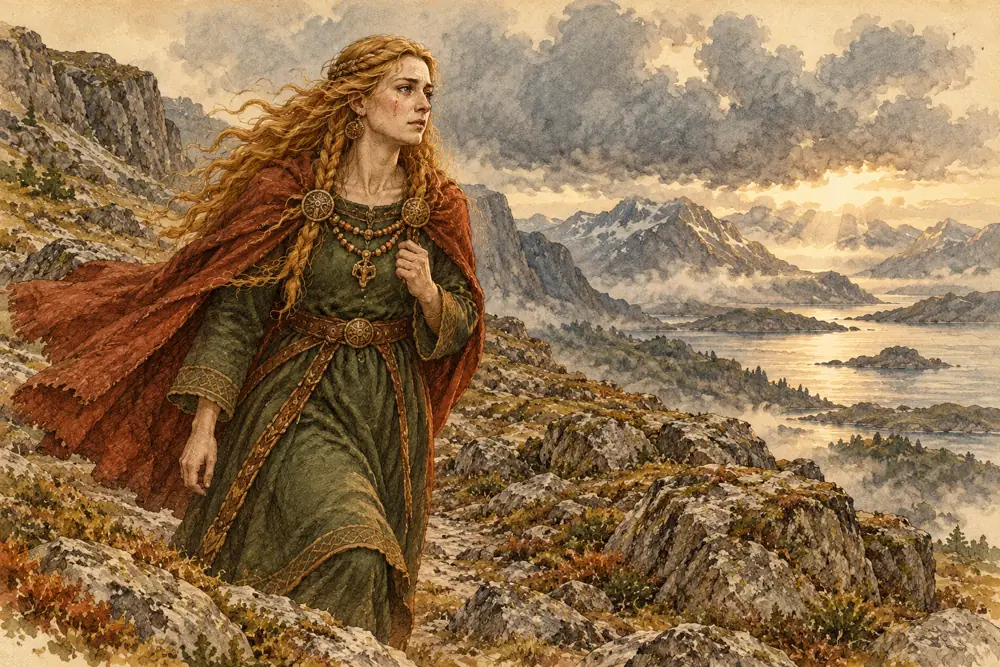
1 min read
Freyja searches for Óðr
A few lines connect Freyja’s sorrow, journeys and many names with an absent husband.
Read the story ↗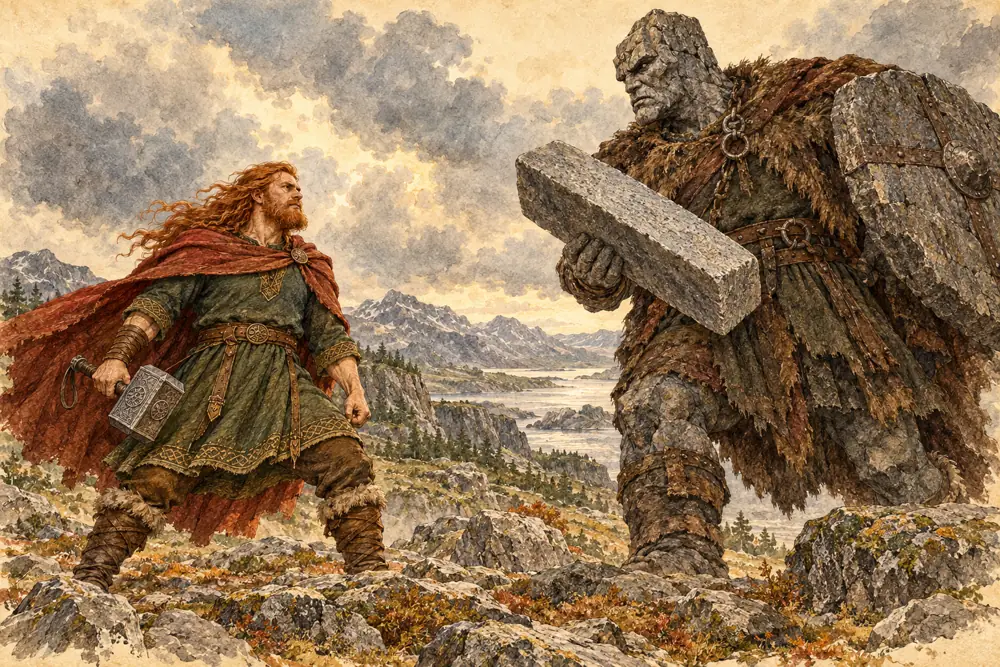
2 min read
Thor and the stone-hearted Hrungnir
Hrungnir pursues Odin into Asgard, boasts beyond hospitality, and challenges Thor to meet him armed.
Read the story ↗
2 min read
Loki’s quarrel at Ægir’s feast
Loki enters the gods’ feast and attacks one guest after another in a formal exchange of insults.
Read the story ↗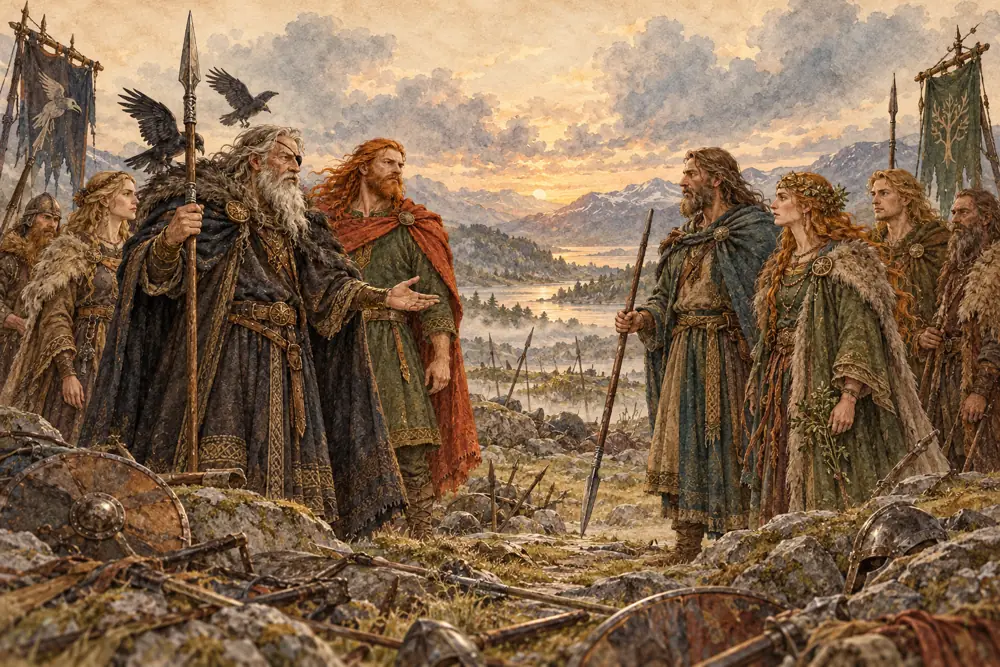
2 min read
The war between the Æsir and Vanir
An early war, a mysterious woman and an uneasy peace survive in accounts that do not fit together neatly.
Read the story ↗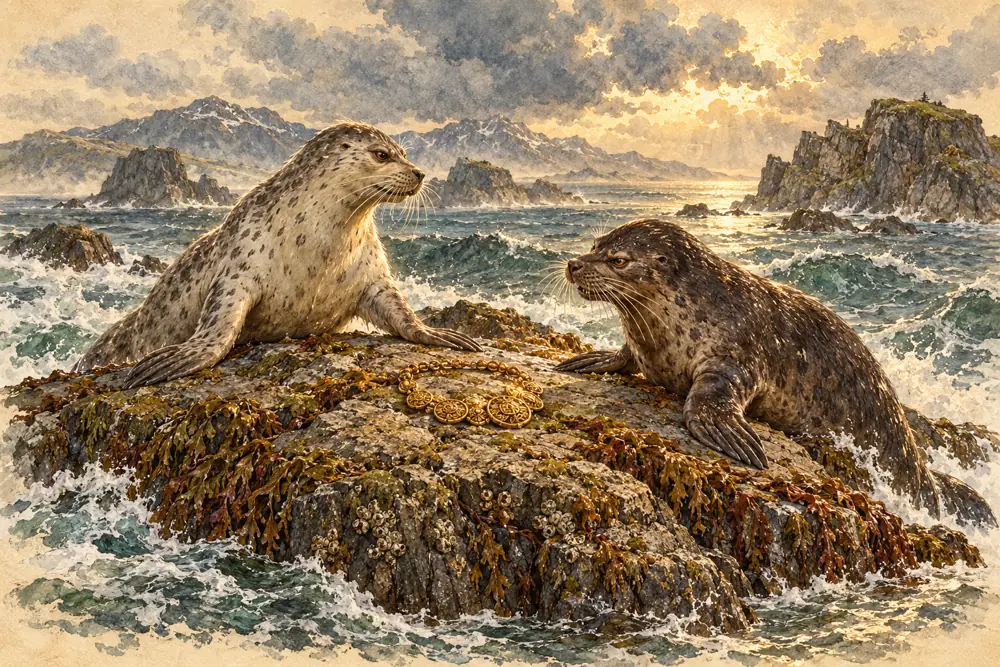
2 min read
Heimdall and Loki at Singasteinn
Two divine enemies fight over Freyja’s necklace, but the fuller story that once surrounded the scene has not survived.
Read the story ↗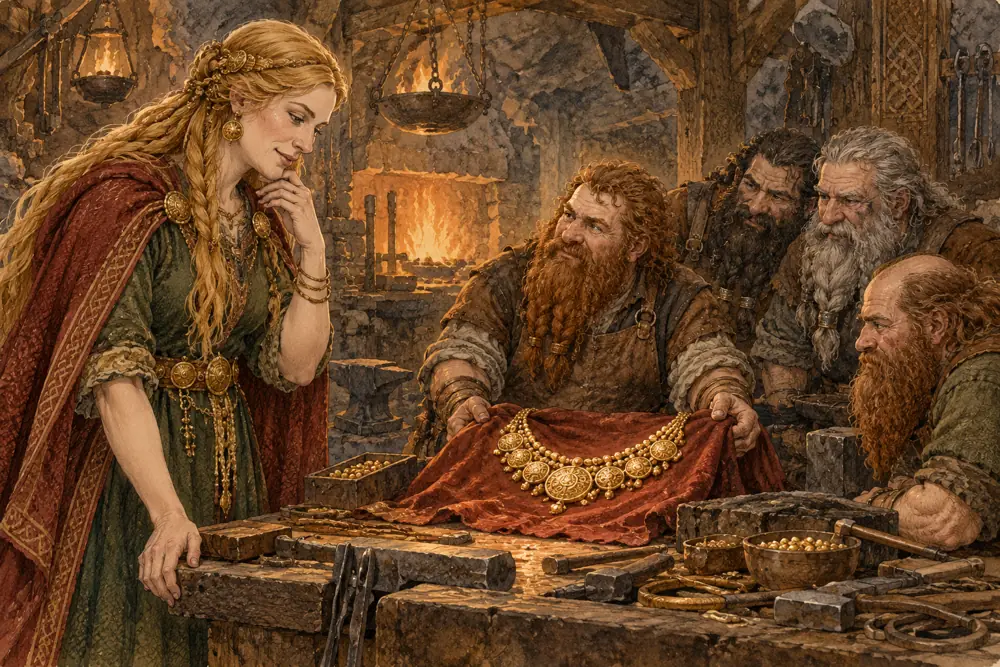
2 min read
Freyja’s necklace in Sörla þáttr
The famous necklace-acquisition story survives in a Christian-framed narrative, centuries after the Viking Age.
Read the story ↗