
A Norse story · 2 min read
The war between the Æsir and Vanir
Two accounts of a divided divine world
An early war, a mysterious woman and an uneasy peace survive in accounts that do not fit together neatly.
Fire before battle
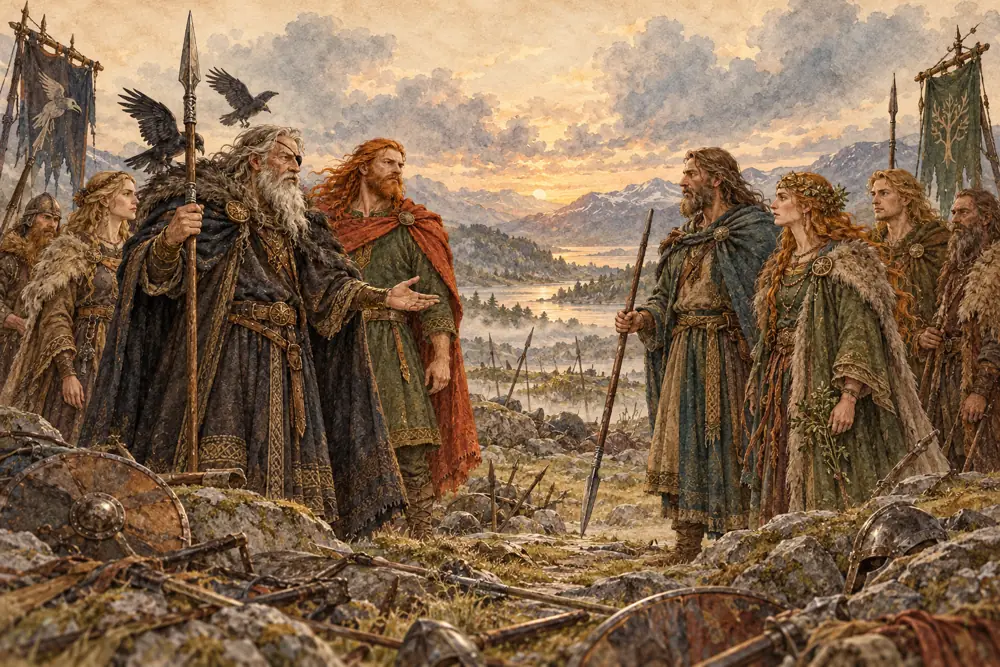
In Völuspá, the seer remembers the first war and the attack on Gullveig. Spears pierce her and she is burned in the hall of the High One, yet repeated burning does not end her life. The following stanza describes Heiðr, a woman skilled in magic. The relationship between these names, the reason for the violence and the precise connection with the war are not fully explained. The poem expects its audience to know more than it tells us.
A breached stronghold
Odin throws a spear over an army. The gods’ defensive wall is broken and the Vanir enter the battlefield. Around this episode the divine assembly debates compensation or shared rights to worship; the wording and arrangement vary between editions. This is not a detailed campaign history. It is a sequence of forceful remembered scenes, with transitions that modern storytellers often supply themselves. Identifying Gullveig confidently as Freyja turns a possible interpretation into a certainty the poem does not provide.
A different account of peace
Ynglinga saga, chapter 4, turns the gods into rulers and peoples of an imagined ancient world. Odin attacks the Vanir; both sides win and lose, ravage each other’s lands and finally exchange hostages. Njord and Freyr come to the Æsir. Hoenir and Mimir go the other way, while Kvasir also appears in the exchange. The peace leads to further violence against Mimir. Freyja teaches the Æsir seiðr in this account. It supplies a political settlement but does not tell the Gullveig episode.
How to read the two versions
The sources share a conflict between divine groups, but they do not give one seamless script. Reading them side by side preserves both the poem’s disturbing images and the saga’s interest in treaties, leadership and exchanged knowledge. It does not establish that a real migration or historical war caused the mythology. That would require evidence beyond the stories themselves.
Read behind the retelling
Sources & limits
Gullveig’s identification with Freyja is debated. Ynglinga saga presents the gods as ancient rulers, not as a direct record of Viking-age events.
- Völuspá, first-war passage (Bellows 21–24; numbering differs)
- Ynglinga saga, chapter 4 (Laing translation)
Retold in contemporary English. Dialogue is summarized, not presented as a translation. How to read our sources and versions.
Another thread to follow
2 min read
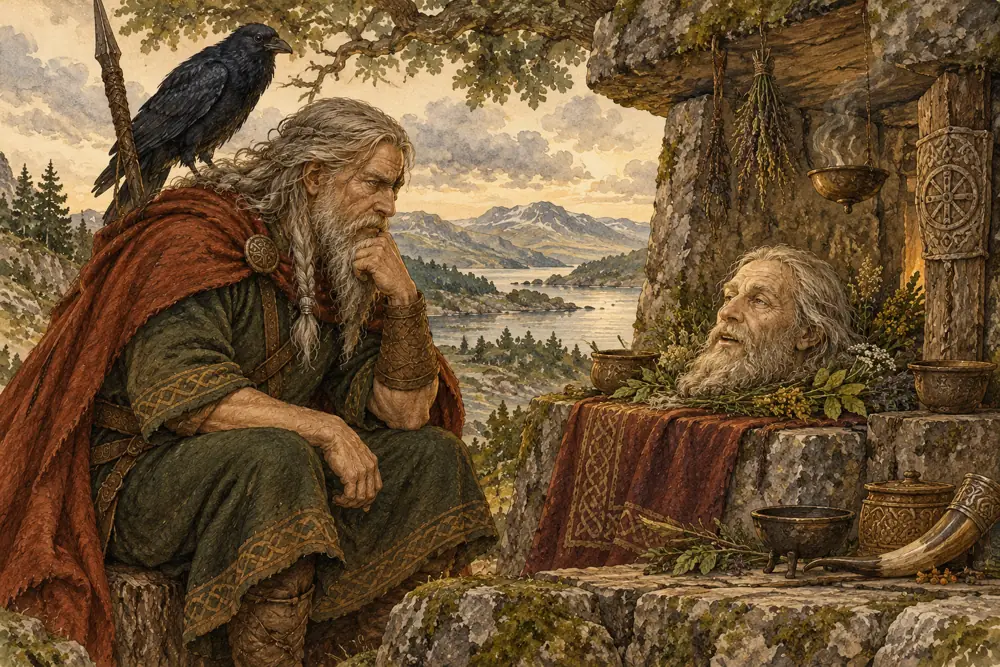
Mimir’s speaking head
A hostage exchange ends in murder, but Odin preserves the counsellor whose advice remains indispensable.
Read the story ↗
2 min read
Loki’s quarrel at Ægir’s feast
Loki enters the gods’ feast and attacks one guest after another in a formal exchange of insults.
Read the story ↗
2 min read
Idunn and the stolen apples
A bargain forced from Loki delivers Idunn to Thjazi. Without her, the gods discover that their youth is not secure.
Read the story ↗