
A guide to the mythology
Where the stories come from
Poems, prose, fragments, and later retellings: a guide to reading Norse mythology without hiding the gaps.
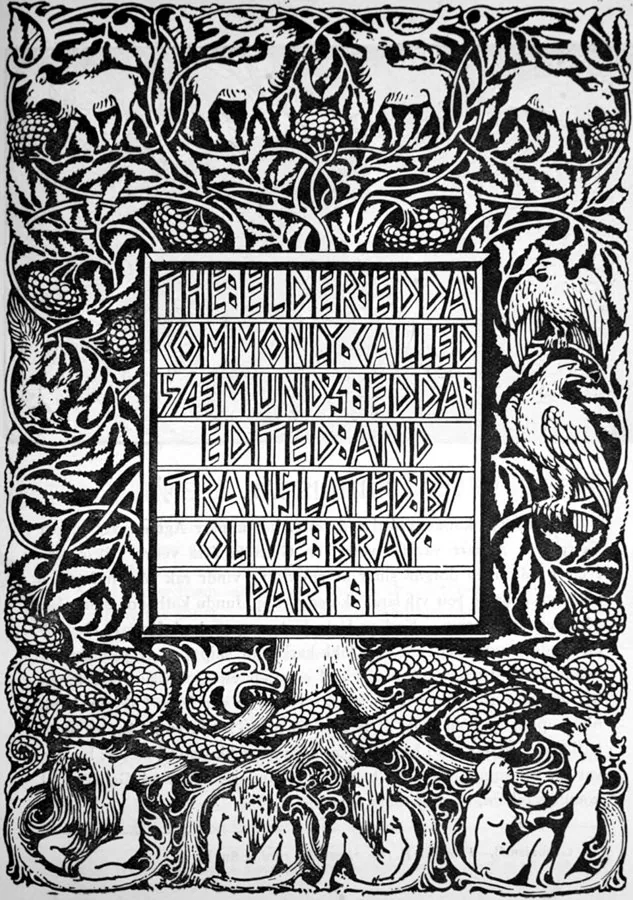

A collection of witnesses
There is no single surviving Norse book that supplies every god with a complete biography. The material includes poems spoken by gods, insults traded at a feast, answers to a traveler’s questions, explanations of poetic imagery, and stories embedded in accounts of legendary rulers. Different witnesses preserve different details. Sometimes they disagree.
Our library brings those witnesses together while keeping the source visible. The figure pages introduce the characters. The story pages retell an episode in contemporary English and identify the text behind it. A brief reference remains brief: it does not become a detailed adventure simply because a modern reader would like to know more.
Gods, Vanir, jötnar, and other powers
The Æsir are the divine group around Odin in many of the stories. Njord, Freyr, and Freyja are associated with the Vanir; accounts of conflict and exchange connect the two groups. These labels do not prevent their members from appearing together as gods. Our directory separates the Vanir to help browsing, rather than pretending they inhabit an entirely unrelated set of stories.
The word jötunn is usually translated as giant, but family and social relationships matter more than a fixed physical size. Skadi, Gerd, and Jord connect the gods with jötunn families. Other figures belong to personified time, fate, ancestry, or the dead. The filters are reading aids, not a claim that the medieval evidence supplies one universally agreed classification for every name.
The Poetic Edda
The name Poetic Edda refers to a collection of Old Norse poems, not one continuous narrative written by a single named author. Some poems concern gods and the structure of the world; others concern heroic families and their catastrophes. Prose introductions and linking passages are also important.
Völuspá offers a seeress’s vision of beginnings, conflict, destruction, and renewal. Hávamál combines counsel with passages about Odin, knowledge, and spells. Vafþrúðnismál and Grímnismál make knowledge part of an encounter. Þrymskviða tells the story of Thor’s stolen hammer; Hymiskviða includes his fishing encounter; Lokasenna turns a feast into a battle of accusations. Each has its own voice. Reading every statement as an equally reliable piece of divine biography loses that difference.
The freely accessible Henry Adams Bellows translation used in many source links was published in 1923. It is useful for following the texts, but its introductions, proposed dates, and explanations of origins reflect an older stage of scholarship. A translator’s speculative footnote is not itself a medieval myth.
Snorri’s Prose Edda
Snorri Sturluson’s Edda is a medieval work concerned with poetry and the stories needed to understand it. Gylfaginning uses a question-and-answer framework. A visitor hears about the gods and their world from three enthroned speakers. Skáldskaparmál explains poetic language and preserves stories behind names and elaborate expressions.
This arrangement matters. A myth may be told because it explains why gold can be called a goddess’s tears or why poetry can be described as a drink. Snorri also organizes the material into an account of the world’s beginnings and end. That organizing work should not be mistaken for proof that every community told the stories in precisely that order.
The source links often use Arthur Gilchrist Brodeur’s 1916 English translation, which is freely available. Chapter numbering can differ between editions. We identify the relevant episode or chapter range as well as giving the link. Readers who want to work with the Old Norse text can consult the editions published by the Viking Society for Northern Research.
Fragments and later accounts
Some myths survive only through a few lines quoted from a poem. The contest between Heimdall and Loki over a necklace is an example of material that cannot responsibly be expanded into a complete, confident screenplay. We explain what the surviving fragment supports and what remains missing.
Other accounts come from later prose or from authors writing about the legendary past in a different way. Ynglinga saga presents divine figures in a royal-history framework. Sörla þáttr gives a late, explicitly Christian-framed story associated with Freyja’s necklace. Such texts are worth reading, but their setting and purpose must stay visible. A vivid later version is not automatically the oldest version.
How we handle conflicting versions
A story page names the account it follows and then explains significant differences. Thor’s fishing encounter is an especially useful example: the surviving poetry and Snorri’s prose do not simply supply interchangeable pieces of one unproblematic story. The outcome, the place of the scene within a larger adventure, and the narrator’s handling of tradition all need attention.
The same care applies to relationships and identities. A name appearing in two texts does not prove that every detail of the two figures should be merged. An accusation in a quarrel is not neutral testimony. A modern theory that two gods were once one god may be interesting, but it is different from something a medieval poem actually says.
Pictures are another layer of interpretation
The illustrations are credited individually, with their artist, date, and image source. Most are much later than the medieval texts. A romantic-era drawing can be beautiful and influential without being archaeological evidence for Viking clothing, ritual, or architecture.
When a direct depiction of a minor figure is unavailable, a page may use a related scene or an illustration of the mythic world. Its caption identifies that contextual use. We do not turn a generic female figure into an authenticated portrait of a little-attested goddess. The image supports reading; its caption limits what it can claim.
How complete is this library?
The aim is broad coverage of surviving stories about the gods, including short episodes, fragments, and relevant boundary material between myth and heroic legend. The collection is not a claim that every oral story has survived, that every medieval allusion can be fully explained, or that every later Scandinavian folktale belongs to the same corpus.
Start with a figure’s page to see their connected episodes. Use the story shelf to compare adventures across several figures. Where no substantial independent story survives in the sources used here, the profile says so. Further additions should be grounded in an identifiable source, rather than invented to make every entry equally long.
A note for families
These are general-reader retellings rather than a children’s storybook. The source material includes death, betrayal, coercion, sexual accusations, and revenge. We describe those themes without adding graphic spectacle. The separate For Kids section provides activities designed for younger readers. A parent or carer can choose individual mythology stories to read together.
Read behind the retelling
Sources & limits
Our prose is an original retelling and reading guide, not a new critical edition or a word-for-word translation. Old public-domain translations make the sources accessible; their historical introductions and interpretive notes should not be treated as the final word in current scholarship.
- Brodeur, The Prose Edda (1916): introduction and editorial context
- Snorri, Gylfaginning: the framing dialogue and accounts of the gods
- Bellows, The Poetic Edda (1923): freely accessible translation
- Viking Society for Northern Research: Faulkes edition of Prologue and Gylfaginning
Retold in contemporary English. Dialogue is summarized, not presented as a translation. How to read our sources and versions.