
A Norse story · 2 min read
Idunn and the stolen apples
The kidnapping that makes the gods grow old
A bargain forced from Loki delivers Idunn to Thjazi. Without her, the gods discover that their youth is not secure.
A meal that will not cook
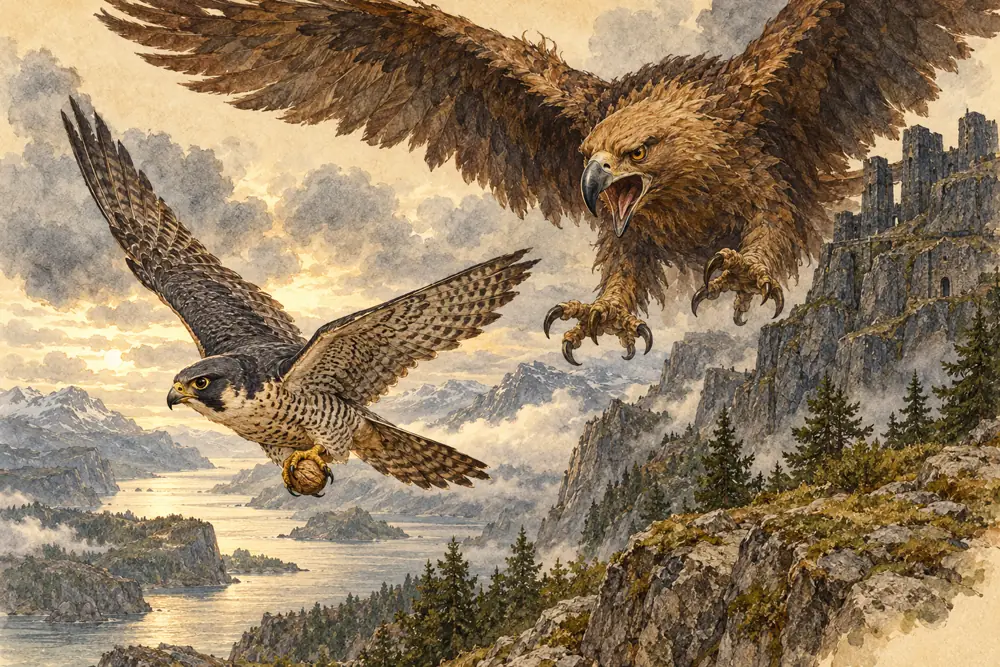
Odin, Loki, and Hoenir travel through difficult country and find food scarce. When they finally put an ox over a fire, it refuses to cook. An enormous eagle in a tree claims responsibility and offers to release the meal if it receives a share. The travellers agree, but the eagle takes so much that Loki attacks it with a pole. The pole sticks to the bird, and Loki’s hands remain stuck to the pole. Dragged across rough ground, Loki is forced to bargain for release. The eagle is the giant Thjazi. He demands that Loki bring Idunn and her apples outside the gods’ protection.
The disappearance
Back in Asgard, Loki tells Idunn that he has found apples worth comparing with her own. She goes with him into a wood, carrying them. Thjazi arrives in eagle form, seizes her, and takes her to his home, Thrymheim. The consequences spread through Asgard: the gods become old and grey. Their strength has depended on a person who can be deceived and carried away. They investigate her last movements and discover Loki’s involvement. Under threat, he promises to bring her back if Freyja lends him her feather garment. The equipment that enables the rescue belongs to another goddess, not to Loki.
The flight home
Loki flies to Thrymheim while Thjazi is away fishing. Finding Idunn alone, he changes her into a nut and carries her in his claws. Thjazi returns, discovers the escape, and pursues them as an eagle. The gods see the smaller bird approaching with the eagle behind. They pile wood shavings near the entrance to Asgard. Once Loki has passed safely, they set the pile alight. Thjazi cannot turn away quickly enough; his feathers catch fire, he falls, and the gods kill him. Idunn is restored to the community, but Thjazi’s death produces another dispute when his daughter Skadi arrives seeking compensation.
Youth, dependence, and the source
Snorri tells this story at the opening of Skáldskaparmál through a conversation between Bragi and Aegir. It is also connected with imagery in the earlier skaldic poem Haustlöng, quoted in the same work. The tale challenges the easy modern label ‘immortal gods’: their youth needs renewal, and the person who provides it is vulnerable. It also shows Loki’s double role. He causes the loss, but his cunning is necessary to reverse it. The source does not require a modern moral in which every harm is neatly cancelled by the rescue.
Read behind the retelling
Sources & limits
The apples belong to Snorri’s account. Do not assume every surviving poetic reference to Idunn describes the same details.
Retold in contemporary English. Dialogue is summarized, not presented as a translation. How to read our sources and versions.
Another thread to follow

2 min read
Loki’s quarrel at Ægir’s feast
Loki enters the gods’ feast and attacks one guest after another in a formal exchange of insults.
Read the story ↗
2 min read
Skadi chooses a husband
After Thjazi’s death, his daughter arrives armed at Asgard. The gods offer compensation, but the marriage that follows cannot reconcile two very different homes.
Read the story ↗
2 min read
The builder of Asgard’s wall
A builder nearly earns the sun, moon, and Freyja. Loki disrupts the work, and the gods’ protected settlement acquires a troubling history.
Read the story ↗