
A Norse story · 2 min read
Skadi chooses a husband
A settlement made by looking only at feet
After Thjazi’s death, his daughter arrives armed at Asgard. The gods offer compensation, but the marriage that follows cannot reconcile two very different homes.
An armed visitor
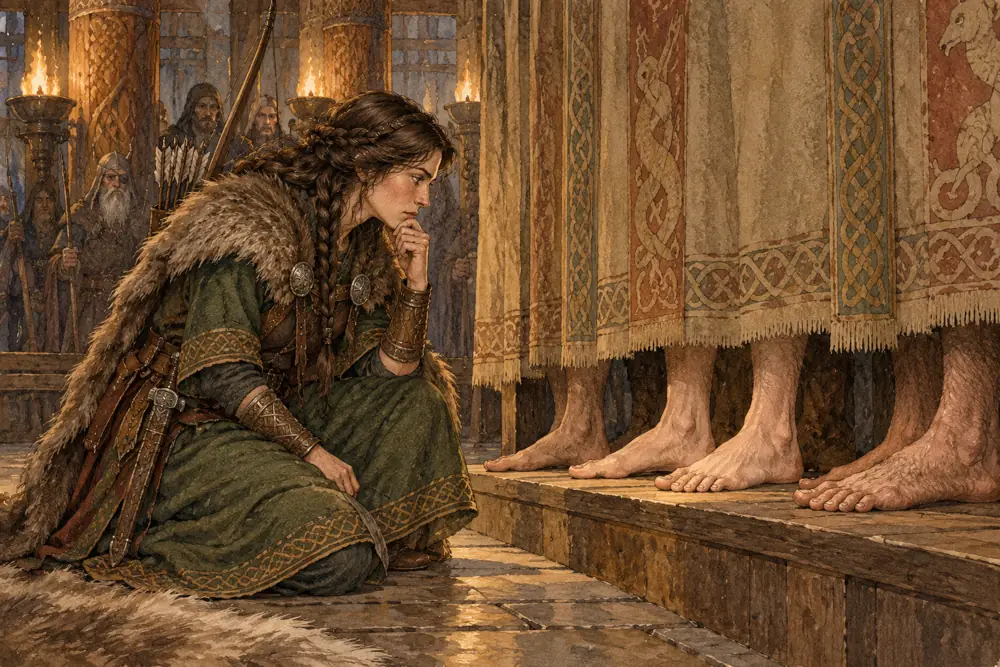
Skadi does not begin this story as a bride waiting to be chosen. She puts on armour, takes weapons, and goes to Asgard to seek redress for the death of her father, Thjazi. The gods have killed him after his pursuit of Idunn and Loki. Rather than continue the conflict, they offer a settlement. One part allows Skadi to choose a husband from among them, but she may judge only by the men’s feet. Their identities and faces must remain hidden. The bargain gives her a choice while restricting the information on which she can make it.
The wrong expectation
Skadi sees particularly beautiful feet and chooses their owner, believing that they must belong to Baldr. They belong instead to Njord of Noatun. Another condition of the settlement is that the gods must make her laugh, something she believes they cannot achieve. Loki succeeds with a deliberately indecorous performance involving a goat and a cord. The episode is bodily comedy, not an elegant courtship. Snorri adds that Odin takes Thjazi’s eyes and sets them in the sky as stars. Compensation thus includes marriage, laughter, and a celestial memorial, though none of these reverses her father’s death.
Sea and mountain
A separate passage in Gylfaginning tells what happens when Njord and Skadi try to live together. She prefers Thrymheim, the mountain home inherited from her father. He prefers Noatun by the sea. They attempt to alternate between the two places. Njord finds the wolves’ howling unbearable in the mountains; Skadi cannot sleep beside the sea because of the cries of birds. The account gives each a voice and a reason. Neither landscape is simply a bad place. Each is wrong for the person made to leave the other. Skadi returns to the mountains, where she travels on skis and hunts with a bow.
Read the mismatch carefully
It is tempting to turn the story into a timeless lesson about incompatible couples. That is one possible modern reading, not an explanation supplied by the medieval narrator. The surviving passages also concern settlements between hostile groups, the risks of a constrained choice, and the strength of attachment to a home. Skadi retains a name, property, and activities of her own beyond the marriage. This retelling joins two passages of Snorri’s work while keeping their different subjects visible: one establishes the marriage, and the other explains the separation of their households.
Read behind the retelling
Sources & limits
Other medieval texts give different relationships for Skadi. This is Snorri’s familiar marriage-and-separation account, not a universal biography.
- Snorri, Skáldskaparmál I: compensation for Thjazi
- Snorri, Gylfaginning XXIII: Njord and Skadi’s homes
Retold in contemporary English. Dialogue is summarized, not presented as a translation. How to read our sources and versions.
Another thread to follow

2 min read
Loki’s quarrel at Ægir’s feast
Loki enters the gods’ feast and attacks one guest after another in a formal exchange of insults.
Read the story ↗
2 min read
The death of Baldr
Frigg tries to protect Baldr from every danger, but Loki finds the one promise she did not obtain.
Read the story ↗
2 min read
Idunn and the stolen apples
A bargain forced from Loki delivers Idunn to Thjazi. Without her, the gods discover that their youth is not secure.
Read the story ↗