
A Norse story · 2 min read
The builder of Asgard’s wall
A bargain, a stallion, and the birth of Sleipnir
A builder nearly earns the sun, moon, and Freyja. Loki disrupts the work, and the gods’ protected settlement acquires a troubling history.
A price the gods think impossible
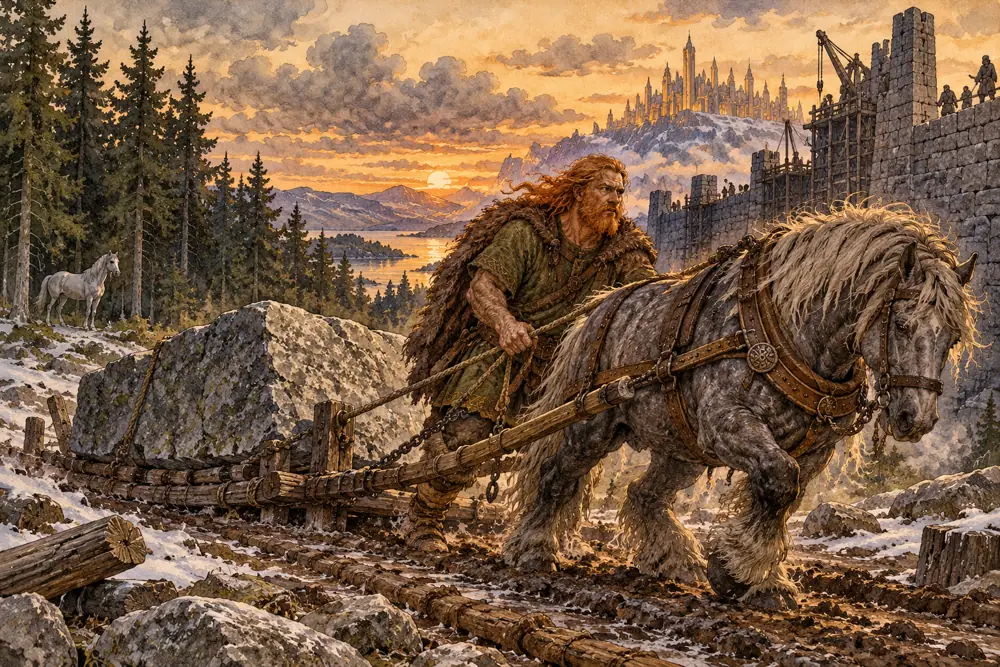
A builder arrives and offers the gods a protective wall. His price is extraordinary: Freyja, the sun, and the moon. After discussion, they agree only if he finishes within one winter and receives no human assistance. At Loki’s advice, he is permitted to use his stallion, Svadilfari. The gods assume the deadline will prevent him from claiming payment. Their assumption overlooks the horse. Svadilfari hauls immense stones at night, making it possible for the builder to progress much faster than expected. The contract that seemed safe begins to threaten the divine community.
Loki is ordered to act
As the deadline approaches, the wall is nearly complete. The gods ask who approved the arrangement and blame Loki for allowing the horse to help. They threaten him unless he prevents the work from being finished. Loki then appears in the form of a mare outside the worksite. Svadilfari breaks away from his harness and runs after her into the woods. The builder must follow, and the night’s labour is lost. The disruption prevents the deadline from being met. It is a solution built on another deception rather than an honest renegotiation.
A broken settlement
When the builder understands that he has been cheated, he falls into a giant’s fury. The gods recognise him as a mountain giant and summon Thor. The hammer ends his claim permanently: Thor kills him instead of paying him. Snorri’s prose and the verses he cites leave the breaking of solemn agreements visible. This is not simply a clever contract story with an innocent ending. Later, Loki gives birth to a grey foal with eight legs. The foal is Sleipnir, the extraordinary horse associated with Odin. Loki’s transformation thus has a lasting consequence beyond the rescue of Asgard’s walls.
What belongs to this version
The fully developed builder-and-horse narrative comes from Gylfaginning. Völuspá contains compressed references to the gods’ council, a dangerous agreement, and broken oaths; it does not itself spell out every detail of Snorri’s account. Modern retellings often smooth these materials into a single continuous scene. Here the distinction matters. Freyja is treated as a possible payment without a narrated choice of her own, and the gods preserve their advantage by abandoning the settlement. The tale explains a wall and a remarkable horse while allowing the foundations of divine security to look morally unstable. Neither the builder’s violent anger nor the gods’ fear requires us to pretend the bargain was honoured.
Read behind the retelling
Sources & limits
Do not merge the full prose story with the poem as if both describe every event. Loki is Sleipnir’s mother in this account.
- Snorri, Gylfaginning XLII: the builder, Svadilfari, and Sleipnir
- Völuspá, stanzas 25–26 in Bellows: the council and broken oaths
Retold in contemporary English. Dialogue is summarized, not presented as a translation. How to read our sources and versions.
Another thread to follow

2 min read
Loki’s quarrel at Ægir’s feast
Loki enters the gods’ feast and attacks one guest after another in a formal exchange of insults.
Read the story ↗
2 min read
Thor’s extraordinary wedding
When Thrym demands Freyja in exchange for Mjölnir, the gods send a very different bride.
Read the story ↗
2 min read
Thor and the stone-hearted Hrungnir
Hrungnir pursues Odin into Asgard, boasts beyond hospitality, and challenges Thor to meet him armed.
Read the story ↗