
Creatures
Sleipnir
Odin’s eight-legged horse
Sleipnir is the extraordinary horse associated with Odin. Gylfaginning explicitly gives him eight legs and places him foremost among horses. His unusual birth connects him to the attempt to build a protective wall around the gods’ stronghold.
Explore the stories ↓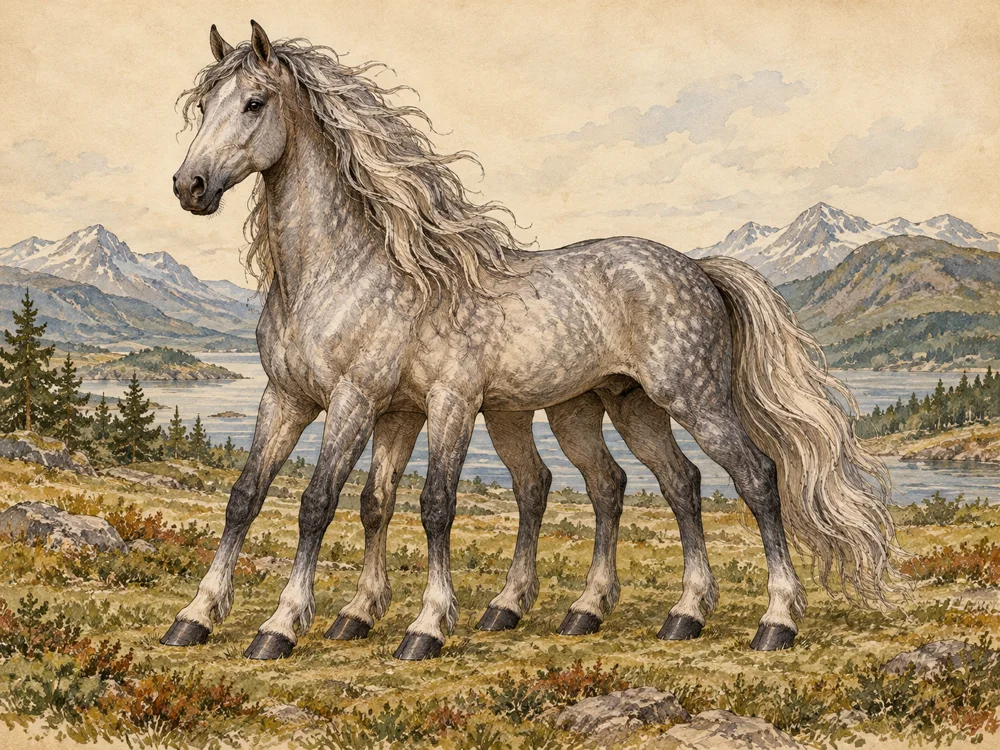
Born from a broken bargain
A builder relies on the powerful stallion Svadilfari to finish the wall before the agreed deadline. The gods fear that they will owe the promised reward, including Freyja. Under pressure, Loki takes the form of a mare and draws the stallion away. Loki later gives birth to Sleipnir. In this story Loki is the horse’s mother, not his father.
A journey to the dead
After Baldr’s death, Hermod rides Sleipnir on the difficult road to Hel. Horse and rider cross the bridge over the river Gjoll and reach the enclosure where Baldr remains. Sleipnir clears its gate with a leap. This is a specific narrative journey, not evidence for every supernatural power attributed to the horse in modern fantasy.
A race that brings Hrungnir into Asgard
Sleipnir carries Odin into Jötunheim in the opening of the Hrungnir story. When the giant admires the horse, Odin wagers his head that no horse there can match it. Hrungnir insists that his own Gullfaxi is better and gives chase. Odin stays ahead, while the furious giant pursues him straight through the gates of Asgard. The gods invite Hrungnir to drink, and his drunken boasts eventually lead to a challenge against Thor. Sleipnir is therefore not just an emblem beside Odin: his speed starts a chain of events that brings a dangerous guest into the gods’ own hall.
The last obstacle on Hermod’s journey
The journey to retrieve Baldr gives Sleipnir another specific task. Hermod rides for nine nights through dark valleys before reaching the bridge over Gjöll. Its guardian, Modgudr, explains that the road to Hel leads downward and northward. At the gate, Hermod dismounts and tightens the horse’s girth. He mounts again, strikes with his spurs and Sleipnir clears the barrier without touching it. The leap gets the messenger inside, but it cannot compel Baldr’s release. That depends on Hel’s condition that everything weep for him. The marvelous horse crosses the physical boundary; he does not cancel the terms governing the dead.
Read behind the retelling
Sources & limits
Eight-legged horse images can invite comparison with Sleipnir, but identifying an archaeological image requires evidence for that particular object.
- Prose Edda: Gylfaginning (Brodeur, 1916)
- Poetic Edda: Grímnismál (Bellows, 1923)
- Prose Edda: Skáldskaparmál, Brodeur translation (1916)
- Prose Edda: Gylfaginning, Brodeur translation (1916)
Retold in contemporary English. Dialogue is summarized, not presented as a translation. How to read our sources and versions.
Follow the thread
Stories & related reading: Sleipnir
2 min read
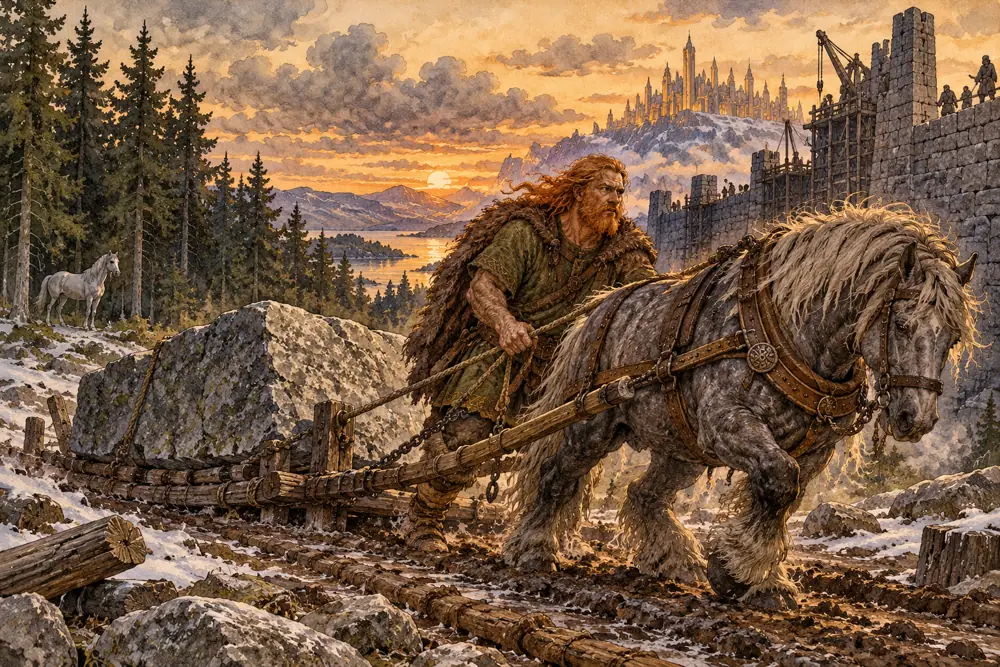
The builder of Asgard’s wall
A builder nearly earns the sun, moon, and Freyja. Loki disrupts the work, and the gods’ protected settlement acquires a troubling history.
Read the story ↗
2 min read
The death of Baldr
Frigg tries to protect Baldr from every danger, but Loki finds the one promise she did not obtain.
Read the story ↗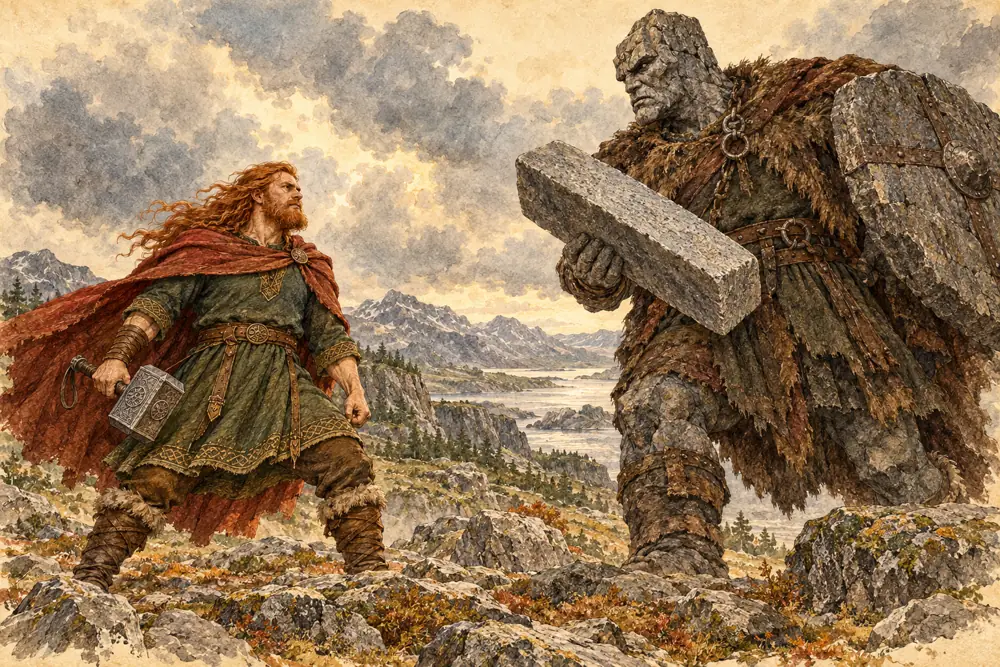
2 min read
Thor and the stone-hearted Hrungnir
Hrungnir pursues Odin into Asgard, boasts beyond hospitality, and challenges Thor to meet him armed.
Read the story ↗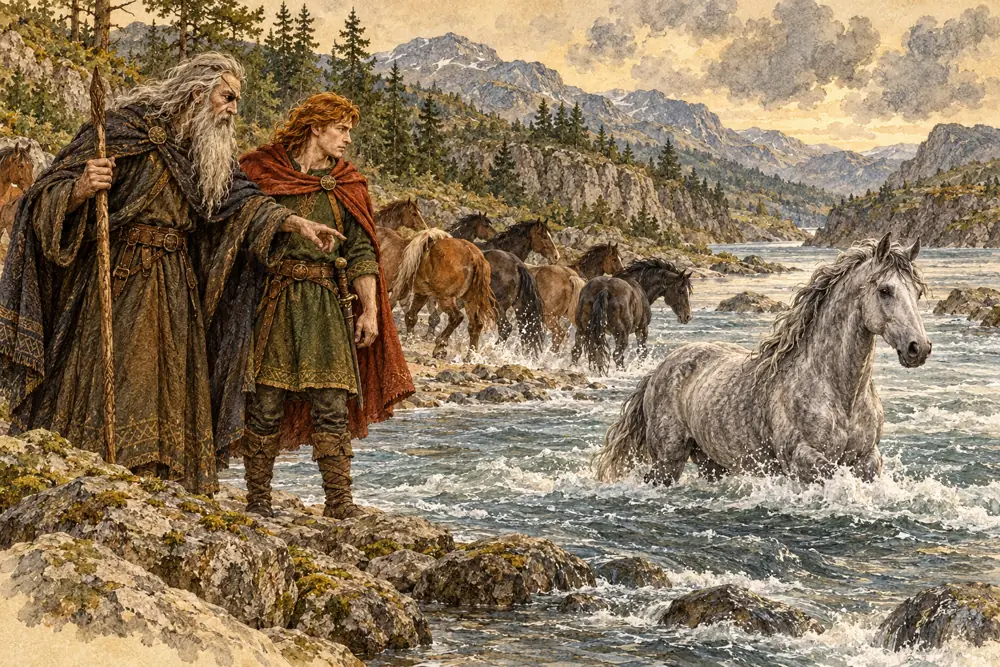
2 min read
Odin helps Sigurd choose Grani
A long-bearded stranger helps the young Sigurd test a herd of horses. The one that remains in the river becomes Grani, whose ancestry reaches back to Odin’s own horse Sleipnir.
Read the story ↗