Other powers
Gullveig
The mysterious figure burned and reborn
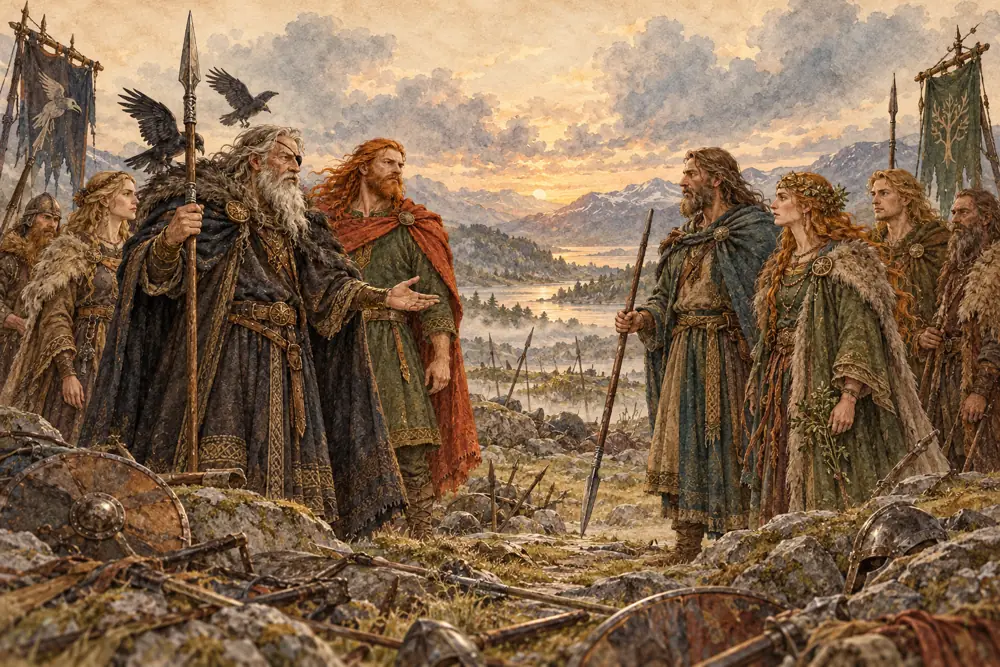
Gullveig appears in a compressed and difficult passage of Völuspá. The poem recalls violence against her in the hall of the High One: she is attacked and repeatedly burned, yet lives again. The passage stands close to the account of the first war.
Explore the stories ↓
Gullveig and Heid
The following stanza describes a seeress called Heid, associated with powerful magic. Readers commonly connect the two figures, but the poem does not supply a full explanatory biography. Its dense sequence of burning, survival, magic and conflict has generated several interpretations.
Why uncertainty matters
One influential suggestion identifies Gullveig with Freyja. That remains an interpretation rather than an explicit statement in the poem. It is equally unsafe to invent a separate goddess with a fully documented family and portfolio simply because the name is memorable. The responsible approach is to read the short passage, explain its proximity to the Æsir–Vanir conflict and distinguish the surviving lines from attempts to reconstruct what older audiences may have understood without explanation.
The burning comes before the war narrative
Völuspá places Gullveig’s repeated burning in the sequence that leads into conflict among the gods. She is pierced with spears and burned in the High One’s hall, yet continues to live. The poem then describes a figure called Heid practicing seeress magic. The relationship between those names is often understood as continuity, but the compressed verses do not read like a modern biography with every transition explained. They also do not identify Gullveig’s parents, assign her a named husband or narrate an expedition in search of gold.
A connection is not a complete explanation
After these verses the poem turns to divine deliberation and warfare, including Odin throwing a spear and the defensive wall being breached. Readers can reasonably investigate connections among violence against Gullveig, magic and the conflict between Æsir and Vanir. It is less secure to claim that the poem explicitly supplies every motive for the war or directly calls Gullveig Freyja. Those stronger statements combine interpretation with the surviving narrative. Keeping the distinction visible lets the passage remain dramatic without giving it a falsely complete plot or a settled identity that the wording itself does not provide.
Read behind the retelling
Sources & limits
Gullveig is not explicitly identified as Freyja in Völuspá; her exact identity remains debated.
Retold in contemporary English. Dialogue is summarized, not presented as a translation. How to read our sources and versions.
Follow the thread