
A Norse story · 2 min read
Freyja’s necklace in Sörla þáttr
A late medieval tale of desire, theft and endless battle
The famous necklace-acquisition story survives in a Christian-framed narrative, centuries after the Viking Age.
A story with its own viewpoint
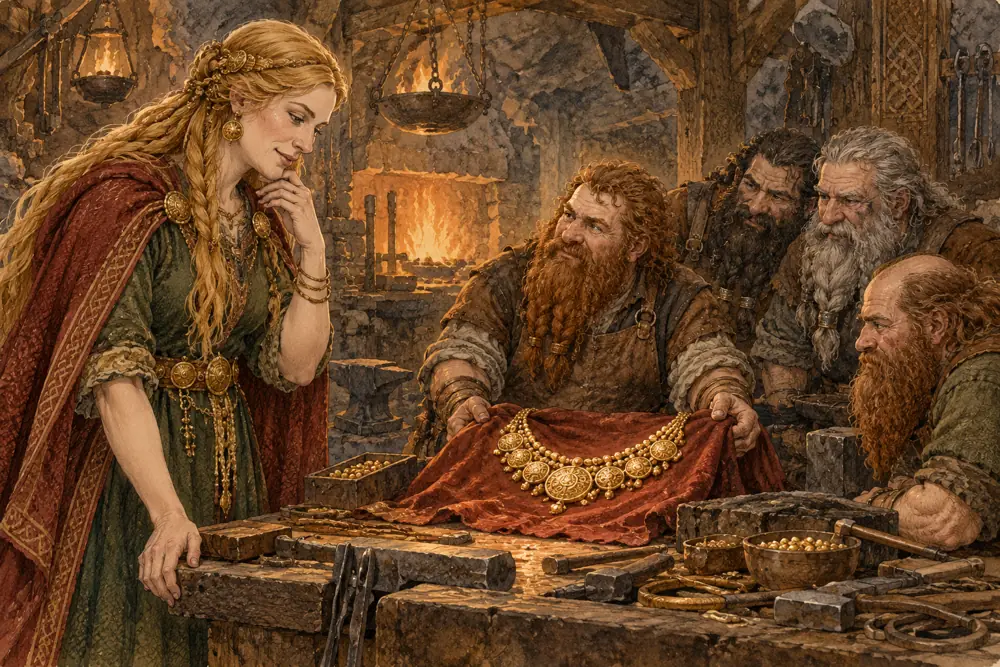
Sörla þáttr places Odin and Freyja in an imagined Asian kingdom, treating Odin as a king and Freyja as his mistress. This is not the same presentation as the gods in the Eddic poems. Four skilled dwarfs make a beautiful necklace. Freyja wants it and offers treasure, but they demand intimacy rather than money: she spends a night with each and receives it. The episode belongs to the tale’s particular portrayal of the old gods, not to a neutral account of Viking-age worship.
The locked room
Loki reports the acquisition to Odin, who orders him to steal the necklace. Freyja’s room is locked, so Loki becomes a fly and eventually finds a tiny opening. Inside, he sees her asleep with the clasp beneath her. Changing into a flea, he bites her so that she turns over. He then removes the necklace and carries it to Odin. The sequence depends on small transformations and patient theft rather than an open contest of strength.
Odin’s condition
When Freyja demands the necklace back, Odin sets a condition. She must cause two great kings to fight under a spell that makes the fallen rise and continue the conflict. Their suffering can end only through the intervention of a suitably favoured Christian man. She agrees, and the narrative develops into the story of Hedin and Hogni. Its conclusion gives Christian power the ability to release people from a disaster associated with the old divine world.
Why it needs a separate label
The story is valuable evidence for medieval storytelling about the gods. It is not equally strong evidence for what Viking-age worshippers believed about Freyja. Older sources know Brísingamen and a conflict involving Loki, but that does not prove that every detail here was already part of the same ancient account. The familiar title “Freyja’s necklace” is retained for readers, while the late source and its religious frame remain visible. The Húsdrápa seal contest with Heimdall is another witness and should be read separately.
Read behind the retelling
Sources & limits
Late medieval, explicitly Christian-framed tradition; includes a non-graphic sexual bargain. Kershaw’s printed translation elides part of the bargain rather than translating it fully.
- Sörla þáttr, chapters 1–2, N. Kershaw translation (1921)
- Sörla þáttr, chapters 1–2, Old Norse text (including the bargain omitted by Kershaw)
- Skáldskaparmál, chapter 8: separate older necklace tradition
Retold in contemporary English. Dialogue is summarized, not presented as a translation. How to read our sources and versions.
Another thread to follow

2 min read
Loki’s quarrel at Ægir’s feast
Loki enters the gods’ feast and attacks one guest after another in a formal exchange of insults.
Read the story ↗
2 min read
Idunn and the stolen apples
A bargain forced from Loki delivers Idunn to Thjazi. Without her, the gods discover that their youth is not secure.
Read the story ↗
2 min read
The builder of Asgard’s wall
A builder nearly earns the sun, moon, and Freyja. Loki disrupts the work, and the gods’ protected settlement acquires a troubling history.
Read the story ↗