
Beliefs & Stories · Focused study
The Hunterston Brooch: An Older Treasure with Scandinavian Runes

In Brief
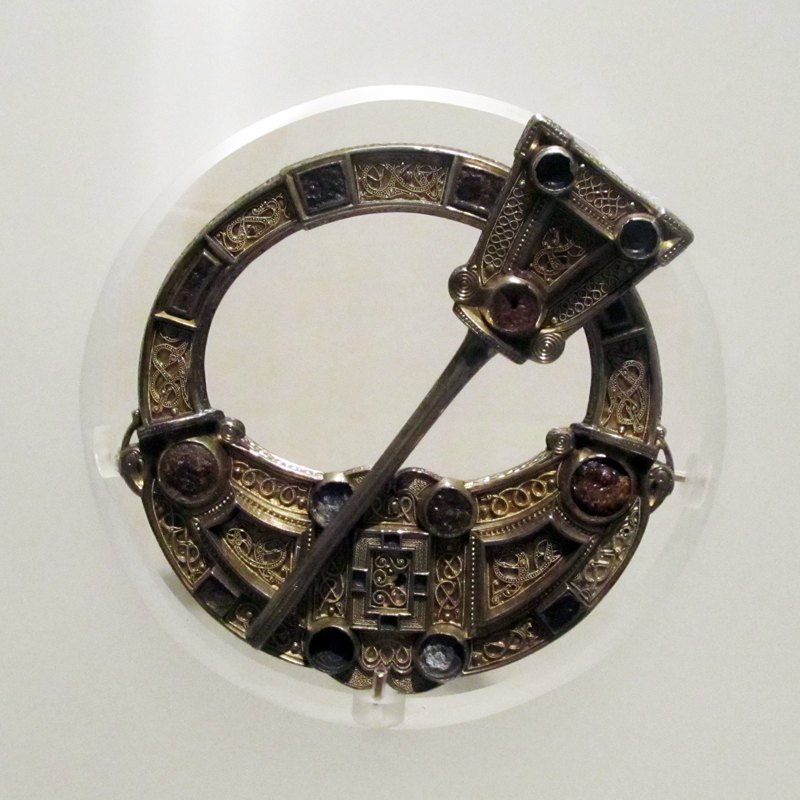
The Hunterston Brooch is not a straightforward example of Viking manufacture. Made around 700, it later received Scandinavian runes: an unusually vivid reminder that treasured objects could outlive their first cultural setting.
On this page
A brooch before the Viking AgeLook beyond the glitterHow the Christian interpretation is builtA later message on the backSourcesA brooch before the Viking Age
National Museums Scotland identifies Ireland or western Scotland as possible places of manufacture. The materials include silver, gold and amber, with elaborate gold filigree decorating the front. Its catalogue records the findspot as Hunterston in Ayrshire and associates a later owner with the name Melbrigda. These are separate kinds of information: findspot, suggested production region and personal association should not be collapsed into a single origin story.
The approximate date of 700 puts its manufacture before the conventional late-eighth-century beginning of the Viking Age. Its later history, however, makes it relevant to understanding that period. People did not discard every older possession when a modern historical boundary was crossed.
Sources for this section: 1
Look beyond the glitter
Curator Alice Blackwell interprets the ornament as more than a demonstration of wealth. Within the terminal designs she identifies two concealed beasts flanking a small cross panel. Amber settings help form the creatures' eyes and mouths; parts of the design can also be read as birds. The decoration rewards a slow examination rather than a single glance.
In this reading, visual complexity is purposeful. A wearer could display precious materials openly while carrying imagery whose relationships required close attention. That gives us a more interesting model of elite jewelry than the assumption that every patterned surface was simply decoration.
Sources for this section: 2
How the Christian interpretation is built
Blackwell's scholarly study compares the Hunterston design with other metalwork and sculpture. It proposes that the animals and central Christian symbol belong to a wider family of images connected with the recognition of Christ by two creatures. The argument depends on recurring relationships between motifs, not merely on finding a cross-shaped detail.
Such comparisons are useful because an image can be highly abbreviated without being meaningless. They also leave room for debate about what an individual viewer recognized. We can explain the published interpretation without pretending to recover every response of the brooch's successive owners.
Sources for this section: 3
A later message on the back
The Scandinavian runic inscription was added centuries after the original manufacture. Its position on the reverse places a later act of marking beside older spiral and interlace ornament. The object therefore preserves more than one historical moment on the same surface: the original design was not erased when somebody gave the brooch a new written association.
This is the practical lesson for reading museum labels. 'Viking' may describe an episode in an object's life rather than its workshop or first owner. Hunterston helps connect studies of runes, inherited possessions and Christian art, while resisting the idea that those subjects belong in sealed cultural compartments. The physical brooch is the link between them; the exact sequence of transfers remains missing.
Sources for this section: 1, 2, 3
The Evidence
The sources below support this article. Interpretations and limits are explained in the text; this is not an exhaustive research review.