
Journeys & Encounters · Deep dive
Frisian Intermediaries: Trade across a Varied North Sea Coast
In Brief
Merchants connected ports and river routes, but their work should not be turned into a stereotype about an entire coastal population.
On this page
Frisia was more than a maritime labelIntermediaries connected different economic zonesYork supplies a useful comparisonA coin from Domburg’s beachSilver combined local and distant connectionsDeposition is a question of motiveCommunication was part of commercial workNetworks do not require a single identitySourcesFrisia was more than a maritime label
Early medieval Frisia is often imagined as one continuous trading society stretching along the North Sea coast. Gilles de Langen and J. A. Mol challenge that picture through landscape analysis for roughly 650–850. Their study distinguishes coastal districts and asks where permanent trading centers actually existed. Outside the major emporia at strategically placed rivers and coasts, everyday exchange did not necessarily require separate market settlements. Much prosperity remained rooted in agricultural production. This distinction changes the starting point: merchants operated within a varied rural and political environment. Their long journeys do not demonstrate that every coastal household depended primarily on overseas commerce.
Sources for this section: 1
Intermediaries connected different economic zones
A study of Carolingian economic connections brings written references to merchants at London, York, and the Baltic into comparison with exported goods recovered archaeologically. Dorestad, Ribe, and Hedeby belonged to overlapping routes rather than a single enclosed market. Intermediaries mattered because goods rarely explain their own movement. A Rhineland product found in Scandinavia could have passed through several hands, ports, and forms of transport. This is an analytical possibility, not proof of a particular itinerary. The importance of Frisian merchants lies in evidence that they participated in such connections, not in an assumption that they personally carried every continental object to its final destination.
Sources for this section: 2

York supplies a useful comparison
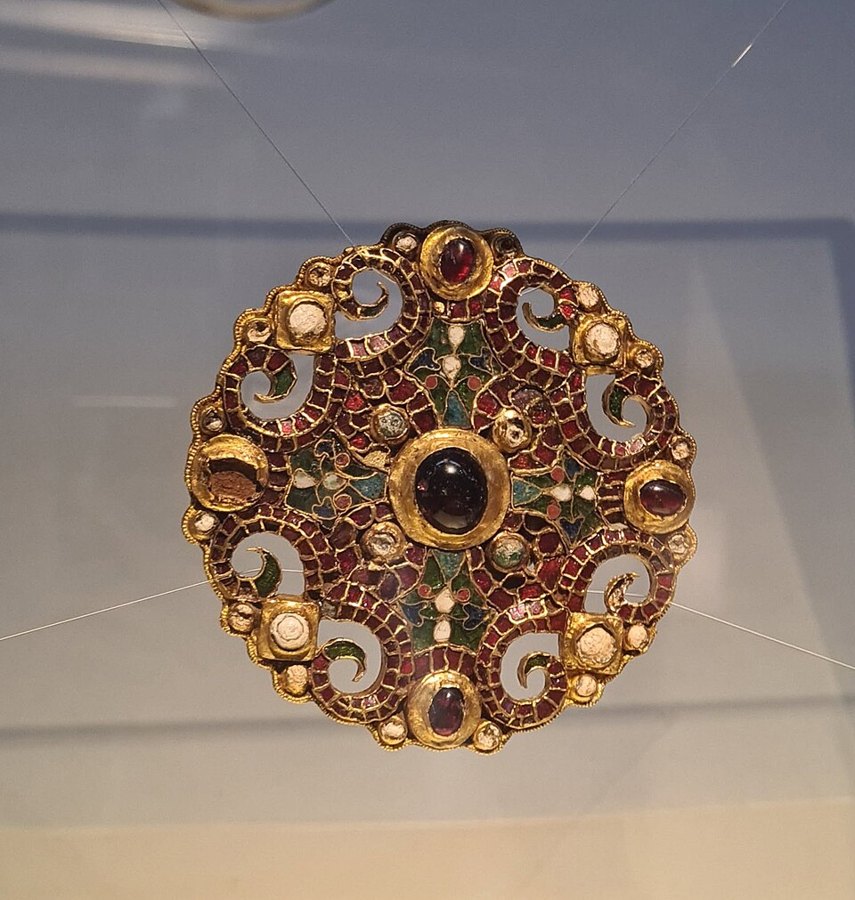
The Fishergate excavation report discusses imported material in Anglian York alongside documentary references to Frisian traders. It compares the assemblage with other trading settlements, including Hamwic and London, where coins, glass, pottery, querns, and whetstones indicate wider contacts. The comparison is stronger than treating a single object as the signature of an ethnic colony. Different materials can independently point toward exchange, while written testimony identifies some of the people involved. Yet the two forms of evidence operate at different resolutions. A text naming traders does not locate every house they occupied, and an imported object does not preserve the language or ancestry of its owner.
Sources for this section: 3
A coin from Domburg’s beach
A coin preserved by the Royal Zeeland Scientific Society offers a small but specific example of coastal connections. Cataloged as Series X, type 31, it is dated to 725–800 and attributed to Denmark, possibly Ribe. It was recovered on the beach at Domburg. The collection record describes a facing head on one side and a stylized animal on the other. These details identify an object with a documented collection history, while its place of manufacture remains qualified. A production attribution and a findspot establish two points in its biography. They do not identify the merchant, route, or transaction that carried it between them.
Sources for this section: 4
Silver combined local and distant connections
The Westerklief hoard on Wieringen contains silver ornaments, ingots, and coins inside a Badorf ceramic pot. The Rijksmuseum van Oudheden gives its total silver weight as 1,662 grams and identifies the latest coin as dating to 850. This combination is more informative than the generic label Viking treasure. Coinage, bullion, ornament, and a continental vessel bring several systems of production and value into one deposit. They demonstrate that different material traditions could coexist in a person’s or group’s accumulated wealth. The hoard does not identify all the exchanges that assembled it. Its composition nevertheless makes a useful counterpoint to any account that treats trade as a series of culturally isolated transactions.
Sources for this section: 5
Deposition is a question of motive
The museum discusses more than one explanation for Westerklief’s burial. It may have been wealth stored for later recovery; another hypothesis links it to an agreement during a change of power. Grass preserved with the deposit has been used to infer springtime burial. These interpretations should remain distinct from the securely observed contents. A hoard is evidence of an action, but its motive has to be argued from context. The same silver could participate in trade, payment, gift exchange, or political settlement before being buried. Calling it commercial wealth alone would therefore narrow its history prematurely, just as calling it plunder would assume an acquisition process the objects do not directly record.
Sources for this section: 5
Communication was part of commercial work
The collection Frisians and their North Sea Neighbours draws attention to a question often hidden behind maps of exchange: how merchants and makers from different regions communicated. Ports can be described as meeting places without explaining the practical work of making a transaction intelligible. Language, repeated contact, and recognizable objects or measures all deserve investigation, although a particular arrangement cannot be supplied without evidence. This shifts attention from routes as lines to relationships as activities. An intermediary’s value could include familiarity with people and expectations as well as possession of a boat or stock. The surviving record is uneven, but the question prevents trade from becoming an impersonal movement of commodities.
Sources for this section: 6
Networks do not require a single identity
Taken together, landscapes, imports, documents, coin evidence, and hoards support a history of overlapping connections. They do not justify imagining all Frisians as merchants or every merchant on the coast as Frisian. The distinction preserves the importance of named traders while allowing rural production, political authority, and mixed material practices to remain visible. It also improves comparison with Scandinavian participants. People could cooperate across regional boundaries without sharing one identity, and objects could travel farther than any individual owner. The most useful reconstruction therefore asks who is directly attested, what moved, where evidence survives, and which steps between those points remain inferred.
Sources for this section: 1, 2, 3, 4, 5, 6
The Evidence
The sources below support this article. Interpretations and limits are explained in the text; this is not an exhaustive research review.
- De Langen and Mol: Landscape, Trade and Power in Early-Medieval Frisia ↗
- Michael McCormick: Connections in Origins of the European Economy ↗
- York Archaeological Trust: Anglian Settlement at Fishergate ↗
- Royal Zeeland Scientific Society: Domburg Series X coin GM7557 ↗
- Rijksmuseum van Oudheden: Westerklief hoard ↗
- Frisians and their North Sea Neighbours: research collection ↗