
Journeys & Encounters · Deep dive
Truso: An Organized Waterfront on the Southern Baltic

In Brief
Regular plots, casting debris, and a small silver hoard reveal how manufacture and exchange shaped the settlement identified with Wulfstan’s Truso.
On this page
A named destination and an excavated settlementMaking access to water part of the planExchange and manufacture in the same placeA casting fragment under the microscopeA small hoard with a long historyThe missing cemetery and the people of TrusoSourcesA named destination and an excavated settlement
Truso first enters the discussion through a voyage. Wulfstan described sailing from Hedeby to a trading place near the Vistula's mouth in the late ninth century. His account was incorporated into the Old English geographical material associated with King Alfred's translation of Orosius. The name survived in writing long before archaeologists located a convincing settlement counterpart.
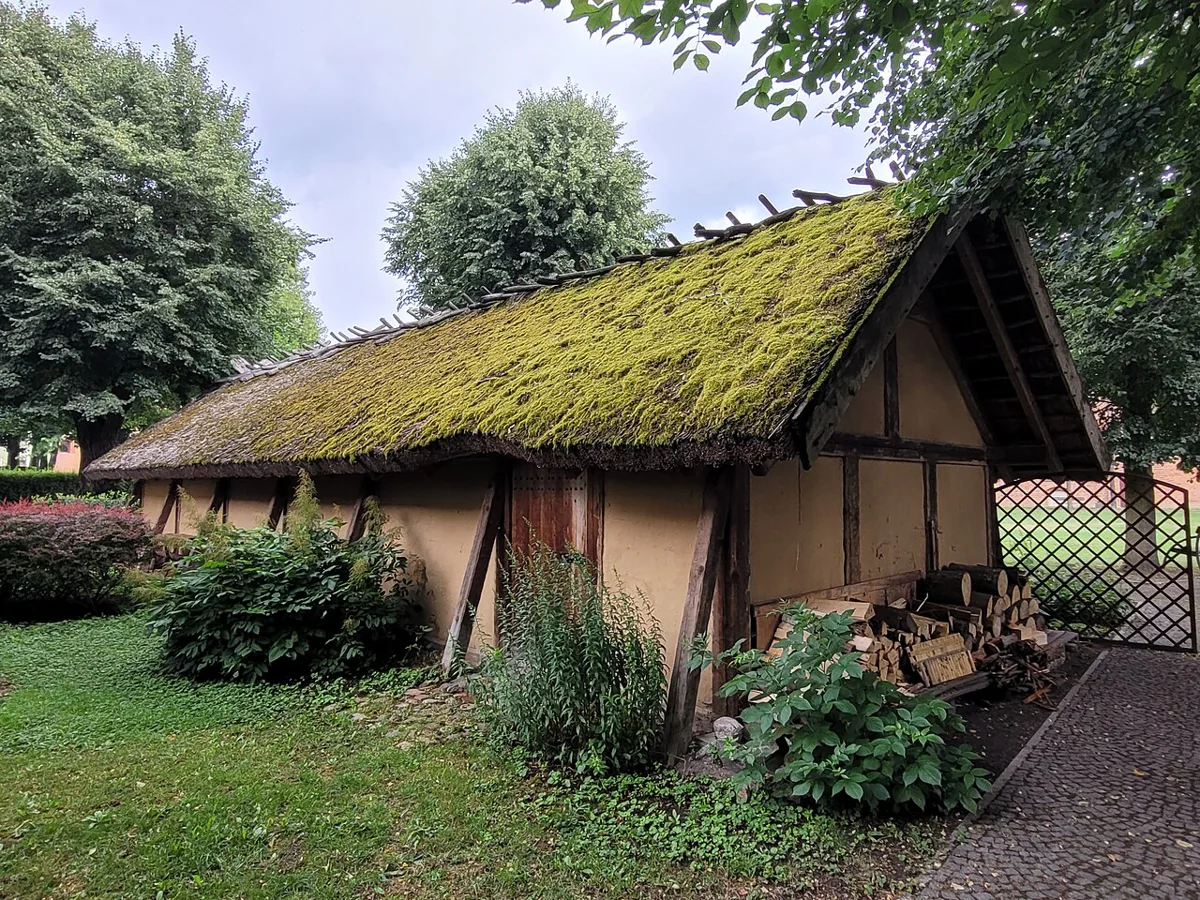
The site at Janów Pomorski, beside Lake Drużno near modern Elbląg, was identified through research in the early 1980 s. The combination of geographical position, chronology, and evidence for exchange underpins its identification with Truso. This is more substantial than finding a similar modern place-name. It also distinguishes the written destination from the excavated settlement: the voyage provides one historical viewpoint, while buildings and objects reveal activities extending beyond a traveler's brief report. Neither source contains a complete population history or a record of every commercial connection.
Sources for this section: 1
Making access to water part of the plan
Marek Jagodziński's synthesis divides the settlement into port, central, and peripheral zones. Excavation revealed regular plots in at least parts of the port and central areas. The recorded plots were approximately 10–11 meters wide and 25–30 meters long, but their orientation differed according to location.
In the central zone, their long axes ran parallel to the shore. Many port-zone plots faced the water with their shorter ends, an arrangement interpreted as giving more properties access to the waterfront. Buildings followed this organization alongside passageways and a regulated stream. The geometry suggests deliberate coordination rather than a completely accidental accumulation of huts. It does not reveal the legal terms of ownership or identify an individual planner. What can be reconstructed is the practical problem being addressed: fitting buildings, movement, and access to boats into a limited waterfront. Urban organization becomes visible through repeated spatial relationships.
Sources for this section: 2
Exchange and manufacture in the same place
The Freiburg–Elbląg research account reports hundreds of coins and weights, together with balances. These finds support the identification of an exchange center. Manufacturing evidence adds another dimension: antler waste and unfinished objects indicate comb production, while amber occurred as raw material, intermediate pieces, and completed ornaments or gaming objects.
Tools and crucibles further indicate ironworking and nonferrous metalworking. Such evidence distinguishes production from the mere possession of finished imports. A completed comb might have arrived with a traveler; manufacturing waste is more directly connected with work at the site. The research account also identifies connections with Slavic, Baltic, Scandinavian, and western European material traditions. Those patterns describe cultural and commercial relationships. They do not require every artifact category to correspond neatly to one resident ethnic group. Truso's position near interacting regions makes that distinction especially important when reconstructing its community.
Sources for this section: 3
A casting fragment under the microscope
Specialist study of Truso's metalworking examines modest debris alongside finished ornaments. One fragment was interpreted as a pouring channel from a lost-wax casting mold. Chemical analysis detected small amounts of zinc and tin in residue on its inner surface. Another fragment preserved the impression of a tiny straw stem in clay.
Organic additions could help a casting mold vent after burning out, creating small passages through which gases escaped. That technological interpretation connects microscopic traces with a practical manufacturing problem. A different ceramic piece bearing metal residue was harder to classify: possible refining equipment and a hearth component were considered. The authors called for further specialist analysis. These examples show the different confidence levels within one workshop assemblage. A fragment's material, shape, residue, and surface impressions must be assessed together; calling every heat-affected ceramic piece a crucible would erase distinctions between casting, refining, and furnace construction.
Sources for this section: 4
A small hoard with a long history
A silver deposit discovered in 1986 contained 11 whole coins and five fragments. The museum identifies Abbasid dirhams alongside a Sasanian drachma bearing the image of Khusro II, whose reign ended in 628. Much younger coins in the same deposit show that the older piece remained available long after its original political setting disappeared.
The hoard therefore records more than a direct journey between a mint and Truso. Coins could circulate, be retained, and change function before being deposited together. Mint identifications demonstrate distant origins, while the mixture of whole pieces and fragments reveals the form in which silver reached the burial place. The museum considers economic and ritual explanations for concealment. Neither the owner's intention nor the precise goods originally exchanged for these coins can be recovered from the deposit alone. Its strongest evidence is the physical conjunction of silver with different production dates and origins.
Sources for this section: 5
The missing cemetery and the people of Truso
The settlement's inhabitants remain harder to reconstruct than its crafts. In 2020, the Elbląg museum described a targeted search for an associated cemetery. Historical information and geophysical results guided small test trenches and a larger excavation area in Janów. The project aimed to locate burials that could address origins, status, cultural practices, and funerary behavior.
That research question exposes a limitation in confident ethnic descriptions of the settlement. Scandinavian-style buildings and objects are important evidence, but burials and biological analysis could contribute different kinds of information. A craft tradition can be learned, an ornament exchanged, and a household connected with several regions. The cemetery search should therefore be understood as an attempt to expand the evidence, not merely confirm an identity already assigned to every resident. Truso is most securely understood as an organized waterfront community whose manufacturing and exchange connected people across the southern Baltic.
Sources for this section: 6
The Evidence
The sources below support this article. Interpretations and limits are explained in the text; this is not an exhaustive research review.