
Journeys & Encounters · Deep dive
Salme: Two Ship Burials and an Early Baltic Expedition

In Brief
Two vessels on Saaremaa preserve a collective burial from around 750, with weapons, provisions, gaming equipment, and evidence for movement across the Baltic.
On this page
Two ships, forty-one peopleReconstructing vessels from iron and sandWeapons placed with the deadFood animals and birds of preyTracing origins without assigning a hometownAn expedition before the familiar beginningSourcesTwo ships, forty-one people
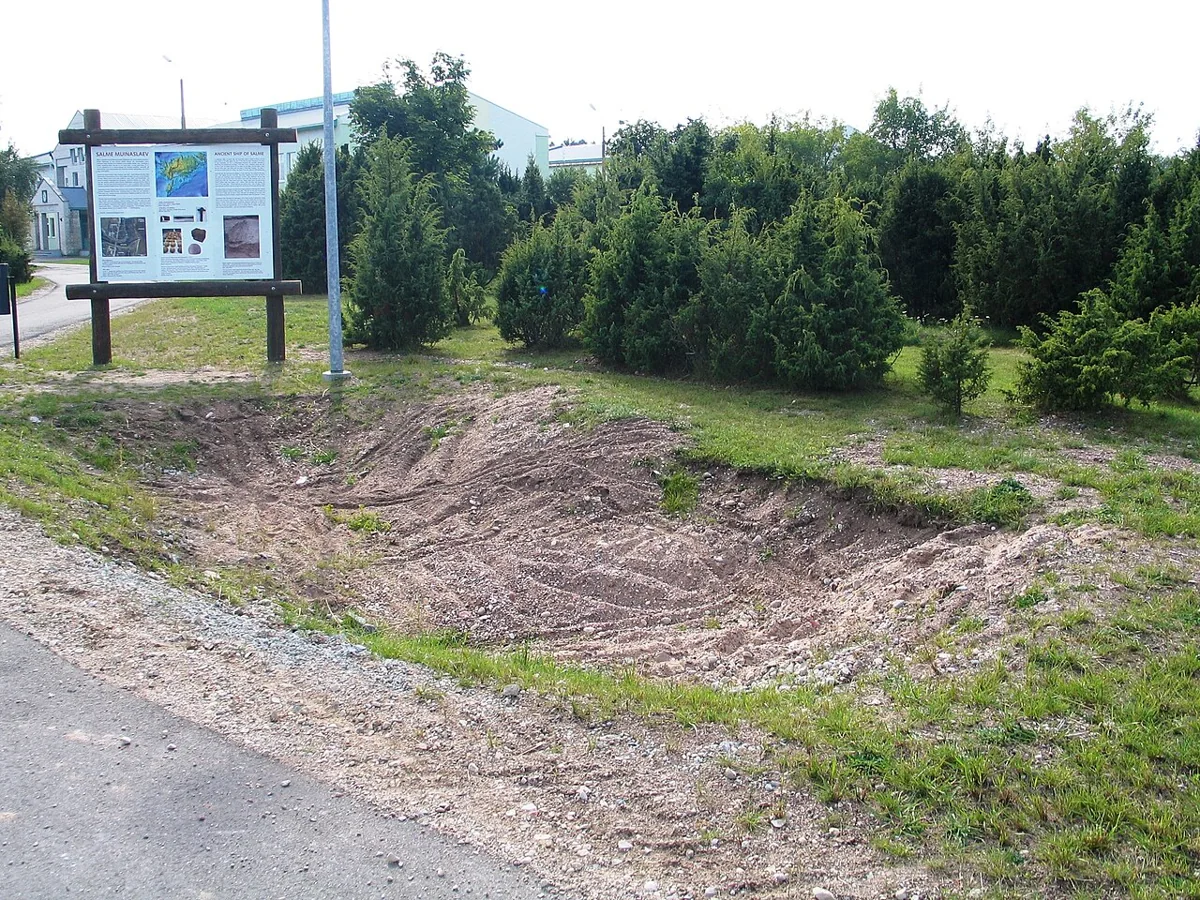
At Salme on the Estonian island of Saaremaa, discoveries in 2008 and 2010 revealed two vessels used for collective burial. Seven people were identified in Salme I and 34 in Salme II. The combination of ships, human remains, and unusually rich equipment made the site fundamentally different from a single elite burial with one principal occupant.
Tallinn University's 2023 publication presents the fieldwork and catalog rather than treating the finds simply as illustrations of a known historical story. Weapons, combs, knives, whetstones, gaming equipment, and animal remains offer several overlapping kinds of evidence. Their combination resembles Scandinavian material and burial practices more closely than contemporary local assemblages. That comparison is a starting point for investigating travel, not a substitute for studying the people themselves. The graves preserve the aftermath of an expedition whose participants cannot be named from a surviving written account.
Sources for this section: 1
Reconstructing vessels from iron and sand
The Salme ships did not survive as complete wooden hulls. Much of their form was reconstructed from rivet positions and traces left in the surrounding sediment. Marge Konsa's heritage report describes Salme I as a light clinker-built vessel about 11.5 meters long and two meters wide. Overlapping planks were secured with iron rivets, and no mast trace was recognized.
Salme II was substantially larger, approximately 17.5 meters long, with construction interpreted as suitable for sailing. The difference matters because the two graves do not simply contain interchangeable copies of one boat type. They represent different capacities within the same expeditionary setting. Measurements are reconstructions from surviving evidence, and published estimates vary in some details. Nevertheless, the rivet patterns distinguish a narrow rowing vessel from a larger seagoing ship. Even where timber has vanished, the distribution of its fastenings can preserve the geometry of construction.
Sources for this section: 2
Weapons placed with the dead
The report on the 2011–2012 excavations describes roughly 40 swords from Salme II, many represented by fragments. Ten single-edged swords were complete, whereas double-edged examples had been broken. The authors anticipated further examination to establish the precise number represented by those fragments. A count of pieces is therefore not automatically a count of separate weapons.
Fourteen deliberately damaged shield bosses were recorded with the uppermost layer of bodies. Their position prompted the suggestion that shields formed a covering over the dead. This is an interpretation of the distribution, not a preserved wooden lid. The combination of weapons and careful deposition complicates a simple picture of bodies abandoned after combat. Whoever arranged the burial retained access to equipment and made choices about its placement. Damaged objects can record both violence and funerary treatment, and distinguishing those processes requires attention to fracture patterns and archaeological context.
Sources for this section: 3
Food animals and birds of prey
The osteological study of Salme I identified cattle, sheep or goats, pigs, and birds of prey. Many mammal bones came from meat-bearing portions of carcasses, while heads and lower limb elements were largely absent. Butchery traces supported the interpretation that portions of meat had been brought into the vessel rather than complete livestock.
The birds presented a different pattern. Researchers identified a female goshawk and a female sparrowhawk, with missing head elements and evidence of bodily changes sustained during life. Hunting use was considered plausible. Their presence should not be collapsed into the same category as butchered provisions. Food portions, valued animals, and funerary deposits could enter a burial through different actions. This particular study concerned Salme I, so its observation that dogs and horses were absent cannot be generalized to every part of the Salme complex. The two vessels must first be compared as separate assemblages.
Sources for this section: 4
Tracing origins without assigning a hometown
A 2020 study examined isotope evidence for the individuals from both vessels. Most had strontium values higher than those characteristic of the Estonian comparison areas. Combined with archaeological evidence, the results favored the Mälaren region of east-central Sweden as the likely origin of much of the group.
Five individuals in Salme II had lower values that could fit Gotland, but also other possible locations. That qualification is essential: similar geological environments can produce overlapping signals. The study compares regional baselines rather than reading a unique address from each tooth. Its results suggest that the buried group need not have shared one narrowly defined childhood location. They also demonstrate why artifact styles and human mobility evidence should be assessed together. Scandinavian-looking equipment may move through exchange, while tooth enamel records aspects of an individual's childhood environment; agreement between them strengthens an interpretation without eliminating all geographical alternatives.
Sources for this section: 5
An expedition before the familiar beginning
Uppsala University's Viking Phenomenon project situates Salme around 750, several decades before the 793 attack on Lindisfarne often used to introduce the Viking Age. This chronology shifts attention toward the Baltic and toward practices already developing during the period conventionally called Vendel in Sweden.
The project describes the group as a probable raiding party while also acknowledging uncertainty about the expedition's precise character. Armed travel can involve raiding, diplomacy, escort, and exchange in combinations that the grave assemblage cannot fully separate. The secure contribution is chronological and geographical: a substantial Scandinavian-connected group crossed the Baltic and was buried on Saaremaa before the famous western raids. Salme does not replace one universal starting date with another. It supplies a detailed early case through which historians can examine how organized maritime movement, elite equipment, and collective violence developed before the conventional period boundary.
Sources for this section: 6
The Evidence
The sources below support this article. Interpretations and limits are explained in the text; this is not an exhaustive research review.
- Tallinn University: fieldwork and catalog publication ↗
- Marge Konsa: Two Vendel Era ship burials, Estonian Cultural Heritage ↗
- Peets and colleagues: excavation results2011–2012 ↗
- Allmäe, Maldre, and Tomek2011: osteology of SalmeI ↗
- Price and colleagues2020: human remains and places of origin ↗
- Uppsala University: Salme and the Viking Phenomenon ↗