
Journeys & Encounters · Deep dive
Alfred and Guthrum: How a Negotiated Peace Worked
In Brief
A short agreement brings boundaries, social rank, trade, and personal guarantees into the same political settlement.
On this page
Two settlements that should not be mergedBoundary and compensationMovement, guarantors, and trustBaptism as a public relationshipGuthrum’s coinage presents another identityAlfred’s lawmaking had a wider settingWhy later manuscripts matterReading agreement as an achievementSourcesTwo settlements that should not be merged
Accounts of Alfred’s victory in 878 describe Guthrum accepting baptism and leaving Alfred’s kingdom. The surviving document commonly called the Treaty of Alfred and Guthrum is a different kind of evidence: a compact legal agreement defining relations between rulers and their subjects. A Bristol study draws attention to the danger of merging the narrative of the settlement after Edington with this surviving text. The distinction changes what can be claimed. A chronicle can place a ceremony within a sequence of campaigns; a legal document can prescribe conduct without describing the negotiation that produced it. Neither genre supplies every detail found in the other. Labeling everything the Treaty of Wedmore hides those differences instead of explaining them.
Sources for this section: 1
Boundary and compensation
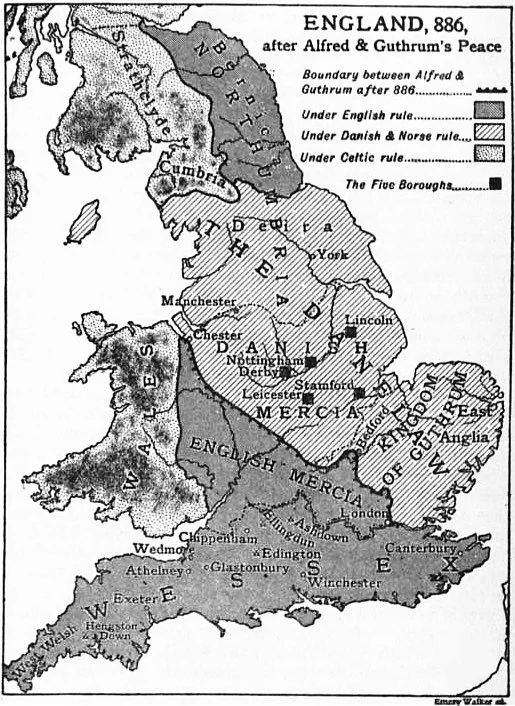
The agreement traces a boundary using rivers, a town, and a road: the Thames, Lea, Bedford, Ouse, and Watling Street. Its compensation provisions equate English and Danish people within specified social categories while preserving distinctions of rank. This is legal reciprocity, not modern equality. The practical comparison is between people recognized as corresponding in status on opposite sides. A map alone misses that concern. The settlement also needed a way to classify an injury and decide what an obligation amounted to when the parties belonged to different political communities.
Sources for this section: 2

Movement, guarantors, and trust
Other clauses require support for oaths, identifiable warrantors in transactions involving enslaved people and livestock, and permission for movement between the communities. Necessary trade could proceed with hostages guaranteeing peaceful conduct. These are mechanisms for managing risk. The text assumes that contact will occur, but treats unregulated movement as a problem. It also places enslaved human beings inside a category of transferable property, revealing a social order that peaceful relations between rulers did not abolish. Negotiation reduced some conflicts while leaving profound inequalities intact.
Sources for this section: 2
Baptism as a public relationship
The account transmitted through Asser connects Guthrum’s baptism with Alfred’s participation and with ceremonies at Aller and Wedmore. The Bristol discussion notes that Guthrum arrived with a selected group of followers. This was therefore a public relationship involving political communities, rather than merely an inaccessible private change of belief. We can analyze the ceremony’s political setting without claiming to know Guthrum’s inner convictions. The account also matters because a ruler could continue to exercise authority after accepting a rival’s sponsorship. The choice was not limited to unqualified military independence or disappearance. Religious ceremony offered another language through which an unequal settlement could be made durable.
Sources for this section: 6
Guthrum’s coinage presents another identity
Numismatic research identifies Guthrum’s coinage under his baptismal name, Æthelstan. A British Numismatic Journal study describes a horizontal type closely imitating Alfred’s coin design. This gives material evidence for political presentation that differs from the treaty’s legal language. The coins show a ruler using a Christian royal name and a recognizable monetary form. The same study explains how the Cuerdale hoard helped scholars distinguish this coinage from earlier issues of another East Anglian Æthelstan. Attribution was therefore an argument built from comparison, rather than something obvious from a single name. The coins do not preserve the treaty’s signature, but they help us see Guthrum as a continuing ruler with an institutional public identity.
Sources for this section: 3
Alfred’s lawmaking had a wider setting
Alfred’s own law collection, the domboc, was much more expansive than the bilateral agreement. Its modern critical edition describes a composition combining biblical legal material, Alfred’s ordinances, and the earlier laws of King Ine. Topics extended from sanctuary and feuding to theft. The comparison is revealing: the treaty addressed relations between two bodies of subjects, while the lawbook placed royal legislation within inherited and sacred traditions. Both involved selection and arrangement. Neither was simply a complete description of everything that happened in practice. Asking who a text addresses and what authority it claims is more useful than assuming that every royal legal statement served the same purpose.
Sources for this section: 4
Why later manuscripts matter
The history of early English law continued through later copying. Textus Roffensis, compiled at Rochester in the early 1120s, preserves a collection of early legal material rather than a snapshot of one king’s reign. UNESCO’s account identifies 35 early English law codes in its first part. This illustrates the transmission environment in which earlier legislation survived: readers with later interests collected, ordered, and preserved texts. A compilation puts earlier enactments beside later ones, making it possible for a reader to compare rulers and legal traditions within a single volume. Manuscript dates, textual dates, and modern editorial reconstruction are separate stages of the evidence.
Sources for this section: 5
Reading agreement as an achievement
The strongest conclusion is not that Alfred drew a permanent ethnic border across England. The surviving provisions show an attempt to make specific relationships governable: territory, compensation, legal proof, property transfer, and controlled contact. Baptismal narrative and coinage add different dimensions to that process. Together they portray a settlement that depended on recognition and practical rules as well as force. The comparison also explains why its survival is valuable. A campaign narrative can tell us who won a confrontation; a negotiated document asks what people were expected to do afterward. That second question brings ordinary disputes and transactions into a history too often told only through victorious kings.
Sources for this section: 1, 2, 3, 4
For the introductory context, read The Danelaw: Boundaries, Law, and Local Lives.
The Evidence
The sources below support this article. Interpretations and limits are explained in the text; this is not an exhaustive research review.
- Bristol doctoral research: treaty and post-Edington settlement ↗
- Fordham Medieval Sourcebook: Alfred and Guthrum’s Peace ↗
- British Numismatic Journal: Guthrum’s coinage ↗
- Cambridge University Press: The Laws of Alfred ↗
- UNESCO UK: Textus Roffensis ↗
- Fordham Medieval Sourcebook: Asser’s Life of King Alfred ↗