
Journeys & Encounters · Deep dive
Æthelred: Diplomacy, Government, and a Reputation for Failure
In Brief
The king’s nickname is familiar; his treaties, diplomas, and coinage reveal a more demanding historical problem.
On this page
A nickname is already an interpretationRouen in 991Negotiating with Scandinavian leadersDiplomas record a functioning courtThe difference between a document and an eventA rare coin type responds to crisisWulfstan’s warning was an interventionAssessing failure without simplifying itSourcesA nickname is already an interpretation
Æthelred’s name means noble counsel, while the later nickname plays on counsel that is bad or ill-considered. Simon Keynes’s comparative study of Alfred and Æthelred treats their familiar epithets as products of developing reputations rather than transparent contemporary character assessments. This does not require reversing the verdict and declaring Æthelred secretly successful. It requires setting the outcome of his reign beside evidence for what he and his advisers actually attempted. A king can lose power while presiding over sophisticated institutions; he can also issue ambitious policies that fail in practice. Those possibilities should be investigated rather than settled by the nickname.
Sources for this section: 1
Rouen in 991
Jenny Benham’s reassessment examines the Anglo-Norman treaty concluded at Rouen in March 991. Instead of treating it only as another failed response to Scandinavian attacks, she analyzes the negotiation as an example of medieval diplomatic practice and arbitration. This changes the scale of the question. The treaty’s value is not confined to whether it permanently ended danger from overseas. It also shows how rulers sought to manage disputes and relations through agreed procedures. Evaluating such an agreement requires attention to the problems it addressed, the participants who could implement it, and the kinds of guarantee available in its political world.
Sources for this section: 2

Negotiating with Scandinavian leaders
The agreement usually called II Æthelred is associated with a settlement in 994 between the English king and Scandinavian leaders. The Early English Laws project describes provisions for peace and for coexistence between their followers. It survives in a twelfth-century manuscript and also entered Latin legal compilation. The text therefore provides evidence of negotiated rules, while its transmission warns against imagining an untouched original sitting before us. Negotiation was not an alternative to politics; it was one of its instruments. It could divide opponents, regulate contact, and create obligations that might be useful even without ending all future violence.
Sources for this section: 3
Diplomas record a functioning court
Research on Æthelred’s diplomas traces continuities with the documentary practices of Edgar’s reign. Formulae for royal subscriptions, witness lists, exemptions, and dating carried through the early years of the new rule. Such documents are not exciting in the manner of a battle narrative, but their structured language preserves the operation of authority. A land grant needed to be expressed, witnessed, and retained in a form that could support a claim. Changes in formula or witness group can therefore illuminate the people and procedures through which government worked. Diplomas reveal an institutional history that does not disappear merely because a later narrative emphasizes disaster.
Sources for this section: 4
The difference between a document and an event
A diploma records an authoritative claim about a transaction; it is not the transaction itself preserved without mediation. The study of diplomatic formulae is valuable precisely because copied or altered texts must be assessed against known patterns. Repeated language can identify continuity in production, while an unusual combination can invite closer examination. That method supports a more disciplined use of royal paperwork. It avoids both dismissing legal documents as empty rhetoric and reading every surviving clause as an uncomplicated fact. In Æthelred’s case, the collective series makes it possible to examine governing practice across years rather than only at moments selected by chroniclers.
Sources for this section: 4
A rare coin type responds to crisis
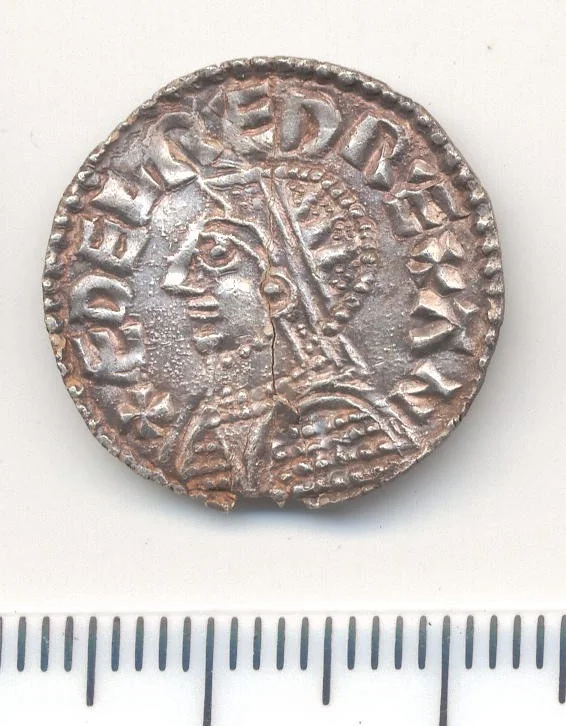
Keynes and Rory Naismith’s study examines the Agnus Dei pennies, a distinctive and rare part of Æthelred’s coinage. The type has been interpreted in the context of the invasion led by Thorkell in 1009. Their article also updates the known corpus as additional specimens were reported. This is a useful reminder that historical interpretation depends on an evolving sample. A rare issue can illuminate a focused response without standing for the whole currency system. The combination of religious imagery and a monetary object also connects public messaging with an institution capable of producing and distributing standardized coinage.
Sources for this section: 5
Wulfstan’s warning was an intervention
Wulfstan’s Sermo Lupi ad Anglos addresses a community facing invasion and political upheaval. Oxford’s account describes it as a text preserved in five manuscripts and repeatedly revised by its author. Its denunciations must therefore be read as an effort to change conduct, not a detached statistical description of social collapse. The sermon’s force came from making disaster morally intelligible and urging reform. Its versions also show that such an intervention could be adapted. When historians use its dark picture, they need to preserve its rhetorical purpose alongside the circumstances that made that purpose urgent.
Sources for this section: 6
Assessing failure without simplifying it
The reign’s final crises are not erased by treaties, diplomas, coins, or sermons. What these sources change is the explanation. They show rulers and advisers negotiating, documenting property, managing currency, and attempting to restore order through religious and legal language. These activities can coexist with military defeat and political miscalculation. A satisfactory account therefore asks which measures worked, for whom, and for how long, rather than assuming that every action of an unsuccessful king was inherently foolish. The distinction produces a more exact history of failure: one rooted in institutions, decisions, opponents, and changing circumstances rather than in a memorable pun.
Sources for this section: 1, 2, 3, 4, 5, 6
For the introductory context, read Danegeld: Paying for Peace, Paying for Defense.
The Evidence
The sources below support this article. Interpretations and limits are explained in the text; this is not an exhaustive research review.