
Journeys & Encounters · Deep dive
Sweyn Forkbeard: From Campaigns to the English Crown
In Brief
The conquest of 1013 depended on movement, submission, supplies, and a political objective that had developed over time.
On this page
Objectives changed over a generationThe route into EnglandSubmission had practical consequencesRecognition and the limits of a short reignA coin presents a Danish kingDeath became a saint’s victoryComparing a chronicle, a coin, and a miracleConquest as a processSourcesObjectives changed over a generation
Research on Sweyn’s invasions emphasizes a movement from raiding and tribute toward conquest across the period from 991 to 1014. That distinction prevents the final result from being projected backward as an unchanging plan. An expedition seeking payment and an effort to replace a king could use similar ships and fighters while requiring different political outcomes. The study also cautions against assuming that larger Scandinavian forces automatically represented a completely new form of state army. Scale, recruitment, and purpose need to be examined separately. A successful conquest was the product of changing circumstances as well as the ambitions of its leaders.
Sources for this section: 1
The route into England
The Chronicle’s entry for 1013 takes Sweyn from Sandwich around East Anglia, into the Humber, and up the Trent to Gainsborough. The Ashmolean’s presentation of the text makes the importance of waterways clear. This was not simply a march inland from the nearest beach. The route brought the force into contact with northern and eastern political communities before its advance south. Reading the place sequence on a map explains how a fleet and an inland campaign could form parts of the same operation. The narrative records an ordered progression, although it does not provide a daily itinerary or complete account of resistance along the way.
Sources for this section: 2

Submission had practical consequences
The same entry associates submission with hostages, provisions, and horses. Sweyn left ships and hostages with Cnut before advancing southward. These details connect political recognition to logistics. A promise of obedience mattered partly because it could make resources available and reduce the need to secure every district by battle. Hostages created a continuing relationship after the main force moved on. The army’s mobility therefore depended on more than the technical qualities of its ships. It also depended on decisions made by local leaders and on arrangements that turned an initial advance into a sustainable campaign.
Sources for this section: 2
Recognition and the limits of a short reign
The National Museum of Denmark summarizes Sweyn’s achievement as recognition as England’s king in 1013, followed by his death the next year. The brevity of that rule matters. Winning recognition did not give him a long period in which to make the new arrangement durable. His son’s later conquest should therefore not be treated as a seamless continuation of settled administration. The museum places Sweyn’s achievement at the foundation of a wider North Sea monarchy, but a foundation is not the completed structure. The distinction helps preserve both the importance of 1013 and the additional political work required afterward.
Sources for this section: 3
A coin presents a Danish king
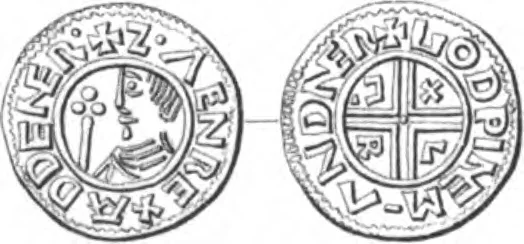
A Swedish History Museum record describes a silver penny issued around 995 in Sweyn’s name, following an English model. Its inscription identifies him as king of the Danes and names the moneyer Godwine. The coin survives as part of a hoard from Uppland, giving it a later archaeological context beyond its place of manufacture. The object connects royal naming, technical imitation, and circulation. It cannot reveal the exact route by which it reached the hoard, but it shows why Sweyn’s history should not be limited to battlefield narratives. Coin production was another way to make authority visible and transferable.
Sources for this section: 4
Death became a saint’s victory
Later traditions associated Sweyn’s death with the intervention of St Edmund. Research on royal saints at the University of Southern Denmark examines accounts in which the king’s demands on the religious community provoked a supernatural response. These are evidence for the development of the saint’s cult and the community’s understanding of protection. They are not contemporary medical reports explaining why Sweyn died. Their political content is nevertheless substantial: a ruler who could compel submission elsewhere was represented as unable to override the saint’s rights. The legend turns an abrupt death into a narrative of institutional authority and divine defense.
Sources for this section: 5
Comparing a chronicle, a coin, and a miracle
The three forms of evidence locate power differently. The campaign entry presents movement and successive submission. The coin names a ruler through a portable object modeled on an established monetary form. The saint’s story imposes a boundary on royal demands through retrospective religious narrative. None is a complete biography, but their differences are productive. Together they reveal military organization, public kingship, and the later memory of coercion. They also prevent a modern account from assuming that a ruler’s success was understood in the same way by an army, a moneyer, and a religious community.
Sources for this section: 2, 4, 5
Conquest as a process
Sweyn’s career illustrates why conquest needs more than a date and a list of victories. Objectives could change; waterways connected distant districts; submission supplied resources; and recognition required continued maintenance. His short English reign ended before those arrangements could acquire a long history under his own authority. Cnut’s subsequent achievement belongs to the same family story without making the two reigns identical. The strongest account therefore follows both continuity and interruption. It gives Sweyn credit for a major political result while preserving the instability that followed and the different memories that his campaigns left behind.
Sources for this section: 1, 3, 4, 5
The Evidence
The sources below support this article. Interpretations and limits are explained in the text; this is not an exhaustive research review.