
Journeys & Encounters · Deep dive
The Five Boroughs: Five Towns, Different Histories
In Brief
Names, pottery, and coinage reveal a regional network that cannot be reduced to a single color on a political map.
On this page
When the collective name appearsAdministrative importance outlived conquestDerby complicates the language mapLincoln’s streets and workshopsA pot from one town can illuminate anotherThe uneven visibility of a mintWhy surviving numbers can misleadA regional network rather than five identical townsSourcesWhen the collective name appears
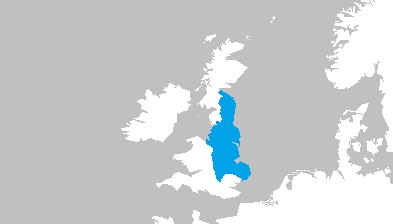
The term Five Boroughs occurs in a poem entered under 942 in the Anglo-Saxon Chronicle. The University of Nottingham’s regional project identifies the towns as Derby, Leicester, Lincoln, Nottingham, and Stamford. The date of that surviving label is important. It does not prove that the five places had always formed one unchanged institution throughout Scandinavian settlement. A collective name can describe a particular political moment while drawing together towns with older and different histories. The poem is evidence for how a regional grouping was expressed, and the towns’ continued administrative importance helps explain why the grouping remained attractive to later historians.
Sources for this section: 1
Administrative importance outlived conquest
The regional project links the boroughs’ growth with administration and trade. It also emphasizes their continuing importance after conquest by West Saxon rulers. That continuity makes the towns useful for studying political change without assuming complete social replacement. A new ruler could benefit from an existing center of collection, exchange, and jurisdiction. The same street or market might serve successive authorities. The implication is not that conquest was harmless, but that a political transfer did not have to erase the structures that made a town valuable. Looking for both change and continuity produces a more demanding account than dividing every find into English or Scandinavian.
Sources for this section: 1

Derby complicates the language map
Of the five names, Derby alone is Scandinavian in form. The Nottingham project contrasts it with the earlier English name Norðworðig and examines whether the later form simply meant a settlement associated with deer. Another possibility connects it with the older river-name Derwent and the Romano-British settlement name Derventio. On that interpretation, settlers adapted a familiar local sound into a meaningful Norse form. The alternatives matter because an apparently straightforward etymology can conceal several languages and periods of occupation. Derby’s name need not record a moment when everyone abandoned an old identity and adopted a new one.
Sources for this section: 2
Lincoln’s streets and workshops
The regional museum account of Lincoln points to street names containing gata, the Old Norse word for street. Danesgate and Flaxengate bring that linguistic inheritance into the modern townscape. The same account describes evidence for coin production and craft activity in the former Roman city. A street name and a coin die answer different questions: one concerns language and naming, the other a specialized operation. Neither alone identifies the background of every resident. Their combination is stronger because it connects the town’s public vocabulary with activities that made it a place of work and exchange, rather than simply a fortified point on a campaign route.
Sources for this section: 3
A pot from one town can illuminate another
Pottery fragments from Derby’s Magistrates Court site include both Stamford ware and Torksey ware. The museum record describes Torksey ware as fast-wheel pottery originating in workshops around Torksey and notes its popularity at York. Stamford ware traveled more widely and included early lead-glazed vessels. These fragments demonstrate why a history organized only by political capitals misses part of the regional economy. Derby’s consumers could use products associated with other production centers. A vessel’s manufacturing tradition and its final place of deposition need to be separated. The fragments do not preserve a merchant’s itinerary, but they establish relationships that a list of town names cannot.
Sources for this section: 4
The uneven visibility of a mint
A Lincoln Museum study of the Lincoln and Stamford mints explains the difficulty of assigning early coins that lack a mint-name. Scholars compare moneyers’ names, style, and later signed issues. Such attribution is not equally secure for every coin group. Stamford’s name appears on issues associated with Edgar’s reform in the 970s, giving firmer evidence than some earlier proposed assignments. The difference between an explicit place-name and a stylistic attribution should remain visible when coins are used to reconstruct urban importance. Otherwise, a tentative identification can quietly turn into a confident statement about an entire town’s economy.
Sources for this section: 5
Why surviving numbers can mislead
The same numismatic study cautions that the apparent abundance of Stamford coins is affected by the history of hoard discovery. It discusses evidence for a large eighteenth-century find at Oakham. A heavily represented mint in surviving collections need not have produced a matching proportion of all original coinage. This is a concrete example of archaeological visibility shaping historical interpretation. The practical solution is comparison: mint signatures, die relationships, discovery records, and archaeological contexts must be considered together. Counting specimens is useful, but the count needs a history of how those specimens reached the evidence base.
Sources for this section: 5
A regional network rather than five identical towns
The comparison produces several distinct pictures: a collective political name, a difficult settlement-name, streets with a linguistic inheritance, pottery moving between centers, and mints visible through uneven coin survival. These are connected histories, but they are not interchangeable. A town could retain administrative importance while its ruler changed; a pot could travel across a jurisdiction; a Scandinavian name could incorporate an older local one. The Five Boroughs are therefore a productive starting point for regional history, provided the label does not become the conclusion. Their importance lies partly in the differences that made them useful to one another.
Sources for this section: 1, 2, 3, 4, 5
For the introductory context, read The Danelaw: Boundaries, Law, and Local Lives.
The Evidence
The sources below support this article. Interpretations and limits are explained in the text; this is not an exhaustive research review.