
Words and their meaning
What does it say?
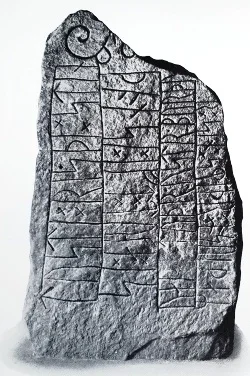
Toste remembers his brother Tue, who worked as Asved’s smith and died in the east. The short text gives both a craft association and a direction of travel without naming a destination.
An editorial summary of the inscription’s meaning, not a complete word-for-word translation. For the full reading and alternative interpretations, follow the inscription source below.
Look closer
The stone had been reused as a threshold between the church and its porch. Its account of an eastern death should not be turned into a claim about one particular country.
Compare the surviving carved surface with the published reading. Painted lines, repairs, lighting, and weathering can affect what is visible in a photograph.
Sources and further reading
- Coordinate source ↗https://samlinger.natmus.dk/dmr/asset/179585
- Further source ↗https://runer.ku.dk/q.php?p=runer/genstande/genstand/103
- Further source ↗http://www.kulturarv.dk/fundogfortidsminder/Lokalitet/125362
Source check: 2026-10-17. Periods and readings can be revised as research develops.