
Journeys & Encounters · Deep dive
Myklebust: A Large Ship, Fragmentary Evidence, and a Modern Reconstruction
In Brief
The Myklebust burial is known through fastenings, grave goods, excavation records, and renewed investigation. The imposing modern ship makes one interpretation tangible without replacing those fragmentary sources.
On this page
A famous discovery without a complete hullWhy thirty meters is an interpretationCremation evidence and the limits of a funeral narrativeReopening an old trench rather than excavating everythingSurveying the mound and its surroundingsThe modern ship as craft and public interpretationSourcesA famous discovery without a complete hull
In 1874, Anders Lorange investigated a large burial mound at Myklebust in Nordfjordeid after the farmer contacted Bergen Museum. The excavation revealed an exceptionally rich ship burial, but it did not produce a standing wooden vessel comparable to the later Gokstad and Oseberg discoveries. Its evidence included numerous iron fastenings, shield bosses, weapons, and cremated remains.
That difference in preservation has shaped the find's public history. A nearly complete displayed hull offers visitors an immediately recognizable object. Thousands of metal pieces require explanation before they become evidence for a ship. Neither presentation measures the original importance of the burial. Myklebust's significance lies in the combination of objects and recorded context, including the actions performed during the funeral. The absence of a complete wooden hull changes the questions researchers can answer and the confidence with which they can reconstruct its proportions.
Sources for this section: 2
Why thirty meters is an interpretation
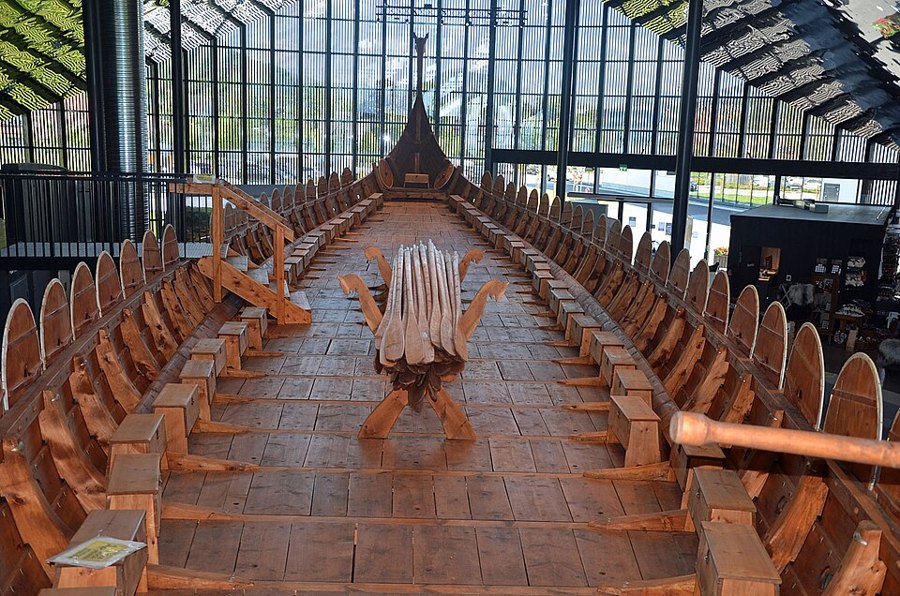
Sagastad presents a reconstructed ship thirty meters long and six meters wide. The estimate for the original draws on the quantity and dimensions of fastenings, the extent of deposits in the mound, and the recovered shield bosses. The museum records forty-four ancient bosses; the modern vessel's equipment should not be confused with an exact inventory of the burial.
Each line of reasoning involves assumptions. Nail dimensions can constrain the thickness of material they joined, but do not independently provide a complete hull plan. Shield numbers may help discuss scale and crew, but converting them directly into evenly spaced rowing stations requires an additional model. The University Museum of Bergen gives a broader original length estimate of twenty to thirty meters. Presenting that range alongside the modern thirty-meter boat makes the interpretive step visible. A complete reconstruction needs one chosen dimension even where archaeology supports a range.
Sources for this section: 1, 2

Cremation evidence and the limits of a funeral narrative
The Bergen museum account describes burnt human remains placed in an ornate bronze vessel, with shield bosses and other objects arranged around the burial. It also records damaged weapons and substantial burnt material. Museum accounts have traditionally interpreted the find as a cremation involving the ship. This is a reconstruction of a sequence of acts from archaeological deposits, rather than an eyewitness description of the ceremony.
Several further stories require caution. Identifying the deceased with a named ruler in later saga tradition is an attractive possibility, not a demonstrated personal identification. Likewise, an arrowhead among the remains does not by itself establish an exact cause of death. Keeping the strongest observations separate from proposed explanations allows the burial to remain historically rich. It gives access to deliberate treatment of bodies and objects without pretending that every participant, motive, and stage of the funeral is known.
Sources for this section: 2
Reopening an old trench rather than excavating everything
The limited investigation in 2024 returned to material associated with Lorange's nineteenth-century trench. Vestland County explains that the purpose included establishing where and how extensively the earlier excavation had cut the mound, and whether ship remains were still present. Additional fastenings were recovered from material left by the earlier investigation. This was not a new complete excavation of the whole monument.
The distinction has important consequences for interpretation. An object in old excavation backfill may still be valuable for study, but its position there is not necessarily its original position in the burial. Researchers must reconstruct two histories together: the ancient deposition and the modern disturbance. The quantity recovered from an old trench also cannot be treated as a fresh, undisturbed sample of the entire ship. The investigation improves understanding precisely by recording the limits of its intervention, rather than claiming to settle every question about the mound.
Sources for this section: 3
Surveying the mound and its surroundings
The University of Stavanger's geophysical report describes a survey commissioned in connection with the renewed investigations. Its aims included defining the mound, looking for internal structures, and investigating possible features around it. That wider area matters because a monumental ship burial was situated within a landscape, not inside the isolated outline shown in a museum diagram.
Survey and excavation provide different kinds of evidence. A subsurface contrast can suggest a feature worth investigating, but its appearance alone does not supply a personal name or a complete historical function. An excavation trench can identify material directly while examining only a limited area. Combining those approaches requires matching their scales and uncertainties. For Myklebust, that means treating the ship remains, the nineteenth-century trench, the mound boundary, and neighboring traces as related but distinct questions. A clearer map is a starting point for interpretation, not the same thing as a fully recovered ancient scene.
Sources for this section: 4, 3
The modern ship as craft and public interpretation
Sagastad's reconstruction was built by experienced boatbuilders from Bjørkedalen and launched in 2019. Its finished form includes choices about missing hull structures and decoration. Those choices draw on practical craft knowledge, but the resulting boat cannot be a direct copy of timbers that no longer survive. It is a working interpretation built at full scale.
The center's architecture reinforces the relationship between boat and burial: its circular room refers to the mound's diameter, while a large opening allows the modern vessel to move outside for launching. That presentation makes scale physically understandable. Visitors can compare their own bodies with the hull and appreciate the coordinated labor involved in moving it. The strongest interpretation keeps that experience connected to the archaeological fragments. The modern ship demonstrates what its builders made and can operate; the original evidence remains the basis for judging how closely particular features may approach the ancient vessel.
Sources for this section: 1, 5
Explore this burial record and its sources in the map collection →
No precise burial-site coordinate or current visitor access has been verified. This entry supports reading and search.
The Evidence
The sources below support this article. Interpretations and limits are explained in the text; this is not an exhaustive research review.