Creatures
Garm
The bound hound at the edge of catastrophe
Garm, Old Norse Garmr, is a fearsome hound associated with the approach of Ragnarök. Völuspá repeatedly evokes his howling before Gnipahellir as bonds break and destruction nears. The refrain makes him an audible warning within the prophecy.
Explore the stories ↓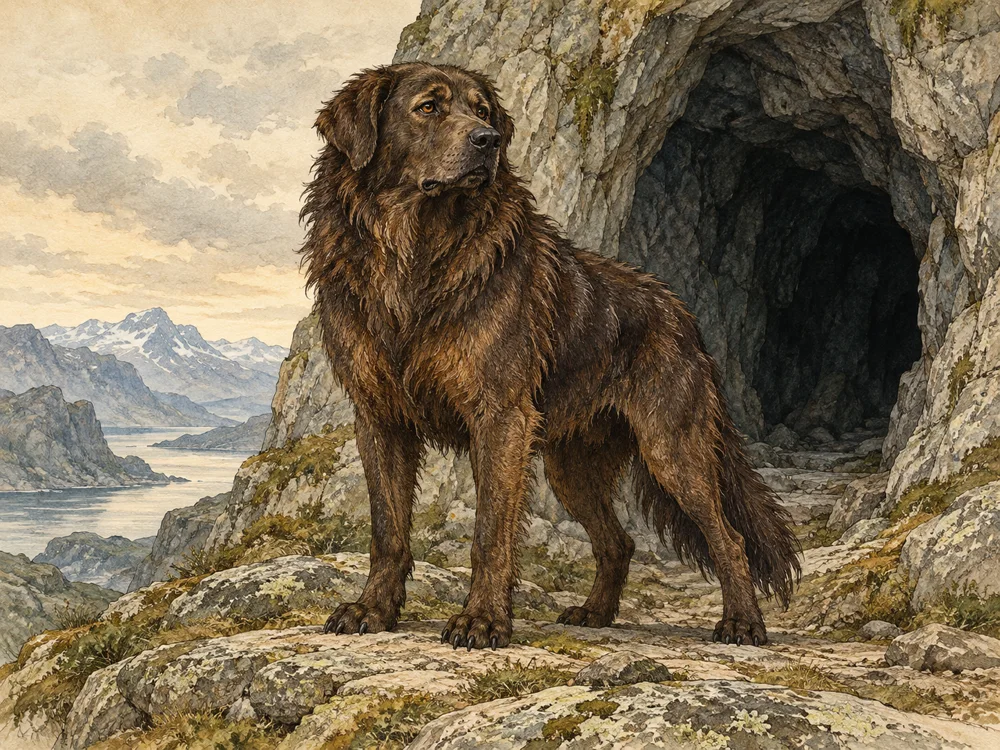
The fight with Tyr
Gylfaginning gives Garm a specific opponent in the last battle. Once released, he fights Tyr, and each kills the other. This account distinguishes him from Fenrir, who devours Odin before being killed by Vidar. Keeping those encounters separate helps readers follow the final battle without merging every threatening canine into a single monster.
Where the evidence ends
Garm is also named in Grímnismál among outstanding beings, as the foremost of hounds. The sources do not provide a detailed owner, upbringing or series of earlier adventures. Calling him simply “Hel’s pet” adds a relationship not established by these passages. Comparisons with other underworld dogs can be interesting, but should be presented as comparisons, not as proof that the traditions tell an identical story.
The howl returns as catastrophe approaches
Völuspá repeats the image of Garm howling before Gnipahellir as the final crisis unfolds. The repetition works like an alarm within the prophecy, alongside other sounds and signs that the world’s established order is breaking. It is not a sequence of separate journeys by the hound. The passage also speaks of a breaking bond and a running wolf, contributing to the difficulty of assigning every detail to a neatly separated creature.
The duel supplied by Snorri
Gylfaginning gives Garm a specific opponent: he fights Tyr, and each kills the other. That is distinct from Fenrir swallowing Odin and being killed by Vidar. The distinction is useful when following Snorri’s battle, even though the poems are less systematic about the relationships among their threatening canines. Neither this duel nor the howling refrain establishes a detailed earlier career as Hel’s trained gatekeeper. The surviving account gives a final action without providing that fuller biography.
Read behind the retelling
Sources & limits
Whether some poetic wolf and hound imagery overlaps is debated; Snorri’s final-battle account treats Garm and Fenrir separately.
- Prose Edda: Gylfaginning (Brodeur, 1916)
- Poetic Edda: Völuspá (Bellows, 1923)
- Poetic Edda: Grímnismál (Bellows, 1923)
- Poetic Edda: Völuspá, public-domain Bellows translation
- Prose Edda: Gylfaginning, Brodeur translation (1916)
Retold in contemporary English. Dialogue is summarized, not presented as a translation. How to read our sources and versions.
Follow the thread