Gods & companions
Hnoss and Gersemi
Freyja’s daughters and the language of precious things
Hnoss and Gersemi are names associated with Freyja’s daughters and with precious possessions. They are briefly recorded rather than given extensive independent adventures.
Explore the stories ↓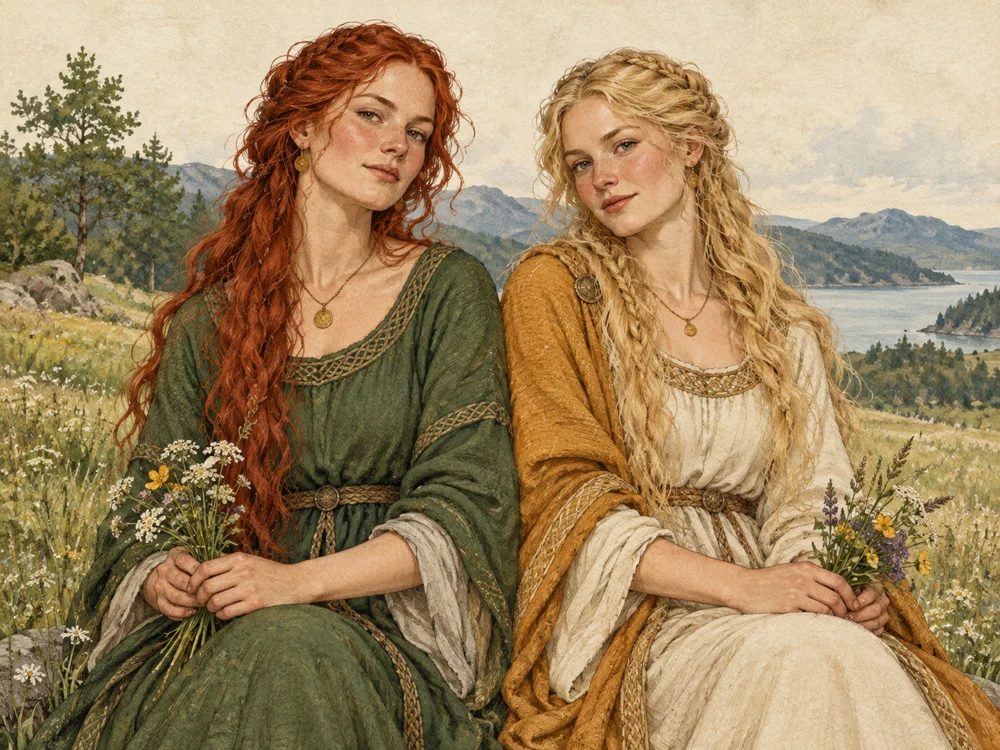
Two accounts of the family
Gylfaginning names Hnoss as the daughter of Freyja and Odr and connects her beauty with the word for a precious object. Ynglinga saga names two daughters, Hnoss and Gersemi, and makes a similar connection with treasured things. The accounts differ in how many daughters they mention; the shorter list need not be treated as an explicit denial of the longer one.
Names without a recovered cycle of stories
Neither passage supplies a detailed childhood, a marriage story or a collection of quests. Ynglinga saga also frames the gods as figures in a remote human past, so its context differs from Gylfaginning’s mythological presentation. Keeping that distinction visible is more useful than combining the references into a fabricated continuous biography.
A daughter becomes a poetic treasure
Hnoss also belongs to the language of poetry. In Skáldskaparmál, Snorri lists Freyja’s motherhood among the relationships that poets can use to identify her. Elsewhere he preserves praise poetry in which a precious object can be described through Freyja’s daughter. This is not a separate adventure in which Hnoss turns into a jewel. It is a poetic way of making kinship and the language of treasure work together.
Reading a name without inventing a biography
The surviving references give Hnoss a stronger place in poetic examples than Gersemi. That imbalance does not establish that one sister mattered more in every historical community. It tells us what these particular texts preserve. Neither sister has an attested marriage quest, magical weapon or role in Ragnarök in these passages. A modern illustration can imagine their appearance, but details such as clothing, hair color and personalities should remain identified as artistic choices.
Read behind the retelling
Sources & limits
The two names survive in brief genealogical explanations. A detailed shared mythology is not preserved in these passages.
- Gylfaginning, chapter 35
- Ynglinga saga, “Of Freya and her daughters” (chapter 13 in this translation)
- Prose Edda: Skáldskaparmál, Brodeur translation (1916)
Retold in contemporary English. Dialogue is summarized, not presented as a translation. How to read our sources and versions.
Follow the thread