
Creatures
Níðhöggr
The creature beneath the world tree
Níðhöggr is a threatening creature associated with the lower regions of the mythic world. In descriptions of Yggdrasil, he damages the tree from below. He also appears in the darker visions of death and the world’s future in Völuspá.
Explore the stories ↓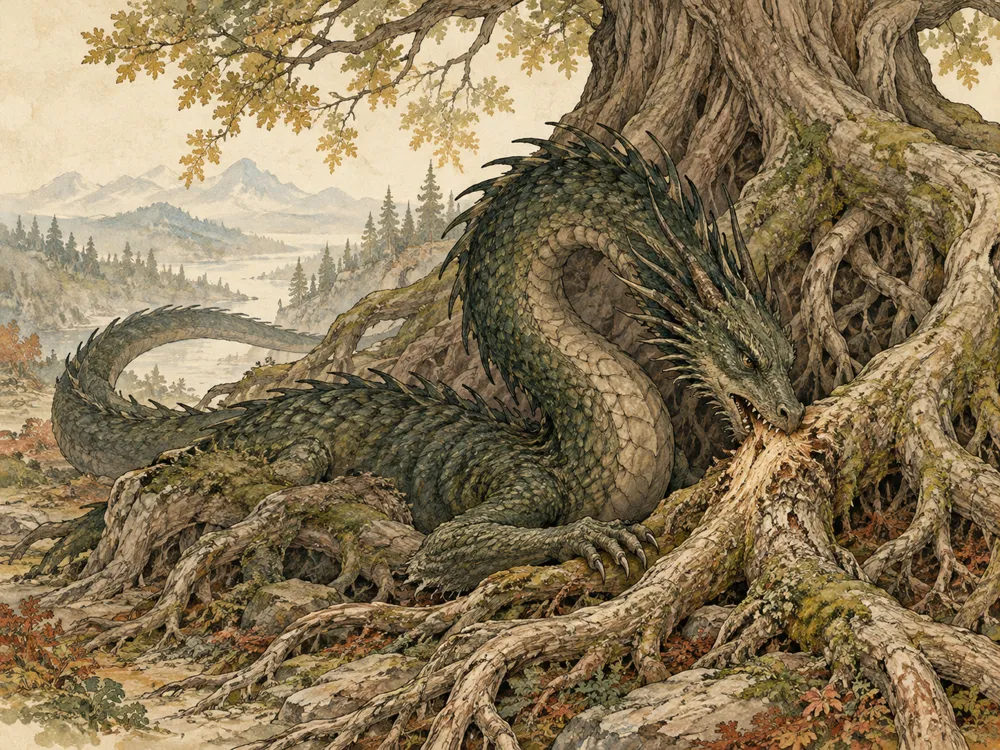
At the roots
Grímnismál describes the suffering of the ash: animals feed on it above while Níðhöggr harms it below. Gylfaginning places him among the serpents at Hvergelmir and describes the squirrel Ratatosk carrying hostile words between him and the eagle above. The tree is a living structure under strain, rather than an untouched decorative symbol.
The closing vision
Völuspá associates Níðhöggr with corpses and ends with a disturbing image of a flying dragon carrying bodies. Its position after the vision of renewal has prompted different interpretations. Readers should not be told with certainty that this proves either a complete victory of evil or an endless cycle of identical worlds. The poem supplies an image, not a detailed explanation of its meaning.
A damaged tree, not an untouched paradise
Grímnismál places Nidhogg within a whole system of damage to Yggdrasil. Deer feed above, the tree suffers decay along its sides, and the dragon gnaws below. Other serpents are named beneath the ash as well. Snorri develops the picture with the Norns tending the tree using water and clay from the well. Destruction and care thus coexist around the same living structure. Nidhogg is important within that picture, but the texts do not make him the sole cause of every injury to the world-tree, nor do they describe a single battle in which the other creatures join forces against him.
The disturbing last image in Völuspá
Near the poem’s end, after scenes of the earth rising again and gods meeting after catastrophe, Nidhogg appears flying with corpses carried in his wings. Earlier verses associate him with the dead in the grim landscape of Náströnd. The final appearance prevents a simple reading in which every threatening being has been permanently eliminated. The closing reference to sinking belongs to the seeress’s withdrawal in the usual reading, not a clear statement that the dragon is killed. The poem does not provide a subsequent expedition, defeat or reconciliation for Nidhogg. Its powerful final image remains unsettling precisely because it is not explained as a complete new adventure.
Read behind the retelling
Sources & limits
Níðhöggr is not simply another name for Jörmungandr; their roles and settings differ.
- Prose Edda: Gylfaginning (Brodeur, 1916)
- Poetic Edda: Grímnismál (Bellows, 1923)
- Poetic Edda: Völuspá (Bellows, 1923)
- Poetic Edda: Grímnismál, public-domain Bellows translation
- Poetic Edda: Völuspá, public-domain Bellows translation
Retold in contemporary English. Dialogue is summarized, not presented as a translation. How to read our sources and versions.
Follow the thread
