
Gods & companions
Ullr
The archer and swift traveller on snow
Ullr is a skilled bowman and traveller on skis, described as Sif’s son and Thor’s stepson. His Eddic appearances are brief, but his identity is more specific than a generic winter god.
Explore the stories ↓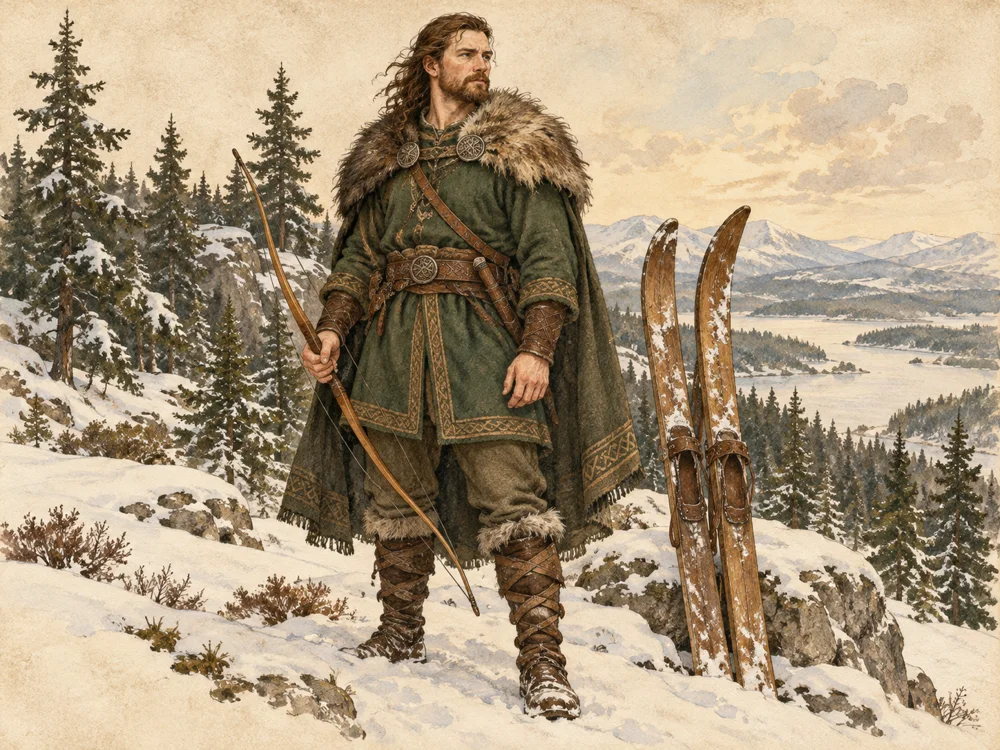
Skill, speed and kinship
Gylfaginning praises Ullr’s archery, movement over snow and qualities as a warrior. It also says that people may call on him in single combat. Older English translations may use “snowshoes” for the equipment now usually described as skis. The distinction matters visually: a modern illustration of broad racket-shaped snowshoes should not be mistaken for an exact reconstruction of the passage.
A home named Ydalir
Grímnismál names Ydalir as Ullr’s dwelling. Beyond the brief references, the Eddic material does not preserve a large cycle of adventures explaining how he acquired every skill or possession. Skáldskaparmál uses associations with Ullr in poetic language, including kennings connected with shields. Such expressions are valuable evidence, but they are not always complete stories waiting to be retold.
Letting the gaps remain
Ullr is sometimes presented as if a detailed biography of a snow-loving god has survived intact. It has not in these texts. His page preserves what is actually stated—family connection, archery, skiing, combat and dwelling—without supplying an invented father or turning a limited set of attributes into a universal ancient theology of winter.
A ring invoked when an oath is broken
Ullr appears unexpectedly in Atlakviða, during the destruction of Gunnar and Högni at Atli’s court. As Gunnar is carried toward death, Guðrún recalls the solemn promises Atli has violated. Among the things invoked in those promises is Ullr’s ring. The reference gives Ullr a place in the language of binding commitments, far from the modern image of a god concerned only with skiing. The poem does not explain where the ring came from or describe a ceremony involving it. Its dramatic function is clear, however: the betrayal is made worse because the promises had been established with sacred guarantees.
Oller’s brief replacement of Odin
Saxo’s Book III preserves a different, humanized tradition about a figure called Oller, commonly compared with Ullr. After Odin is expelled, Oller receives his authority and even his name. Nearly ten years later Odin returns, and Oller flees to Sweden, where he is killed. Saxo also says that Oller could cross water using a bone marked with spells. This is a separate medieval witness, not an episode narrated in the Eddas. The identification with Ullr is a scholarly comparison, and the bone should not confidently be transformed into a magical ski or shield when Saxo does not say that.
Read behind the retelling
Sources & limits
The cited Eddic passage does not name Ullr’s father. Claims about his complete biography require evidence beyond these brief references.
- Gylfaginning, chapter 31
- Grímnismál, stanza 5
- Skáldskaparmál, expressions for Ullr and shields
- Atlakviða, stanza 32; Bellows translation
- Saxo, Gesta Danorum, Book III; Elton translation
Retold in contemporary English. Dialogue is summarized, not presented as a translation. How to read our sources and versions.
Follow the thread
Stories & related reading: Ullr
No substantial independent adventure is preserved in the sources used for this profile. The account above brings together the surviving references; we have not invented a missing story.