
A guide to the mythology
Yggdrasil & the mythic worlds
A living tree, distant halls, dangerous boundaries: find your bearings without turning a changing body of stories into a fixed map.

Start with a living world
The Norse mythic world is not introduced as a single atlas. A seeress recalls its beginnings; a disguised god names halls and rivers; a traveler asks questions in a mysterious hall. Places emerge through those different acts of storytelling. A name may describe a region, a dwelling, a boundary, or a power. Keeping these differences in mind is more useful than treating every named place as a separate planet.
In Snorri’s Gylfaginning, the world takes shape between cold and heat. Ymir’s body becomes the material of earth and sky, and the gods establish an enclosure for human beings. Völuspá presents a more compressed vision: the world rises into order, powers gather, and the first human pair receives life. Our creation story follows both accounts without forcing their differences away.
Yggdrasil: the tree under strain
Yggdrasil connects different parts of the mythic landscape. In Grímnismál, roots stretch toward Hel, the frost-giants, and human beings. Snorri arranges the roots differently in Gylfaginning. That difference is a useful reminder that the surviving texts are related witnesses, not identical diagrams.
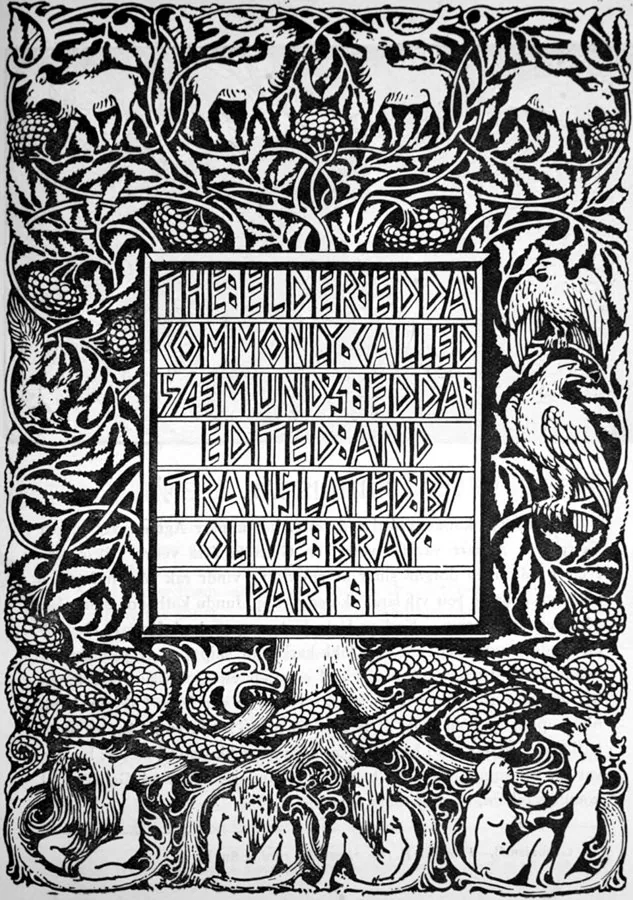
The tree is full of activity. An eagle sits above; the squirrel Ratatosk runs with messages; deer browse its growth; serpents damage it below. Grímnismál emphasizes the suffering of the tree. Snorri also describes the norns tending it with water and earth from the well. The resulting picture is of a world that needs care even while it is being worn away. It is not simply a decorative symbol of perfect harmony.
Asgard, Midgard & the journeys between
Asgard belongs to the gods’ world. Midgard is the human enclosure. In Gylfaginning the rainbow bridge Bifröst connects earth and heaven, and Heimdall watches near its end. Yet the myths do not make travel a simple matter of choosing a destination. Rivers, boundaries, disguises, bargains, and hostile hosts make a journey dangerous.
Thor may cross a river instead of taking the route used by other gods. Odin may travel concealed beneath another name. Hermod’s journey toward Hel follows a road whose darkness and guarded crossing matter as much as its destination. Read these places through what happens on the journey, rather than expecting every road to fit a modern map.
The halls of the gods
Grímnismál is especially rich in divine dwellings. Thor is associated with Bilskirnir; Baldr with Breidablik; Njord with Noatun; Heimdall with Himinbjorg; and Forseti with Glitnir, where disputes are settled. Freyja’s Folkvangr and Odin’s Valhalla belong to the poem’s account of the slain. These are memorable places, but they are not nine interchangeable “worlds”.
Valhalla is not presented as the inevitable destination of everyone who dies. The sources describe more than one destination and more than one way of imagining death. A profile of Odin, Freyja, or Hel therefore needs its own textual setting. A modern chart that puts every person into one neat category can look more certain than the texts allow.
Jotunheim, the sea & places of danger
Jotunheim is associated with the jötnar, often translated as giants. But “giant” does not mean that every member of this group behaves the same way or always has an enormous body. Divine families cross these boundaries: Skadi joins the gods, Freyr desires Gerd, and Thor has a jötunn mother. Enmity, marriage, knowledge, and hospitality coexist.
The surrounding sea is also a mythic frontier. Jormungandr encircles the human world, and Thor’s fishing expedition pulls the great conflict between them into a small boat. Aegir hosts a feast, while Ran is associated with the danger of the sea. The same environment can be a home, a route, a gathering place, and a threat.
What about the nine worlds?
The expression “nine worlds” belongs to the surviving poetry, including Völuspá. It does not come with one agreed numbered list that all the sources repeat. Familiar modern diagrams combine names and passages from different texts, sometimes treating overlapping places as separate realms. They can be helpful illustrations if their choices are explained; they should not be presented as a preserved Viking map.
This guide therefore starts with named places and their stories. Niflheim and Muspell belong to Snorri’s account of primordial cold and heat. Alfheim appears in Grímnismál as a gift to Freyr and in Snorri’s account of elves. Hel is both a name associated with a destination of the dead and, in Snorri, the figure who rules there. The categories are not all equivalent.
From a tree to a story
For a first route, begin with Creation, then read The Building of Asgard’s Wall, Thor’s Fishing Expedition, and Ragnarok. For another route, follow knowledge: Odin’s eye at Mimir’s well, his ordeal for the runes, and his contest with Vafthrudnir. Each story page links to its figures and sources.
The nineteenth- and early twentieth-century pictures in this library offer another layer: artists imagining the myths many centuries after the medieval manuscripts. Their landscapes, costumes, and compositions are interpretations. They help us encounter the stories visually, but they cannot settle the geography of Yggdrasil or show precisely what Viking-Age worshippers imagined.
Explore the maps and the real journeys
Our companion guide, The Viking World, brings a clickable reading diagram together with a geographical map of travel networks. Compare mythic journeys with routes across the North Atlantic and through eastern river systems using the map link below.
Read behind the retelling
Sources & limits
This is a guide assembled from several medieval accounts, not a claim that one consistent cosmological map survives. Differences between the root arrangements in Grímnismál and Gylfaginning are preserved rather than silently corrected.
- Gylfaginning, chapters IV–XVII: creation, journeys, roots, wells, and halls; Arthur Gilchrist Brodeur, 1916
- Grímnismál, especially stanzas 4–35: halls, animals, and Yggdrasil; Henry Adams Bellows, 1923
- Völuspá, especially stanzas 2 and 17–20: worlds, humanity, and the tree; Bellows, 1923
Retold in contemporary English. Dialogue is summarized, not presented as a translation. How to read our sources and versions.