
Journeys & Encounters · Place profile
Cork: A Place in the Viking World
In Brief
Cork’s Viking connection lies partly beneath the modern city. Written accounts of raids and archaeological evidence for a later Hiberno-Norse town describe different stages of its development, and should not be compressed into a single certain foundation date.
Present-day location: Ireland · Britain and Ireland
Browse places by country →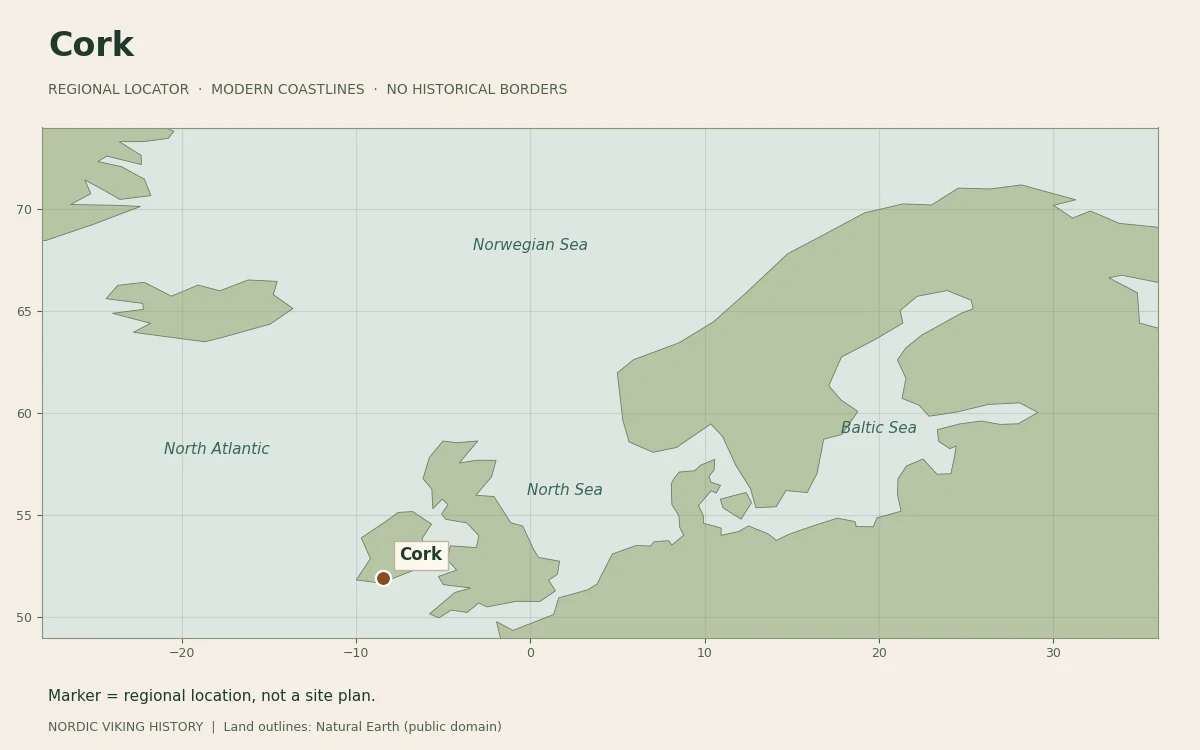
The Viking-Age connection
The settlement had an ecclesiastical history before Scandinavian attacks. Cork City Council describes ninth-century raiding while emphasizing the contribution of excavations around South Main Street and the drainage works to understanding later occupation. These investigations revealed a town adapted to a wet environment, with raised clay platforms and wooden boundaries or revetments.
Reading the evidence
The public museum’s Below Our Feet exhibition focused especially on late eleventh- and twelfth-century deposits. Wooden buildings and objects illuminate life in a community shaped by both Irish and Scandinavian traditions. This material extends beyond the conventional end of the Viking Age, making Cork valuable for tracing continuation and transformation rather than stopping the story at 1066.
Understanding the place
Modern streets preserve elements of the medieval layout, but that does not make every visible wall a Viking survival. Compare the underlying ground, the street pattern and excavated timber structures as different categories of evidence. A city built through repeated reclamation and rebuilding can retain older alignments while replacing almost everything a pedestrian sees above ground.
Explore more Viking-Age places →
The Evidence
The sources below support this article. Interpretations and limits are explained in the text; this is not an exhaustive research review.