
Journeys & Encounters · Place profile

Eigg and Laig Bay: A Place in the Viking World

In Brief

Eigg offers an unusually tangible connection with Viking-Age boatbuilding. Two curved oak pieces discovered near Laig Bay preserve parts of boats themselves, rather than only the iron nails that normally survive after wooden vessels decay in Scottish soil.

On this page

The Viking-Age connectionReading the evidenceUnderstanding the placeSources

Present-day location: Scotland · Britain and Ireland

Browse places by country →
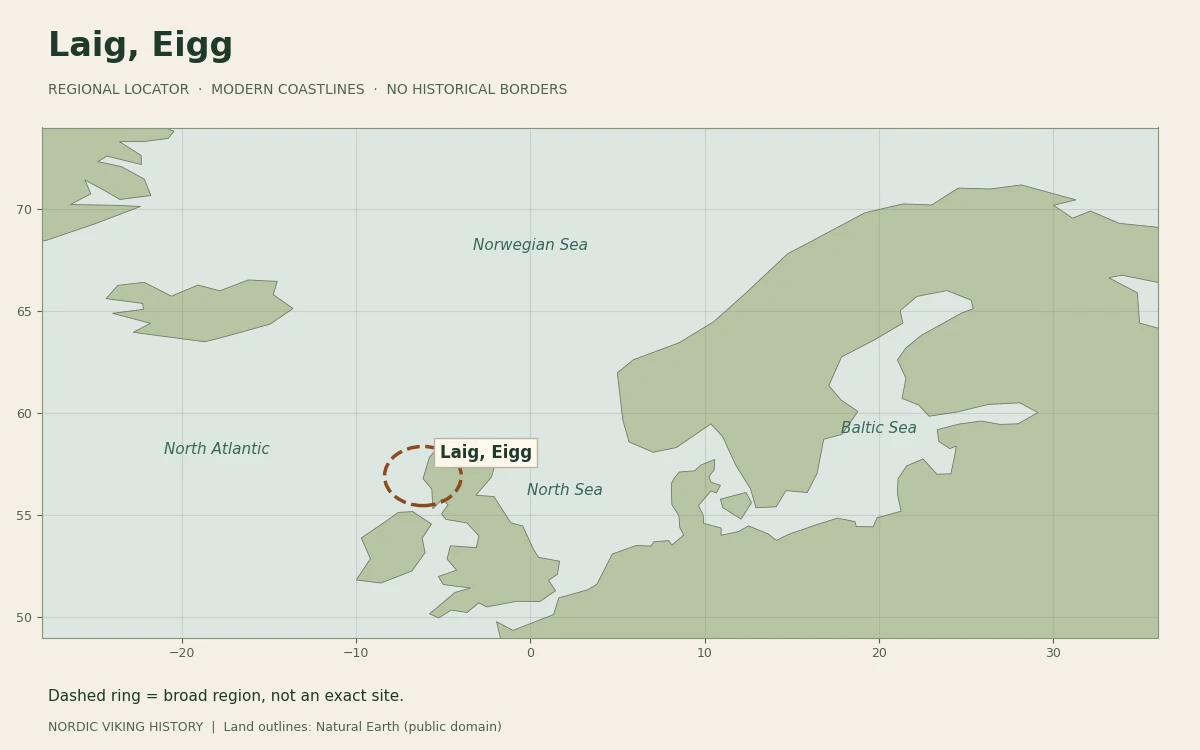
Regional locator map highlighting Laig, Eigg against generalized modern coastlines.
Original geographic locator diagram with generalized modern land outlines; not a photograph, historical reconstruction or navigation map. The Laig area on Eigg, located from Scotland's historic-environment record; no complete Viking-Age settlement plan is implied. The Laig area on Eigg, located from Scotland's historic-environment record; no complete Viking-Age settlement plan is implied.Image: Nordic Viking History; base geography: Natural Earth · Base land data: public domain

The Viking-Age connection

Workers draining peat in 1878 found the two boat stems and reported another wooden piece that was not preserved. National Museums Scotland dates the stems broadly to 880–1050. They illuminate Scandinavian-influenced seafaring technology, although the finds do not provide an excavated shipyard plan with identifiable workshops and slipways.

Reading the evidence

The discovery history matters. The objects were reported as lying some distance apart, and their nineteenth-century recovery cannot supply the controlled archaeological context available from modern excavation. They should not be assembled imaginatively into one complete longship. Their survival nevertheless allows direct study of shaped timber and boat construction rather than reconstruction entirely from metal fastenings.

Understanding the place

Elsewhere on Eigg, graves near Kildonnan produced weapons, ornaments and textile remains. The museum identifies a wool fragment from a grave dated around 900–950, including traces of clothing with fur. These finds broaden the island’s story from vessels to the people who wore, maintained and buried material possessions. Laig’s boat pieces and Kildonnan’s graves are different discoveries in different parts of the island.

Explore more Viking-Age places →

The Evidence

The sources below support this article. Interpretations and limits are explained in the text; this is not an exhaustive research review.

  1. National Museums Scotland: Eigg boat stems ↗
  2. National Museums Scotland: Kildonnan textile ↗
FacebookPinterestXEmail

Places & evidence

Locations and coordinate sources

These points identify the places described in the source notes. A regional, historical or museum reference is not a surveyed entrance, parking place or guarantee of public access. Check the linked institution or visitor information before traveling.

Eigg and Laig Bay

Approximate area — not an exact object location

This area reference is for the former peat bog associated with the Laig Bay boat stems. It covers neither the Kildonnan graves nor the island as a whole. The 1878 findspots were recorded only approximately.

WGS84 · latitude, longitude
56.912330, -6.154680

Original findspot: Two wooden boat stems came to light in 1878 while workers drained a bog near Laig Bay. The original account relates their position to the former wetland below Laig farmhouse. The Highland Council, Highland Historic Environment Record · Dr Adrián Maldonado, National Museums Scotland · University of the Highlands and Islands research repository

Current location: National Museums Scotland identifies the stems as X.IN 4 and X.IN 5 and places both in the Early People gallery in Edinburgh. The Kildonnan graves lay on the opposite side of Eigg. Dr Adrián Maldonado, National Museums Scotland

Access information: The Early People gallery at the National Museum of Scotland in Edinburgh is the public destination for the surviving timbers. The historic bog find area has no verified visitor entrance. Dr Adrián Maldonado, National Museums Scotland · National Museums Scotland · University of the Highlands and Islands research repository

Location-source review: 2026-11-20. This is a source check, not a field survey.

Visitor / navigation point: National Museum of Scotland, Chambers Street, Edinburgh. The Early People gallery displays the two stems from Laig. The visitor point identifies the museum building.

55.947042, -3.189051 · WGS84 latitude, longitude

Open visitor location in Google Maps ↗

Visitor source: National Museums Scotland. Last source check: 2026-11-20.

Visitor context: Dr Adrián Maldonado, National Museums Scotland — A Viking Age boatyard on Eigg.

Coordinate source: Historic Environment Scotland — National Record of the Historic Environment, Eigg, Laig, 22163 ↗

Open Eigg and Laig Bay in Interactive Viking Map →