
Journeys & Encounters · Place profile
Groß Strömkendorf and Reric: A Trading Place Caught in Royal Conflict
In Brief
Groß Strömkendorf on Wismar Bay is widely identified with Reric, the trading place mentioned in Frankish accounts of events in 808. It belonged to a southern Baltic world of Slavic communities, Scandinavian connections, and merchants whose livelihoods could be redirected by political force.
Present-day location: Germany · Mecklenburg-Vorpommern
Names and search variants: Groß Strömkendorf and Reric · Reric · Rerik · Gross Stromkendorf · Groß Strömkendorf
Browse places by country →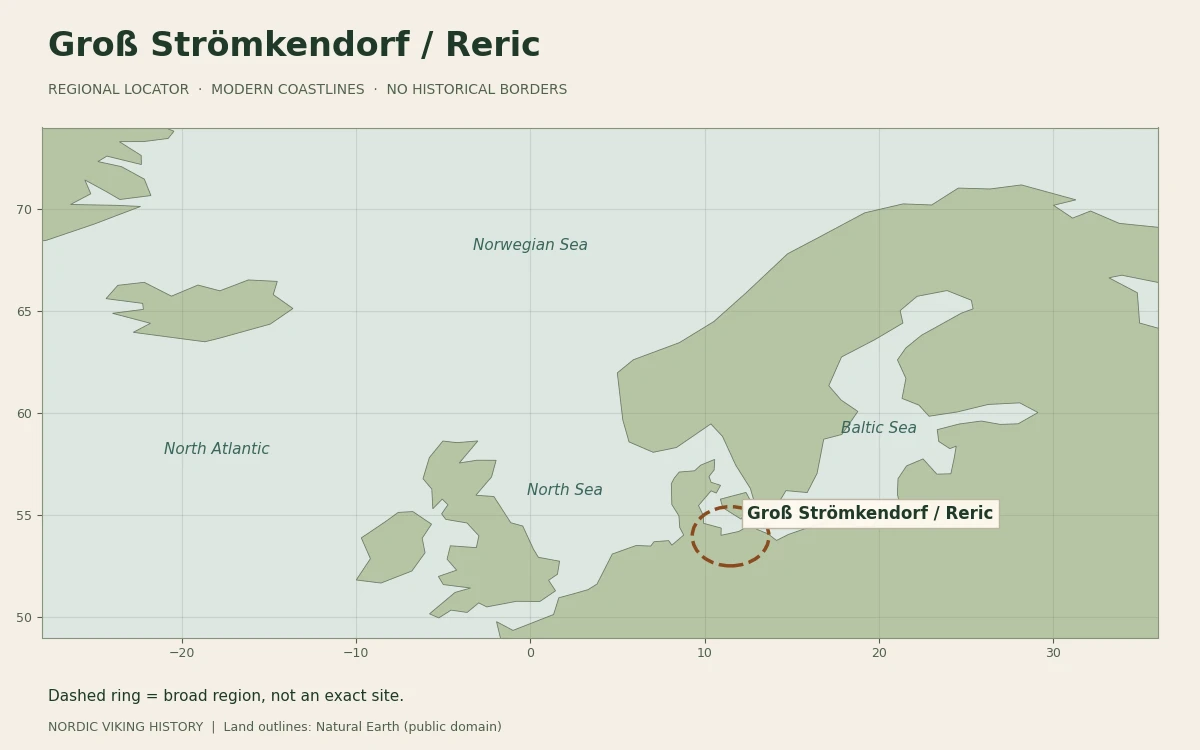
The historical setting
The written account associates the destruction of Reric with the Danish king Gudfred and the movement of merchants to Hedeby. Archaeology at Groß Strömkendorf revealed a harbor, settlement, and cemetery consistent with a flourishing trading and craft center that ended in the early ninth century. The identification joins two different kinds of evidence.
What the evidence shows
The regional heritage authority describes Scandinavian and western European elements in the material culture, along with coins, weights, and dress fittings. These indicate extensive connections, not a homogeneous population that can simply be called Danish. The settlement’s inhabitants participated in networks across political and cultural boundaries before the place’s abrupt end.
How to read this place
Reric’s story makes the human consequences of commercial policy visible. Moving merchants meant more than redirecting goods: skills, households, partnerships, and local knowledge could be displaced. That is an interpretive way to think about the account, not a recovered list of migrants. Compare the political narrative with the archaeological chronology rather than assuming that every burned feature belongs to the same recorded attack.
Explore more Viking-Age places →
The Evidence
The sources below support this article. Interpretations and limits are explained in the text; this is not an exhaustive research review.