
Journeys & Encounters · Place profile

Heysham: A Place in the Viking World

In Brief

Heysham on the Lancashire coast brings early medieval burial and sculpture into an Irish Sea setting. The ruined chapel, rock-cut graves and carved stones belong to a longer Christian landscape, not to a single identifiable Viking raid.

On this page

The Viking-Age connectionReading the evidenceUnderstanding the placeSources

Present-day location: England · Britain and Ireland

Browse places by country →
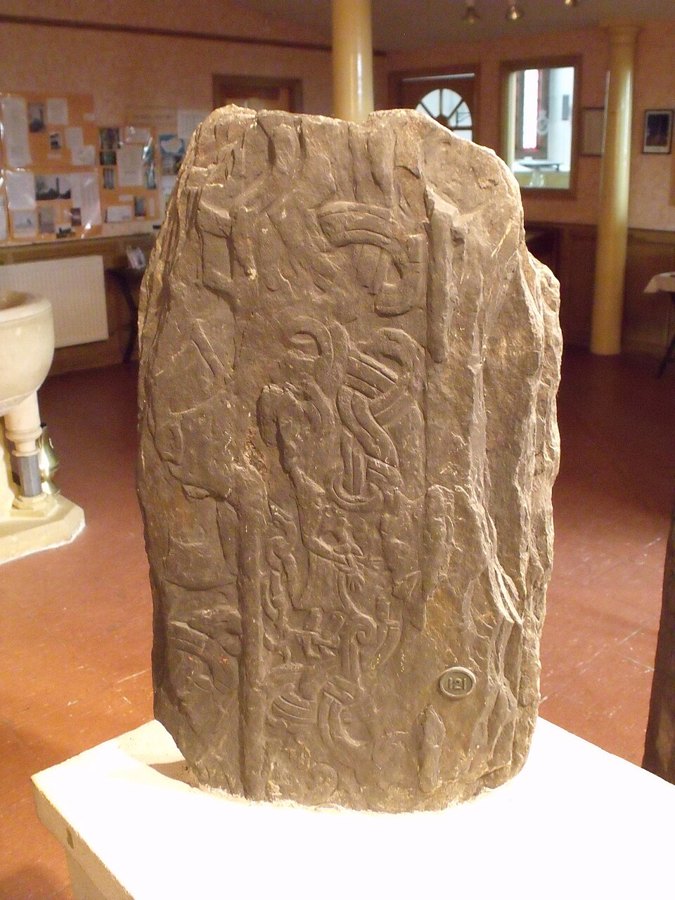
A Manx carved cross
Cross 121B at Kirk Andreas on the Isle of Man. Its carved imagery belongs to a setting where Scandinavian and Christian traditions encountered one another. A Manx carved cross provides a regional comparison; it is not a photograph of Heysham’s graves or hogback.Image: Malost · CC BY-SA 3.0

The Viking-Age connection

The cemetery beside St Patrick’s Chapel includes remains dated to the tenth and eleventh centuries. Some graves are cut into the sandstone and have sockets thought to have held crosses. Nearby sculpture includes an earlier Anglian cross fragment as well as the celebrated hogback tradition associated with Scandinavian-influenced northern Britain.

Reading the evidence

The dates and forms of these monuments differ. An earlier cross, a later burial and a hogback should not be treated as one contemporary ensemble made by the same community. The record instead allows questions about continuity of burial, changing patrons and the selection of different commemorative forms.

Understanding the place

Heysham’s coastal position makes wider connections easy to imagine, but the strongest interpretation starts with individual objects and their contexts. Look at the practical work involved in cutting graves into rock and carving durable memorials. Such choices made burial visible and lasting, even when the names and biographies of the dead disappeared.

Explore more Viking-Age places →

The Evidence

The sources below support this article. Interpretations and limits are explained in the text; this is not an exhaustive research review.

  1. Site history and archaeological evidence ↗
  2. Historic England: Heysham high cross ↗
FacebookPinterestXEmail

Places & evidence

Locations and coordinate sources

These points identify the places described in the source notes. A regional, historical or museum reference is not a surveyed entrance, parking place or guarantee of public access. Check the linked institution or visitor information before traveling.

Heysham

Approximate area — not an exact object location

The marker locates the scheduled St Patrick’s Chapel and cemetery. St Peter’s churchyard and its high cross form a neighbouring part of the religious landscape.

WGS84 · latitude, longitude
54.047466, -2.902829

Original findspot: St Patrick’s Chapel and the excavated cemetery occupy the headland above Heysham. The rock-cut graves form two groups beside the chapel. Historic England

Current location: The chapel ruins and rock-cut graves survive on the headland. An Anglian cross fragment stands in St Peter’s churchyard, and the hogback stone is now inside the church. Historic England · Historic England · Thor Ewing, Historic Society of Lancashire and Cheshire

Access information: The National Trust directs visitors along Main Street and past St Peter’s Church to the path up to the chapel. The route includes steep and uneven ground. National Trust

Location-source review: 2026-11-20. This is a source check, not a field survey.

Visitor / navigation point: Heysham Coast, the National Trust’s visitor destination on the headland. Approach on foot from the village following signs to St Patrick’s Chapel. The property has no car park of its own.

54.046973, -2.902574 · WGS84 latitude, longitude

Open visitor location in Google Maps ↗

Visitor source: National Trust. Last source check: 2026-11-20.

Visitor context: National Trust — Heysham Coast Access Statement.

Coordinate source: Historic England — St Patrick’s early Christian chapel and associated cemetery, NHLE 1020535 ↗

Open Heysham in Interactive Viking Map →