
Journeys & Encounters · Place profile

Kvarnbo: A settlement beneath a later landscape

In Brief

Kvarnbo in Saltvik belongs to Åland’s late Iron Age landscape between the Swedish mainland and southwestern Finland. It also hosts modern Viking-themed interpretation, making it especially important to distinguish archaeological evidence from the activities and buildings created for visitors today.

On this page

A settlement beneath a later landscapeModern Viking activitiesÅland as a meeting regionSources

Present-day location: Finland · Åland

Names and search variants: Kvarnbo · Saltvik · Kvarnbo Saltvik

Browse places by country →
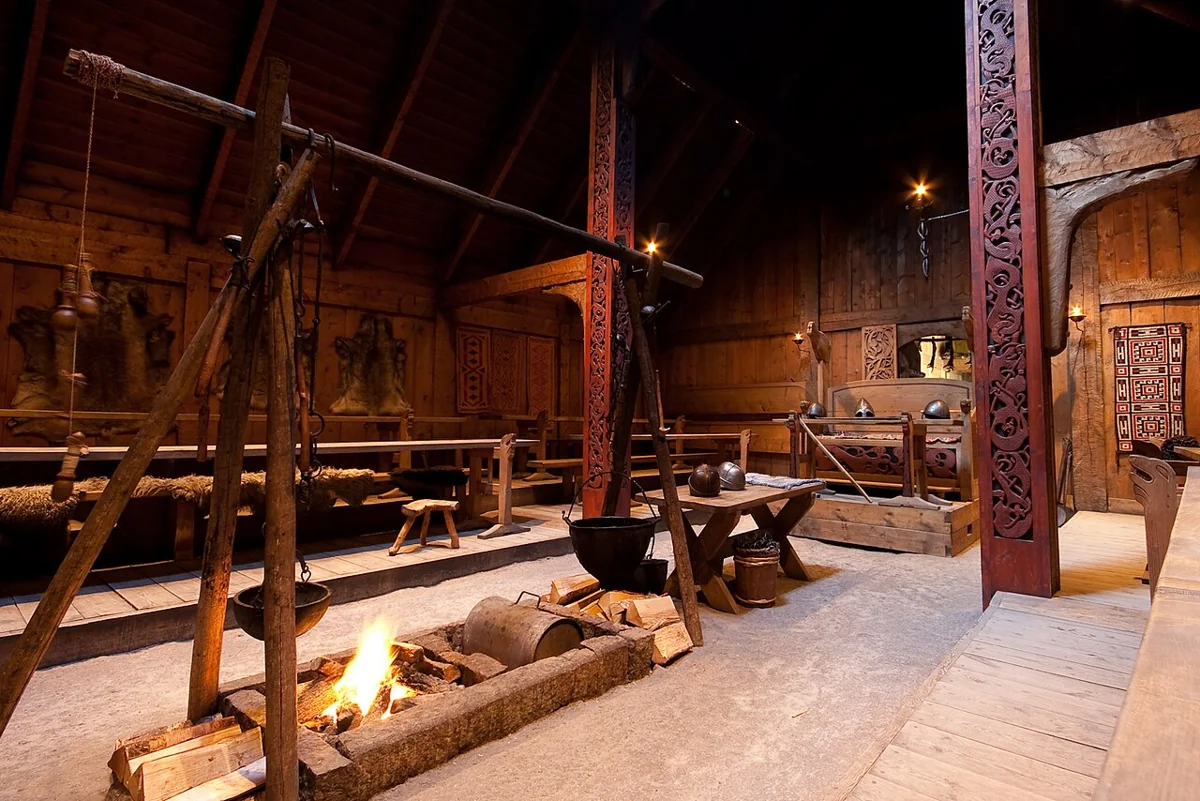
Dim reconstructed timber hall with a central hearth and roof supports.
Interior of the reconstructed Viking hall at Lofotr, Norway. The modern reconstruction helps visitors consider lighting, heat and shared indoor space; it is not an intact ancient interior or a measurement of Viking-Age air quality. Comparative reconstruction at Lofotr in Norway, not Kvarnbo. It illustrates a modern interpretation of a northern hall, not the exact buildings or furnishings of the Åland settlement.Image: Jon Olav Eikenes · CC BY 2.0

A settlement beneath a later landscape

Visit Åland’s account of Saltvik church notes archaeological interpretations of a significant late Iron Age and Viking-Age trading center in the area. The church itself is medieval. Its presence can help locate the historical landscape but is not evidence that the surviving walls stood in the Viking Age.

Modern Viking activities

The local Viking village and market offer living-history experiences organized in modern times. They may help visitors think about craft and material culture, but a market stall or reconstructed building is not an excavated original. The distinction should be explicit in photographs, especially when dramatic reenactment images are used to introduce the place.

Åland as a meeting region

On a map, the archipelago helps explain possibilities for movement between larger landmasses. That geographical position does not reduce local people to a simple mixture of modern national identities. The most useful questions concern the particular settlement evidence, objects, and routes, rather than assigning every inhabitant a present-day nationality or assuming every crossing followed a single fixed itinerary.

Explore more Viking-Age places →

The Evidence

The sources below support this article. Interpretations and limits are explained in the text; this is not an exhaustive research review.

  1. Visit Åland: Saltvik church ↗
  2. Visit Åland: modern Viking village ↗
FacebookPinterestXEmail

Places & evidence

Locations and coordinate sources

These points identify the places described in the source notes. A regional, historical or museum reference is not a surveyed entrance, parking place or guarantee of public access. Check the linked institution or visitor information before traveling.

Kvarnbo

Approximate area — not an exact object location

The marker is the centre of the registered archaeological area, calculated in its national grid and converted to WGS84. It represents the area as a whole.

WGS84 · latitude, longitude
60.276150, 20.052000

Original findspot: Ilves identifies the field immediately north of Saltvik church as Sa 14.9. Kristin Ilves, University of Helsinki repository

Current location: The Åland register maps the surviving archaeological site in Kvarnbo. The centroid represents that registered area. Government of Åland, Register of Ancient Monuments · Kristin Ilves, University of Helsinki repository

Access information: The field report describes an agricultural field. The reviewed evidence supplies no public entrance for the excavated area. Kristin Ilves, University of Helsinki repository

Location-source review: 2026-11-20. This is a source check, not a field survey.

Visitor / navigation point: Not yet verified. The reference coordinate above must not be treated as a current visitor destination.

Coordinate source: Government of Åland, Register of Ancient Monuments — Fornminnen, Sa 14.9, Kvarnbo ↗

Open Kvarnbo in Interactive Viking Map →