
Journeys & Encounters · Place profile

Nottingham: A Place in the Viking World

In Brief

Nottingham belongs to the inland world of Viking campaigning and settlement. Its role is easily obscured by the later castle, whose dramatic rock and surviving buildings are not the location of a preserved Viking fortress.

On this page

The Viking-Age connectionReading the evidenceUnderstanding the placeSources

Present-day location: England · Britain and Ireland

Browse places by country →
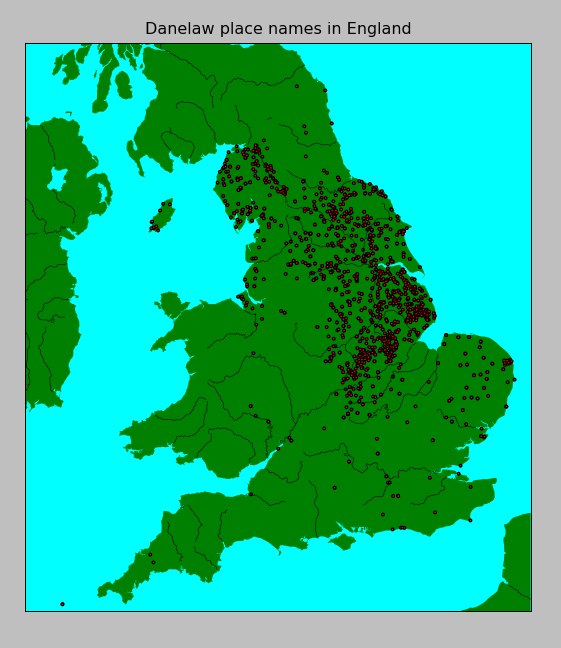
Scandinavian place names in England
A published distribution map of Scandinavian place names in England. Distribution patterns need linguistic and chronological interpretation; they are not a direct census of Viking settlers. Historical map of Scandinavian place names in England; contextual illustration, not a plan of this particular site.Image: Steven Kay from Edinburgh, United Kingdom · CC BY-SA 2.0

The Viking-Age connection

The Great Army occupied Nottingham in 868, and the town subsequently became one of the Five Boroughs. The early settlement focus lay east of Castle Rock. This distinction is essential: the Norman castle was founded after the Viking-Age events usually invoked in accounts of the town.

Reading the evidence

Modern heritage assessment separates archaeological discoveries on the castle site from the documented history of the earlier settlement. A prehistoric find or an Anglo-Saxon brooch does not prove that a Viking royal residence stood beneath the castle. Place, date and context must be kept together.

Understanding the place

Nottingham offers a useful exercise in resisting the attraction of the most visible landmark. Begin with the early town and its relationship to routes through the Trent region, then examine the later castle as a new intervention. Political importance can move within a settlement; the center familiar to modern visitors need not be the earliest one.

Explore more Viking-Age places →

The Evidence

The sources below support this article. Interpretations and limits are explained in the text; this is not an exhaustive research review.

  1. Site history and archaeological evidence ↗
FacebookPinterestXEmail

Places & evidence

Locations and coordinate sources

These points identify the places described in the source notes. A regional, historical or museum reference is not a surveyed entrance, parking place or guarantee of public access. Check the linked institution or visitor information before traveling.

Nottingham

No verified coordinate supplied

The Chronicle locates the army at Nottingham. Researchers have proposed both the defended settlement and ground nearer the Trent.

No verified coordinate is supplied. No map pin or navigation destination has been invented.

Original findspot: The surviving written account establishes a winter stay at Nottingham in 867–868. Researchers have yet to identify the limits of the camp. Dawn Hadley and Julian Richards, The Antiquaries Journal · Transactions of the Thoroton Society of Nottinghamshire, University of Nottingham repository

Current location: The defended urban core and sites nearer the river are among the candidates. The river finds discussed in the local study belong to a later period. Transactions of the Thoroton Society of Nottinghamshire, University of Nottingham repository

Access information: The reviewed research identifies no public entrance to the winter camp. Transactions of the Thoroton Society of Nottinghamshire, University of Nottingham repository

Location-source review: 2026-11-20. This is a source check, not a field survey.

Visitor / navigation point: Not yet verified. The reference coordinate above must not be treated as a current visitor destination.

Coordinate source: Transactions of the Thoroton Society of Nottinghamshire, University of Nottingham repository — From ‘House of Caves’ to nexus of central England: future research directions for Nottingham ↗

Open Nottingham in Interactive Viking Map →